 |
|
Christianity
Core Beliefs and
Key Concepts
Christianity is a
monotheistic religion centered on the life and
teachings of Jesus Christ as presented in the
New Testament.
Christians believe
that, as the Messiah, Jesus was appointed by God
as ruler and savior of humanity, and hold that
Jesus' coming was the fulfillment of messianic
prophecies of the
Old Testament.
Christians
generally believe in the immortality of the
soul. Forgiveness of sins is one of the key
marks of Christianity. |
|
 |
For we walk by faith, not by sight. |
Jesus |
| |
|
"The kindness you offer is the
kindness God places back in your
hands."
~
KoRe proverb
|
|
|
| |
|
The first Christians were Jewish
Christians. Through missionary
work and colonization,
Christianity spread firstly in
the Middle East, North Africa,
Europe and parts of India and
subsequently throughout the
entire world.
The Trinity is often regarded as
an essential doctrine of
mainstream Christianity. The
common understanding of the Holy
Trinity, espoused in the Nicene
Creed, is one God who exists in
three Persons – Father, the Son,
and the Holy Spirit – who are
coequal, co-eternal, of the same
substance.
|
|
|
| |
|
The Moral Law
The moral law is often
summarized in the "Ten
Commandments", which the Bible
says were given by God to Moses.
|
|
|
| |
|
The Ten Commandments
❶
I am the Lord your God. You
shall have no other gods before
me.
❷
You shall not make for yourself
an idol.
❸
You shall not make wrongful use
of the name of your God.
❹
Remember the Sabbath and keep it
holy.
❺
Honor your father and mother.
❻
You shall not murder.
❼
You shall not commit adultery.
❽
You shall not steal.
❾
You shall not bear false witness
against your neighbor.
❿
You shall not covet your
neighbor's house or wife.
|
|
|
|
 |
| |
|
Christian Beliefs
There is one God and only one
God. He is personal and
knowable. He manifests Himself
in three persons: the Father,
the Son and the Holy Spirit.
God created
the universe and all that is
in it. God is a person, but of a
somewhat different type than
human beings. God is entirely
spiritual. He exists in a sphere
outside the physical universe he
created.
The Bible is the Word of God. It
is inspired and inerrant in its
original autographs. It is a
complete and final revelation of
God.
Jesus Christ is God manifest
in the flesh, born of a virgin,
without sin, and the chosen
Messiah who will one day set up
his kingdom on earth.
Jesus Christ died on the cross
for our sins, was buried, rose
again from the dead, ascended
back to heaven, and will one day
return to this earth again.
All persons are sinners, guilty
before God, deserving of
judgment, and in need of a
Savior, Jesus Christ our Lord.
Salvation from sin, death, and
hell is by God's grace, based on
the work of Jesus Christ alone.
It is received by faith apart
from any human performance or
merit.
Eternal life is a gift of God
and nothing can separate the
believer from the love of God.
Unbelievers face eternal
punishment. Believers face
eternal life.
All believers should attend a
local church for mutual
edification, encouragement,
evangelism, service and worship.
|
|
|
| |
|
Jesus on Love
'You
must love the Lord your God with
all your heart, all your soul,
and all your mind.' This is
the first and greatest
commandment.
A
second is equally important: ‘Love
your neighbor as yourself.’
The entire law and all the
demands of the prophets are
based on these two
commandments..
|
|
|
|
|
| |
|
Jesus
Jesus Christ also known as Jesus
of Nazareth, is the central
figure of Christianity. Jesus is
revered by Christians as the
incarnation of God.
Muslims consider him a
prophet, and several other
religions also consider him an
important figure.
Christians profess that Jesus is
the Messiah prophesied in the
Old Testament, who, through his
life, death, and resurrection,
restored humanity's communion
with God in the blood of the New
Covenant. His death on a cross
is understood as the redemptive
sacrifice: the source of
humanity's salvation and the
atonement for sin which had
entered human history through
the sin of Adam.
The Bible's four canonical
gospels are the main sources for
the traditional Christian
biography of Jesus' life.
According to Matthew and Luke,
Jesus was born in Bethlehem of
Judea to Mary, a virgin, by a
miracle of the Holy Spirit.
Jesus' childhood home is
identified as the town of
Nazareth in Galilee. The Gospels
state that Jesus, as Messiah,
came to "give his life as a
ransom for many" and "preach the
good news of the
Kingdom of God."
Over the course of his ministry,
Jesus is said to have performed
various miracles, including
healings, exorcisms, walking on
water, turning water into wine,
and raising several people, such
as Lazarus, from the dead. At
the height of his ministry,
Jesus attracted huge crowds
numbering in the thousands.
In
Jerusalem, high priests and
elders condemned Jesus for
blasphemy. Jesus was crucified
Golgotha. According to the
Gospels, Jesus rose from the
dead on the third day after his
crucifixion. Christians consider
the resurrection of Jesus to be
the cornerstone of their faith
and the most important event in
human history.
Jesus promised to come again to
fulfill the remainder of
Messianic prophecy.
|
|
|
| |
|
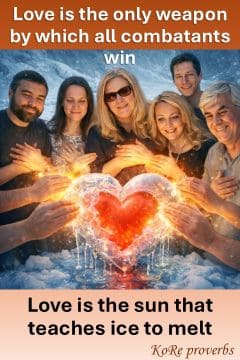
Christian Love: the Foundation
for all Relationships
The motivating force behind the
Christian life is love.
Jesus' teachings are largely a
description of what love
means:
Love is patient; love is kind;
love is not envious or boastful
or arrogant or rude. It does not
insist on its own way; it is not
irritable or resentful; it does
not rejoice in wrongdoing, but
rejoices in the truth. It bears
all things, believes all things,
hopes all things, endures all
things.
|
|
 |
 |
|
Christianity is characterized by
helping people. This ranges from
the personal to the
institutional. At the personal
level, Christians should help
others.
|
|
 |
| |
|
Afterlife and Eschaton
Most Christians believe that
upon bodily death the soul
experiences the particular
judgment and is either rewarded
with eternal heaven or condemned
to an eternal hell.
The elect are called "saints"
and the process of being made
holy is called sanctification.
At
the second coming of Christ at
the end of time, all who have
died will be resurrected bodily
from the dead for the Last
Judgment, whereupon Jesus will
fully establish the
Kingdom of God in
fulfillment of scriptural
prophecies.
|
|
|
| |
|
Christian-toned KoRe Proverbs
Christian-toned
KoRe Proverbs communicate
the essence of Christian beliefs
and landscapes of mind and
attitudes.
→
Discover
|
|
|
|
|