In pursuit of
sustainable development and
cleaner production, Xerox
used in its Model 914 the
relatively new
environment-friendly
electrophotography process,
which is a dry process that
avoids the use of wet chemicals.
While the technology was
superior to earlier copy
methods, the cost of the machine
was six to seven times more
expensive than alternative
technologies.
The model of
selling the equipment below
cost and making up the
difference by large margins in
the sale of supplies was not
viable because the cost of the
supplies was about the same as
that of the alternatives, so
there was little room to
maneuver.
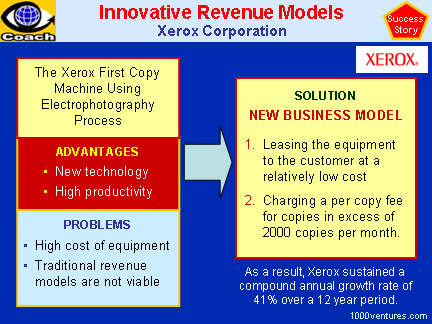
Xerox then decided to market the
new product itself and developed
a new business model to do so.
The new model leased the
equipment to the customer at a
relatively low cost and then
charged a per copy fee for
copies in excess of 2000 copies
per month. At that time, the
average business copier produced
an average of only 15-20 copies
per day.
For this model to be
profitable to Xerox, the use
of copies would have to increase
substantially.
Fortunately for Xerox, the
quality and the convenience of
the new copy technology proved
itself and companies began to
make thousands of copies per
day.