|
10
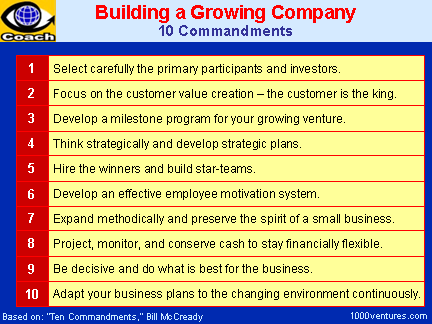
Rules for
Designing a High-Growth Startup
By: Venture Planning Associates
①
Pre-Incorporation Agreement
Limit the primary participants
to people who can consciously
agree upon and contribute
directly to that which the
enterprise is to accomplish, for
whom, and by when. Only consider
investors that bring more than
money to the table: e.g.
connections, marketing skills,
technical expertise, etc.
②
The Customer is King
Define the business of the
enterprise in terms of what is
to be bought, precisely by whom,
and why. Avoid disaster by
testing the market prior to
development of a product.
③
Use a Rifle Not a Shotgun
Concentrate all available
resources on accomplishing two
or three specific, operational
objectives within a given time
period.
④
Failing to Plan is Planning
to Fail
Prepare and work from a written
plan that delineates who in the
total organization is to do
what, by when. Use your business
plan as a budget. If you cannot
stick to that budget, your
business plan is too ambitious.
⑤
Pick the Winners and Pay a
Premium
Employ key people with proven
records of success at doing what
needs to be done, in a manner
consistent with the value system
of the enterprise. When in
doubt, hire your biggest or best
competitor's key people. Free
agency works in business too.
⑥
Reward the Superstars
Reward individual performance
that exceeds agreed upon
standards. Move the
non-producers into
administrative positions, or
replace them.
⑦
Is Bigger Really Better?
Resilience is wiser than growth.
Expand methodically from a
profitable base toward a
balanced business. A smaller,
more focused business can
sometimes be far more profitable
and stable than a large and
fractured one.
⑧
Cash Flow is King, and the
Secret of a Good Night's Sleep!
Project, monitor, and conserve
cash, and protect credit
capability. Over-expansion,
failure to see coming trends or
competition, and poor credit
policies are your biggest
enemies.
⑨
Nothing Personal, But You're
Fired
Maintain a detached point of
view. Never hire family or
friends, unless you are also
willing to fire them. Be
decisive and do what is best for
the business. This could include
firing yourself and hiring a
more qualified manager!
⑩
The Only Universal Constant:
"Everything Always Changes"
Anticipate constant change by
periodically testing adopted
business plans for their
consistency with the realities
of the world marketplace. Read
Kenichi Ohmae's books, "The End
of the Nation State", "The
Borderless World", and "the Mind
of the Strategist".
|