| |
|
Definition ▪ Types
▪ Examples ▪
Boosters
|
|
|
| |
Creative
intelligence is the capacity to generate
original ideas, make unexpected connections, and
devise innovative solutions to novel challenges.
It goes beyond conventional thinking, embracing
flexibility, imagination, and experiential
insight. |
|
 |
| |
Creative
intelligence is the ability to generate new,
useful ideas and unique solutions to problems,
blending imagination with existing knowledge to
innovate and adapt in complex situations, a key
skill in fields from art to business for driving
progress beyond standard analytical thinking. |
|
 |
| |
|
A Skill that Can Be Learned
Creative Intelligence
is a skill that can be learned and developed, not just
an innate talent.
It involves
highersight, seeing things
differently,
superconscious thinking, courage, taking
intellectual risks, and applying
creativity to new
challenges.
|
|
|
 |
|
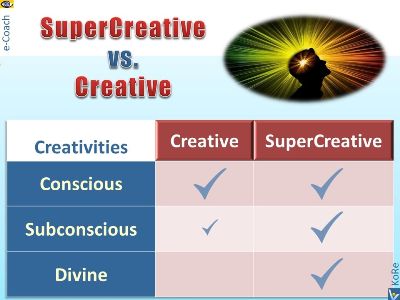
Superconscious creativity makes it possible to fly
from a compelling ‘Why?’ to a creative ‘How’
on
autopilot.
"Have the courage to follow your heart and
intuition," advised
Steve Jobs.
Intellect is blind,
but intuition can see and tell you everything you
need to know. |
|
| |
|
Creative intelligence aligns closely with human ingenuity and is increasingly being explored in AI systems through generative models, natural language processing, and creative computation.
|
|
|
| |
|
Key Aspects of Creative
Intelligence
|
|
|
 |
|
Problem-Solving: Inventing novel solutions for
unexpected or complex challenges.
Innovation: Developing new products, ideas, or ways of
doing things.
Adaptability: Using existing knowledge in new ways to
handle new situations.
Perspective: Seeing things from different viewpoints and
thinking unconventionally.
Risk-Taking: Willingness to explore new ideas, even with
the possibility of failure.
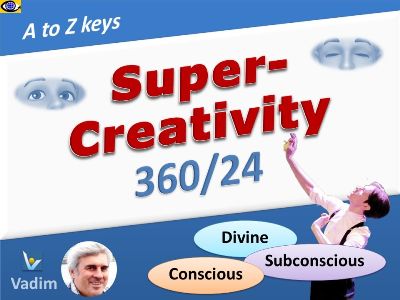
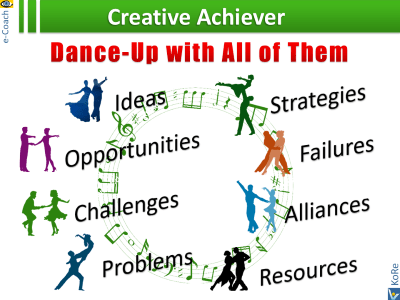
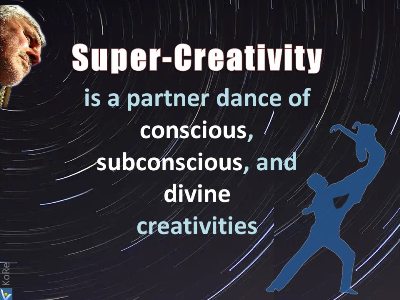
SuperCreativity:
Synergizing conscious, superconscious, and
divine creativities and making them to
dance up...
More
Proactive Futuring:
Inventing and designing a greater future...
More
Addressing Challenges:
Failing forward and
restarting smarter...
More
|
|
| |
|
How to use this information
|
|
|
|
|