| |
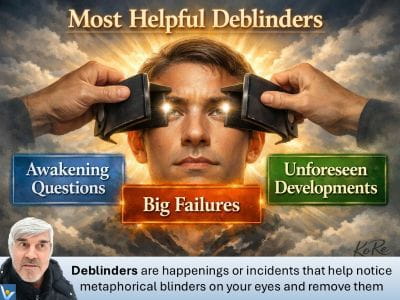
Deblinders are happenings or
incidents that help notice the
metaphorical blinders on your mind
and remove them.
Mental
blinders hinder lateral thinking. They also
represent narrow-mindedness, ignoring unpleasant
realities, biases, or blinkered vision. |
|
 |
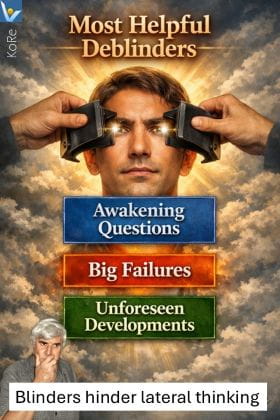
Mental blinders hinder lateral thinking. They also
represent narrow-mindedness, ignoring unpleasant
realities, biases, or blinkered vision.
*** Blinders force eyes to see forward only. Blinders
(or blinkers) are leather flaps on a horse’s bridle
restricting side vision to improve focus, mainly used in
racing/driving. ***
Happenings and Incidents. Happenings are general, often
unexpected occurrences or ongoing events, sometimes
implying amusing or artistic situations. Incidents are
specific, usually singular, and negative events that
interrupt normal activities and require action, such as
accidents or security breaches. Happenings are
descriptive, while incidents are disruptive.
*****
Three Most Helpful Deblinders
Deblinders are happenings or incidents that help notice
the metaphorical blinders on your eyes and remove them.
They are life’s way of tapping you on the shoulder and
saying, “Look again. You’ve been missing something
important.”
Some deblinders arrive gently. Others crash into your
life like a falling tree. All of them, however, expand
your awareness and upgrade your decision‑making.
Below are the three most powerful deblinders you can
intentionally cultivate or at least learn to recognize
when they show up.
Awakening Questions sharpen your thinking.
Big Failures strengthen your resilience and accuracy.
Unforeseen Developments expand your adaptability and
vision.
1. Awakening Questions
Awakening Questions are those rare prompts that pierce
through your habitual thinking. They don’t give answers;
they force you to confront the assumptions you’ve been
living inside.
Why they work
Your mind runs on autopilot more often than you realize.
You follow routines, beliefs, and interpretations that
once served you but may now limit you. A well‑crafted
question interrupts that autopilot and forces a
cognitive reboot.
Examples of Awakening Questions
What if the opposite of my assumption is true
What am I pretending not to know
If I weren’t afraid, what would I do next
What would this look like if it were easy
What am I optimizing for without realizing it
How this deblinder changes you
Awakening Questions shift you from reacting to
designing. They help you see hidden motives, outdated
fears, and unexplored options. They turn fog into
clarity and stagnation into movement.
2. Big Failures
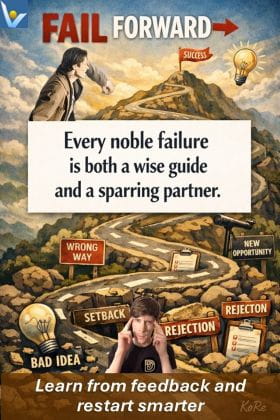
Few things rip blinders off as effectively as a failure
big enough to shake your identity.
Why they work
Success reinforces your current worldview. Failure
challenges it.
When something collapses—your plan, your confidence,
your assumptions—you’re forced to examine the structure
that produced it. Big failures expose the gap between
how you think the world works and how it actually works.
What Big Failures reveal
Overconfidence in flawed assumptions
Skills you thought you had but didn’t
Blind spots in preparation or strategy
Emotional patterns that sabotage you
People or systems you relied on but shouldn’t have
How this deblinder changes you
A major failure can become a turning point. It humbles
you, sharpens your judgment, and teaches you to build
more robust strategies. Many people trace their greatest
breakthroughs to the moment something important fell
apart.
3. Unforeseen Developments
These are the surprises—good or bad—that disrupt your
expectations. They can be sudden opportunities,
unexpected obstacles, or shifts in circumstances you
never planned for.
Why they work
Unforeseen developments reveal the limits of your mental
model. They show you that the world is more dynamic,
interconnected, and unpredictable than your plans
assume.
Types of Unforeseen Developments
A sudden market shift
A chance encounter that changes your trajectory
A crisis that forces rapid adaptation
A new technology that rewrites the rules
A personal event that reshapes your priorities
How this deblinder changes you
They teach flexibility. They force you to update your
worldview, revise your strategies, and sometimes
reinvent yourself. They remind you that adaptability is
more valuable than certainty.
Bringing It All Together
Deblinders are not pleasant, but they are profoundly
useful.
Awakening Questions sharpen your thinking.
Big Failures strengthen your resilience and accuracy.
Unforeseen Developments expand your adaptability and
vision.
If you learn to welcome these three deblinders instead
of resisting them, you accelerate your growth, deepen
your wisdom, and navigate life with far more clarity.
***** BIG FAILURES ***
Big Failures as Great Deblinders
Deblinders are happenings or incidents that help notice
the metaphorical blinders on your mind and remove them.
Figuratively, blinders represent narrow-mindedness or
ignoring unpleasant realities.
Few things rip blinders off as effectively as a failure
big enough to shake your identity. Why they work Success
reinforces your current worldview. Failure challenges
it. When something collapses ‒ your plan, your
confidence, your assumptions ‒ you’re forced to examine
the structure that produced it. Big failures expose the
gap between how you think the world works and how it
actually works.
What Big Failures reveal:
•Overconfidence in flawed assumptions
•Skills you thought you had but didn’t
•Blind spots in preparation or strategy
•Emotional patterns that sabotage you
•People or systems you relied on but shouldn’t have
How this deblinder changes you: A major failure can
become a turning point. It humbles you, sharpens your
judgment, and teaches you to build more robust
strategies. Many people trace their greatest
breakthroughs to the moment something important fell
apart.
|