|
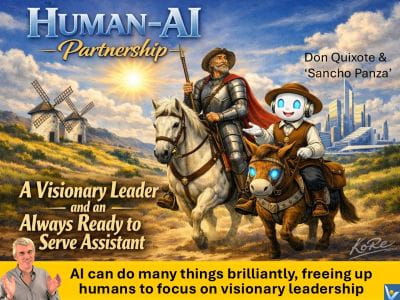
AI is a wonderfully
skilled assistant but a poorly skilled leader
Slide
Human–AI Partnership
The most powerful future is where humans lead with AI at
their side.
Draw red lines for what AI may advise but never decide.
What decisions do you want AI to inform - but never
make?
Please write a one page essay titled "AI is a
wonderfully skilled assistant but a poorly skilled
leader", containing an executive summary, 5 coaching
questions and a 5-point to-do list
Here’s a polished, one‑page essay with all the elements
you requested—executive summary, full argument, five
coaching questions, and a five‑point to‑do list.
AI is a Wonderfully Skilled Assistant but a Poorly
Skilled Leader
🌟 Executive Summary
Artificial intelligence has become an extraordinary
amplifier of human capability. It processes information
at scale, identifies patterns with precision, and
executes tasks with tireless consistency. Yet these
strengths do not translate into leadership. Leadership
requires judgment, moral reasoning, contextual
awareness, emotional intelligence, and the ability to
navigate ambiguity – domains where AI remains
fundamentally limited. AI excels when directed; it
falters when expected to direct. The future belongs to
leaders who understand how to harness AI as a powerful
assistant while retaining responsibility for vision,
values, and decisions.
AI as an Exceptional Assistant
AI thrives in environments defined by structure, data,
and repeatability. It can analyze vast datasets in
seconds, summarize complex information, automate routine
workflows, and provide decision support with remarkable
accuracy. These capabilities make AI an invaluable
partner for leaders who must process more information
than ever before. As an assistant, AI enhances
productivity, reduces cognitive load, and frees humans
to focus on higher‑order thinking.
Why AI Makes a Poor Leader
Leadership is not a computational problem. It is a human
one. Effective leaders interpret nuance, weigh competing
values, and make decisions that balance logic with
empathy. They inspire trust, navigate conflict, and
adapt to shifting social dynamics. AI lacks lived
experience, emotional grounding, and moral
accountability. It cannot assume responsibility for
consequences, nor can it authentically motivate or
empathize. When placed in a leadership role, AI risks
becoming either overly rigid or dangerously
confident – both incompatible with the human-centered
nature of leadership.
The Human–AI Partnership
The most powerful future is not one where AI leads, but
one where humans lead with AI at their side. Leaders who
understand how to delegate tasks to AI – while retaining
ownership of judgment, ethics, and direction – will
outperform those who either reject AI entirely or
abdicate leadership to it. The challenge is not to make
AI more human, but to make humans more capable through
AI.
❓ Five Coaching Questions
Where in your work are you relying on intuition when
data could support you?
Where are you relying on data when human judgment should
take precedence?
How can AI free you to spend more time on leadership
rather than administration?
What decisions do you want AI to inform – but never make?
How will you ensure that your leadership remains
grounded in empathy, ethics, and accountability?
✔️ Five‑Point To‑Do List
Map your tasks into “automate,” “augment,” and “lead”
categories.
Use AI for analysis, but reserve final decisions for
human judgment.
Develop AI literacy so you understand its strengths and
limitations.
Create ethical guardrails for how AI is used in your
team or organization.
Invest in human skills – empathy, communication, and moral
reasoning – that AI cannot replicate.
*****
Please write a one page essay titled "AI is a
wonderfully skilled assistant but a poorly skilled
leader", containing an executive summary, 5 coaching
questions and a 5-point to-do list
Here’s a polished, one‑page essay with all the elements
you requested—executive summary, full argument, five
coaching questions, and a five‑point to‑do list.
AI is a Wonderfully Skilled Assistant but a Poorly
Skilled Leader
🌟 Executive Summary
Artificial intelligence has become an extraordinary
amplifier of human capability. It processes information
at scale, identifies patterns with precision, and
executes tasks with tireless consistency. Yet these
strengths do not translate into leadership. Leadership
requires judgment, moral reasoning, contextual
awareness, emotional intelligence, and the ability to
navigate ambiguity – domains where AI remains
fundamentally limited. AI excels when directed; it
falters when expected to direct. The future belongs to
leaders who understand how to harness AI as a powerful
assistant while retaining responsibility for vision,
values, and decisions.
AI as an Exceptional Assistant
AI thrives in environments defined by structure, data,
and repeatability. It can analyze vast datasets in
seconds, summarize complex information, automate routine
workflows, and provide decision support with remarkable
accuracy. These capabilities make AI an invaluable
partner for leaders who must process more information
than ever before. As an assistant, AI enhances
productivity, reduces cognitive load, and frees humans
to focus on higher‑order thinking.
Why AI Makes a Poor Leader
Leadership is not a computational problem. It is a human
one. Effective leaders interpret nuance, weigh competing
values, and make decisions that balance logic with
empathy. They inspire trust, navigate conflict, and
adapt to shifting social dynamics. AI lacks lived
experience, emotional grounding, and moral
accountability. It cannot assume responsibility for
consequences, nor can it authentically motivate or
empathize. When placed in a leadership role, AI risks
becoming either overly rigid or dangerously
confident – both incompatible with the human-centered
nature of leadership.
*** Prompt:
Turn this into a more provocative thought‑leadership
piece. ***
***
Absolutely – here’s a sharper, more provocative, more
confrontational version of your thought‑leadership
piece. It keeps the structure you wanted but raises the
stakes, challenges assumptions, and pushes the reader to
rethink their relationship with AI. ***
AI Is a Wonderfully Skilled Assistant but a Disastrously
Unqualified Leader
🌟 Executive Summary
AI is brilliant at tasks and terrible at leadership –
and pretending otherwise is one of the most dangerous
illusions of our time. We keep handing AI more
responsibility because it feels efficient, neutral, and
scalable. But leadership is not a spreadsheet problem.
It is a human, ethical, emotionally charged endeavor
that cannot be delegated to an algorithm. The leaders
who thrive in the next decade will be the ones who stop
fantasizing about AI as a replacement and start
mastering it as a force multiplier – while keeping the
reins firmly in human hands.
AI Is a Genius at Execution – and That’s Exactly Why It
Shouldn’t Lead
AI is the world’s most overqualified assistant. It never
sleeps, never gets bored, and never loses track of
details. It can analyze, summarize, categorize, and
optimize at a scale no human can match. But these
strengths seduce us into a dangerous assumption: that
intelligence equals leadership potential.
It doesn’t.
Leadership requires moral courage, emotional nuance, and
the ability to make judgment calls when the data is
incomplete or contradictory. AI has none of these. It
cannot feel the weight of consequences. It cannot sense
when a team is afraid, confused, or inspired. It cannot
choose values. It cannot take responsibility.
Expecting AI to lead is like expecting a calculator to
negotiate peace.
The Real Risk: Leaders Abdicating Instead of Delegating
The real crisis isn’t that AI is becoming too powerful.
It’s that humans are becoming too passive. Many leaders
are quietly outsourcing their thinking – not just their
tasks – to systems that cannot understand the world they
are influencing.
When leaders stop thinking, AI doesn’t take over. Vacuum
does.
And vacuums get filled by speed, convenience, and false
certainty – all things AI provides in abundance.
The Future Belongs to AI-powered Leaders Who Stay Human
The leaders who will dominate the next era are not the
ones who fear AI or worship it. They are the ones who
treat AI as a brutally efficient assistant – and nothing
more. They will use AI to clear the noise, accelerate
insight, and expand their cognitive reach. But they will
reserve the most important work — meaning-making,
judgment, courage – for themselves.
AI can help you think. It cannot tell you what is worth
thinking about.
❓ Five Provocative Coaching Questions
What decisions are you quietly letting AI make because
they feel uncomfortable to make yourself?
Where have you mistaken speed for wisdom?
If AI disappeared tomorrow, which parts of your
leadership would collapse?
What human signals – fear, hope, resistance, trust – are
you currently blind to because the data doesn’t show
them?
What is the one leadership responsibility you must never
delegate, no matter how advanced AI becomes?
✔️ Five Non‑Negotiable To‑Dos for Leaders
Audit your leadership: Identify where you’ve outsourced
judgment instead of tasks.
Reclaim ambiguity: Make at least one decision each week
that cannot be justified by data alone.
Strengthen your human edge: Invest in empathy,
storytelling, and moral reasoning.
Set hard boundaries for what AI may inform but never
decide.
Model responsible use: Show your team that AI is a tool
– not a crutch, not a compass, and definitely not a
leader.
*** Prompt ***
Please make this writing more poetic and add some humor
to it
***
Here’s a more poetic, more mischievous, more
delightfully irreverent version of your
thought‑leadership piece — still sharp, still
provocative, but now with a lyrical pulse and a wink.
***
AI Is a Wonderfully Skilled Assistant but a Disastrously
Unqualified Leader
🌟 Executive Summary
AI is dazzling — a tireless librarian, a caffeinated
analyst, a cosmic‑scale intern who never complains about
the printer. But leadership? That’s where the magic ends
and the comedy begins. Leadership requires soul,
courage, and the ability to read a room without asking
for a data export. AI can juggle galaxies of
information, but it cannot feel the tremor of a
difficult decision or the quiet bravery of choosing the
right thing over the easy thing. The leaders of tomorrow
will be the ones who keep AI close, but keep the
steering wheel closer.
AI: The Overachieving Assistant With Zero Leadership
Potential
AI is the kid in class who always has the homework done,
color‑coded, and alphabetized — but who should never,
under any circumstances, be put in charge of the field
trip. It excels at execution, pattern‑spotting, and
turning chaos into spreadsheets. It is a virtuoso of the
predictable.
But leadership is gloriously unpredictable.
Leadership is the art of navigating storms with no map,
no compass, and occasionally no clue. It’s sensing when
a team is exhausted, when a decision is morally heavy,
when silence speaks louder than data. AI can calculate
probabilities, but it cannot feel consequences. It can
optimize a process, but it cannot inspire a human heart.
Expecting AI to lead is like asking a microwave to host
a dinner party. It will heat things up, but it won’t
know what to do with the guests.
The Real Danger: Leaders Who Outsource Their Backbone
The real threat isn’t AI becoming too powerful — it’s
leaders becoming too comfortable. When leaders start
outsourcing not just tasks but courage, judgment, and
responsibility, AI doesn’t become the leader. The void
does.
And voids are terrible leaders. They make decisions
based on convenience, speed, and the seductive illusion
of certainty.
AI is brilliant at giving you answers. It is terrible at
telling you which questions matter.
The Future Belongs to Leaders Who Stay Stubbornly,
Beautifully Human
The leaders who will thrive are the ones who treat AI
like a supercharged sidekick — a kind of digital Robin
to their Batman – but never confuse the sidekick for the
hero. They will use AI to clear the fog, accelerate
insight, and expand imagination. But they will keep the
moral compass, the empathy, and the responsibility
firmly in human hands.
AI can help you think faster. Only you can decide what
is worth thinking about.
❓ Five Poetic (and Slightly Cheeky) Coaching Questions
Which decisions are you secretly hoping AI will make so
you don’t have to sweat through them?
When did you last confuse “fast” with “wise”?
If AI took a vacation, what parts of your leadership
would suddenly look suspiciously flimsy?
What human signals — fear, hope, sarcasm, that eyebrow
raise — are you missing because they don’t show up in
dashboards?
What is the one leadership responsibility you would
guard with your life rather than hand to an algorithm?
✔️ Five To‑Dos for Leaders Who Refuse to Become
Algorithms
Audit your leadership spine: Identify where you’ve
outsourced courage instead of tasks.
Practice ambiguity: Make one decision this week that no
spreadsheet can justify.
Sharpen your human edge: Empathy, storytelling, humor —
the things AI imitates but never embodies.
Draw bright red lines for what AI may advise but never
decide.
Model the partnership: Show your team that AI is a tool,
not a prophet, and definitely not the boss.
***
| |
|
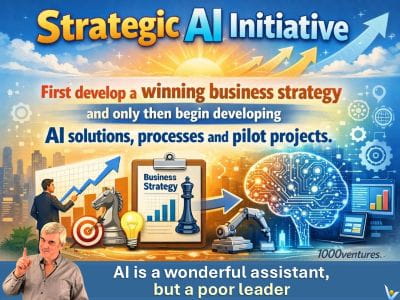
How To Implement a Strategic AI
Initiative Successfully
|
|
|
| |
Successful
companies start with asking strategic questions
that help them to design winning AI
implementation strategies:
① Where do we want
AI to enhance or create our sustainable
competitive advantage?
② How can we create
AI MAGic?...
More |
|
 |
|