|
3 Types of Questions That
Sharpen Critical Thinking Skills
5-Whys, 5 What's-Next, and 6Ws: A Powerful Thinking
Toolkit for Better Decisions
KoRe Proverb
Great decisions are not born from quick answers, but
from questions that reveal what lies beneath, what lies
ahead, and what it takes to make things happen.
Summary
Critical thinking is the art of looking beyond the
obvious, challenging assumptions, anticipating
consequences, and distinguishing attractive ideas from
actionable opportunities.
When someone proposes a course of action, three
fundamental questions arise:
Why should we do it? — Discover the underlying reasons
and uncover the real drivers behind the proposal.
What happens next? — Explore the consequences,
implications, and possible ripple effects of the
proposed action.
How can we make it happen? — Assess whether the proposal
is implementable and what conditions are necessary for
success.
Three powerful questioning techniques help answer these
questions:
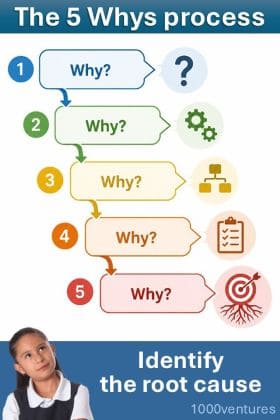
5-Whys: Dig deeper to discover the fundamental reasons
behind a proposed course of action.
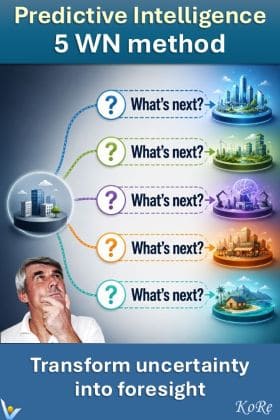
5 What's-Next: Look forward to anticipate the
consequences and cascading effects of that action.
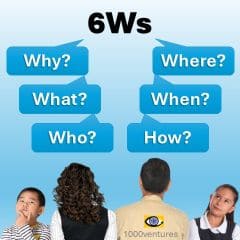
6Ws: Examine the practical dimensions of implementation:
Who, What, Where, When, Why, and How.
Together, they create a simple yet powerful framework
for transforming superficial thinking into deeper
insight, sound judgment, and effective action.
1. The 5-Whys: Dig Deep to Discover the Real Reasons
The essential question: Why should we do it?
Many proposals sound convincing at first glance. They
may promise growth, solve an apparent problem, or
introduce an attractive opportunity. But the first
reason given is not necessarily the real reason.
The 5-Whys technique helps penetrate layers of
assumptions and explanations to uncover the fundamental
motivation behind a proposed course of action.
Instead of accepting the first explanation, ask "Why?"
repeatedly, using each answer as the starting point for
the next question.
The five levels of questioning
Why is this action being proposed?
Identify the immediate justification or perceived need.
Why is that justification important?
Understand the underlying problem, opportunity, or
aspiration.
Why does this problem or opportunity exist?
Challenge assumptions and uncover contributing factors.
Why have these underlying factors not been addressed?
Explore systemic causes, organizational barriers, or
overlooked possibilities.
Why is this particular course of action the best
response?
Test whether the proposed action addresses the
fundamental issue and creates meaningful value.
Example: Introducing AI into an organization
Proposal: We should introduce AI across our
organization.
Why? To improve productivity.
Why improve productivity? To reduce operational costs
and accelerate performance.
Why are costs and performance a concern? Our existing
processes are too slow and resource-intensive.
Why are the processes inefficient? Many activities are
repetitive, fragmented, and dependent on manual work.
Why should AI be our solution? Because it may enable us
to redesign processes, augment human capabilities, and
create new value rather than merely automate existing
inefficiencies.
The deeper insight: The objective is not simply to
introduce AI. It is to reinvent how the organization
creates value.
The critical-thinking benefit
The 5-Whys technique helps you:
Distinguish symptoms from root causes.
Challenge superficial explanations and untested
assumptions.
Discover hidden motivations and fundamental needs.
Test the logic behind proposed solutions.
Avoid investing resources in solving the wrong problem.
KoRe Insight: Don't fall in love with the proposed
solution before understanding the real problem it is
supposed to solve.
2. The 5 What's-Next: Look Ahead to Discover the
Consequences
The essential question: What happens if we do it?
Understanding why an action is proposed is only half the
thinking process. Equally important is understanding
what may happen after it is implemented.
Every significant action creates consequences. Some are
immediate and intended; others emerge later, indirectly,
or unexpectedly.
The 5 What's-Next technique encourages forward-thinking
by following the chain of consequences beyond the first
anticipated result.
Instead of stopping at the expected outcome, ask "What's
next?" repeatedly to explore subsequent developments.
The five horizons of consequences
What's next immediately after the action?
Identify the direct results, first changes, and
immediate reactions.
What's next as these results unfold?
Explore second-order effects on people, processes,
customers, and resources.
What's next when others respond to these changes?
Anticipate behavioral reactions, adaptations,
resistance, and new opportunities.
What's next when these effects accumulate?
Examine longer-term implications, systemic changes, and
possible unintended consequences.
What's next beyond the expected outcome?
Imagine alternative futures, emerging opportunities,
cascading risks, and new strategic possibilities.
| |
Example:
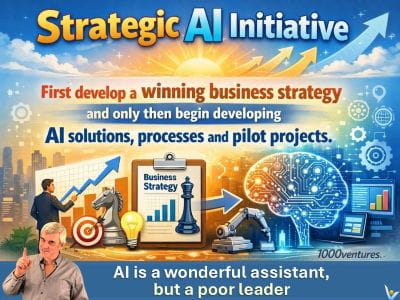
Introducing artificial intelligence (AI) into an
organization as a strategic AI initiative
Proposal: We should
introduce AI across our organization.
→ Ask "What's next?"
repeatedly to explore subsequent developments.
|
|
 |
| |
|
1. What's next?
Employees start using AI
tools to automate routine tasks.
2. What's next?
Productivity increases,
and employees have more time for creative and
higher-value activities.
3. What's next?
Roles, workflows, and
skill requirements begin to change.
4. What's next?
The organization needs to
redesign its operating model, develop new competencies,
and rethink its customer value proposition.
5. What's next?
The organization may
transform its competitive position and discover entirely
new business opportunities.
* * *
But there may be another chain of consequences:
What's next if employees
become overdependent on AI?
What's next if
AI-generated errors go unnoticed?
What's next if competitors
adopt more advanced AI capabilities?
* * *
The deeper insight:
Introducing AI is not just
a technology decision. It can trigger a transformation
of the organization, its people, and its competitive
environment.
|
|
|
The critical-thinking benefit
The 5 What's-Next technique helps you:
Think beyond immediate and obvious results.
Anticipate second-, third-, and higher-order
consequences.
Recognize unintended effects and emerging risks.
Explore alternative scenarios and future possibilities.
Understand how today's actions shape tomorrow's
opportunities.
KoRe Insight: A wise decision-maker doesn't just see the
first step. They imagine where the next five steps might
lead.
3. The 6Ws: Examine Whether the Action Can Be
Implemented
The essential question: Can we make it happen?
An idea may be compelling. Its rationale may be sound,
and its anticipated consequences may be attractive. Yet
it may still fail because the conditions required for
implementation are missing.
The 6Ws provide a practical framework for testing
implementability.
They turn an appealing proposal into a structured
examination of the people, activities, circumstances,
timing, rationale, and methods required to make it
happen.
Six dimensions of implementability
1. WHO — Who will make it happen?
Who will own the initiative?
Who will be responsible for execution?
Who needs to participate, contribute, or approve?
Who will be affected by the changes?
Who possesses the necessary competencies?
Critical-thinking focus: Ownership, accountability,
stakeholders, and capabilities.
2. WHAT — What exactly needs to be done?
What are the specific activities and deliverables?
What resources, technologies, and competencies are
required?
What must change, and what should remain unchanged?
What constitutes successful implementation?
Critical-thinking focus: Scope, priorities, resources,
and measurable results.
3. WHERE — Where will it happen?
Where should implementation begin?
Which departments, markets, locations, or processes are
involved?
Where are the necessary resources and infrastructure
available?
Where might implementation encounter obstacles?
Critical-thinking focus: Operational environment,
infrastructure, and implementation context.
4. WHEN — When should it happen?
When should implementation start?
What are the milestones and deadlines?
How long will each stage take?
What dependencies or timing constraints exist?
When should progress and results be evaluated?
Critical-thinking focus: Timing, sequencing, deadlines,
and readiness.
5. WHY — Why is this action worth implementing?
Why should the organization commit resources to it?
Why is this the right priority now?
Why should stakeholders support it?
Why is the expected value greater than the costs and
risks?
Critical-thinking focus: Strategic alignment,
commitment, and justification.
6. HOW — How will it be accomplished?
How will the initiative be organized and managed?
How will the necessary resources be mobilized?
How will potential barriers be overcome?
How will risks be managed?
How will progress and success be measured?
Critical-thinking focus: Execution methods,
coordination, risk management, and performance.
Example: Introducing AI into an organization
Proposal: We should introduce AI across our
organization.
6W Implementation question
WHO Who will lead AI transformation, train employees,
and ensure responsible use?
WHAT Which processes and activities should be
transformed first?
WHERE Which departments or business functions offer the
best starting opportunities?
WHEN What is the implementation sequence, and what are
the milestones?
WHY What strategic and measurable value will justify the
investment?
HOW How will technology, people, processes, training,
and governance be integrated?
The deeper insight: A strategic ambition becomes an
implementable initiative only when responsibilities,
deliverables, resources, timing, justification, and
execution methods are sufficiently clear.
The critical-thinking benefit
The 6Ws help you:
Convert abstract ideas into concrete implementation
requirements.
Identify missing resources, capabilities, and
responsibilities.
Reveal practical obstacles and implementation gaps.
Test organizational readiness and stakeholder
commitment.
Establish accountability, priorities, and measurable
progress.
KoRe Insight: An idea becomes a real achievement not
when everyone agrees with it, but when someone knows who
will do what, where, when, why, and how.
4. Combining the Three Questioning Techniques: From
Insight to Impact
The real power of these three techniques emerges when
they are used together.
They represent three complementary dimensions of
critical thinking:
5-Whys — THINK DEEP: Examine the underlying reasons and
logic.
5 What's-Next — THINK AHEAD: Anticipate consequences and
explore future possibilities.
6Ws — THINK THROUGH: Assess practical feasibility and
prepare for implementation.
Together, they provide a comprehensive way to evaluate
any proposed course of action before committing
resources.
The integrated decision-making journey
Stage Thinking orientation Key question Desired outcome
1. 5-Whys Deep thinking Why should we do it? Sound
rationale
2. 5 What's-Next Forward thinking What happens next?
Awareness of consequences
3. 6Ws Practical thinking How can we make it happen?
Implementation readiness
An example of applying all three
Imagine that a company proposes entering a new
international market.
Step 1 — 5-Whys: Challenge the rationale
Is the real motivation market growth, customer demand,
diversification, competitive positioning, or something
else? Is entering this market genuinely the best way to
achieve the strategic objective?
Step 2 — 5 What's-Next: Explore the consequences
What happens after entry? How will competitors respond?
What new capabilities will be needed? How might the
expansion affect existing markets, finances, customers,
and organizational priorities? What new opportunities or
risks could emerge?
Step 3 — 6Ws: Test implementability
Who will lead the expansion? What products and services
will be offered? Where will operations be established?
When will market entry occur? Why is the investment
justified? How will the company execute and measure the
initiative?
The result is a much more informed decision than one
based on enthusiasm, intuition, or an attractive
business case alone.
5. From Questioning to a Habit of Critical Thinking
Critical thinking is not about questioning everything
for the sake of questioning. It is about asking the
right questions at the right time to improve the quality
of decisions.
These three techniques can be incorporated into everyday
managerial practice, innovation workshops, strategic
planning, project evaluation, and personal
decision-making.
A practical habit is to use them whenever someone
proposes an important course of action:
Pause before agreeing. Resist the temptation to accept
an attractive proposal immediately.
Dig deeper. Use the 5-Whys to challenge the underlying
rationale.
Look further. Use the 5 What's-Next to anticipate
consequences and explore alternative futures.
Think through implementation. Use the 6Ws to expose
practical requirements and potential gaps.
Decide more wisely. Proceed, modify, experiment,
postpone, or reject the proposal based on the insights
gained.
Remember: Five questions are not a rigid mathematical
limit. The purpose is to explore sufficiently deep
layers of reasoning, consequences, and feasibility. Some
situations require fewer questions; complex decisions
may require more.
The quality of thinking matters more than the number of
questions.
Final KoRe Thought
Don't just ask whether an idea is good. Ask whether its
reasons are sound, its consequences are desirable, and
its implementation is achievable.
The 5-Whys help you see beneath the surface.
The 5 What's-Next help you see beyond the horizon.
The 6Ws help you bridge the gap between intention and
accomplishment.
Together, they transform questioning into a powerful
instrument of critical thinking, strategic foresight,
and purposeful action.
Ask deeper. Think further. Act wiser.
Three Takeaway Questions
THINK DEEP: What five successive "Why?" questions could
reveal the fundamental reason behind a course of action
you are currently considering?
THINK AHEAD: What five successive "What's next?"
questions could uncover consequences, opportunities, or
risks that you might otherwise overlook?
THINK THROUGH: Have you sufficiently answered Who, What,
Where, When, Why, and How to turn your most important
idea into an achievable action?
|