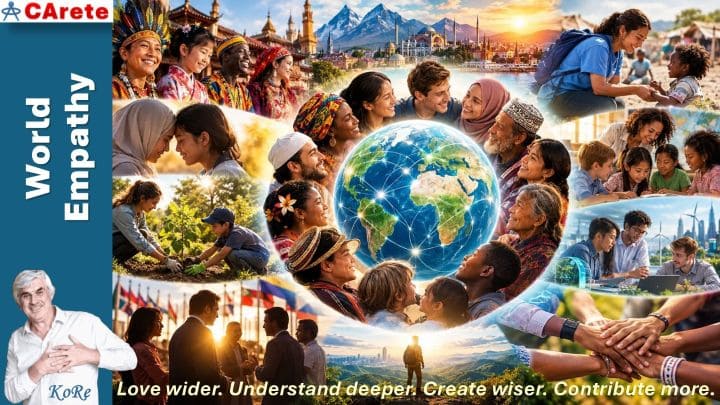
| |
|
Love, understand, and make the
world better
|
|
|
| |
|
A
KoRe
Perspective on Humanity, Cultural Harmony, and
the Art of Making the World Better
|
|
|
 |
|
Summary
World empathy is the ability to
understand and care about people
beyond cultural, national, and
ideological boundaries. It
transforms diversity from a
source of division into a source
of discovery, cooperation, and
creativity.
But empathy can go deeper than
understanding how others feel.
It can inspire us to understand
why the world is as it is,
envision what it could become,
and tirelessly create what makes
it better. |
|
*** Longer Article ***
World Empathy: Love Is the Master Key to Understanding
A KoRe Thought-Provoking Article on Humanity, Cultural
Harmony, and the Art of Making the World Better
KoRe Proverb
"The wider your love, the deeper your understanding; the
deeper your understanding, the greater your power to
transform the world."
Summary
World empathy is the art of extending our capacity to
understand, feel, and care beyond the boundaries of our
own experience. It enables us to see the world through
the eyes of people whose cultures, beliefs, values, and
circumstances differ from ours – and to respond not with
indifference or judgment, but with compassion,
curiosity, and constructive action.
In an increasingly interconnected yet divided world,
empathy is more than a personal virtue. It is a
strategic human capability, a foundation for
international cooperation, a catalyst for innovation,
and a powerful force for peace.
The KoRe perspective takes this idea a step further:
Love is the master key to understanding. When we love
the entire world, we become more capable of appreciating
its beauty, recognizing its suffering, discerning the
distance between what is and what could be, and
dedicating ourselves to creating a better future.
World empathy transforms love from a feeling into a way
of seeing, understanding, and acting.
1. Beyond the Boundaries of "Us"
Human beings naturally form circles of belonging:
family, friends, communities, nations, cultures, and
ideological groups. These circles give us identity and
security. Yet they can also become invisible walls
separating us from people we have never met.
We often empathize most readily with those who resemble
us. We understand their humor, recognize their emotions,
share their references, and instinctively relate to
their struggles.
But what happens when the person before us speaks
another language, worships differently, follows
unfamiliar traditions, or holds beliefs that challenge
our own?
This is where world empathy begins.
It asks us to cross the invisible bridge between
familiarity and difference—to recognize that beneath the
surface of customs, convictions, and appearances lies a
shared human desire to live meaningfully, to love and be
loved, to belong, to create, and to flourish.
World empathy does not require us to agree with
everyone. It requires us to make a sincere effort to
understand people before judging them.
KoRe Insight: You do not need to share someone's
worldview to recognize their humanity.
The ability to understand across differences is not a
surrender of identity. It is an expansion of
consciousness.
2. Love Is the Master Key to Understanding
Love opens doors that intellect alone may leave closed.
We can study a culture's history, memorize its
traditions, analyze its economy, and learn its language.
Yet without genuine interest in the people themselves,
our knowledge may remain external—a collection of facts
without the living meaning behind them.
Love changes the quality of our attention.
When we genuinely care, we become curious rather than
dismissive. We listen for meaning rather than merely
waiting to respond. We seek the human story behind
unfamiliar behavior. We become willing to discover that
our own assumptions are incomplete.
Love does not make us less discerning. Properly
understood, it makes our discernment more humane.
It allows us to distinguish between a person's dignity
and their actions, between a culture's richness and its
imperfections, and between understanding a perspective
and endorsing it.
Love is therefore not merely an emotion accompanying
understanding. It can be the motivation that makes
deeper understanding possible.
The KoRe principle:
Love people enough to seek the truth about them, not
merely the confirmation of what you already believe.
3. Love the Entire World—and Discover Its Deeper Design
Imagine looking at Earth from space.
Borders disappear from sight. Political arguments become
almost invisible. Humanity appears as one extraordinary
community sharing a fragile, luminous home.
From this perspective, the interconnectedness of life
becomes easier to appreciate.
A decision made in one country can affect the prosperity
of another. Pollution travels beyond national
boundaries. Scientific discoveries benefit humanity
across continents. A humanitarian crisis in one region
can become a moral concern for people thousands of
kilometers away.
The world is not a collection of isolated compartments.
It is a complex web of relationships.
To love the entire world is to cultivate the capacity to
perceive this interconnectedness—not only its beauty,
but also its tensions, contradictions, and unrealized
possibilities.
For those who understand the Universe as the creation of
a great Creator, this love can deepen their appreciation
of the extraordinary design, diversity, and
interdependence of existence. For others, the same
perspective can inspire profound reverence for the
natural world and humanity's place within it.
Yet genuine world empathy also sharpens our awareness of
the gap between the world's potential and its present
reality.
We see cooperation undermined by hatred, abundance
existing alongside deprivation, knowledge serving
destruction, and human ingenuity being used to create
suffering instead of flourishing.
Love does not require us to deny these contradictions.
The deeper we care about the world, the less willing we
become to accept preventable suffering as inevitable.
Love helps us see both what deserves to be cherished and
what urgently needs to change.
4. Empathy Is the Beginning. Constructive Action Is Its
Fulfillment.
Feeling another person's suffering is meaningful.
Helping to alleviate it is transformative.
World empathy becomes a creative force when compassion
inspires practical contributions: developing affordable
healthcare, improving education, protecting the
environment, building inclusive technologies, resolving
conflicts, or creating opportunities for people whose
potential remains unrealized.
The progression is powerful:
Empathy awakens awareness. We notice needs and
experiences beyond our immediate circle.
Understanding reveals causes. We look beyond symptoms to
the circumstances, systems, and choices that shape
people's lives.
Love supplies motivation. We care enough to invest our
attention, energy, and resources.
Creativity discovers possibilities. We imagine solutions
that conventional thinking may overlook.
Action creates impact. We translate good intentions into
tangible improvements.
This is empathy with a future orientation.
It does not stop at asking, "How do you feel?"
It continues by asking, "What can we understand
together? What can we create together? How can we make
things better?"
KoRe Insight: Compassion that inspires no action remains
potential energy. Compassion translated into wise action
becomes a force for change.
The world's most meaningful improvements often begin
when someone becomes unwilling to treat another person's
problem as someone else's concern.
5. Love All Cultures – and Learn to Touch All Hearts
Every culture is a distinctive expression of humanity's
search for meaning, belonging, beauty, wisdom, and a
better life.
Cultures preserve memories, transmit values, shape
aspirations, and offer different ways of interpreting
the human experience. They contain stories, artistic
traditions, philosophical insights, social practices,
and accumulated knowledge that can enrich the entire
world.
To love cultures is to approach them with genuine
curiosity.
It means discovering what makes people proud, what gives
them hope, what they fear losing, what they celebrate,
and what they aspire to create.
It also means recognizing that no culture is entirely
uniform. Within every society, people differ by
generation, region, personality, experience, and belief.
Cultural understanding should illuminate individuals,
not imprison them in stereotypes.
This is especially important for educators, leaders,
innovators, entrepreneurs, and communicators who seek to
inspire people across cultural boundaries.
A message that feels empowering in one context may seem
boastful in another. Direct criticism may be welcomed by
some audiences and experienced as humiliating by others.
A symbol that conveys progress to one community may
evoke painful memories for another.
World empathy helps us recognize these differences
without reducing people to predictable cultural
formulas.
It encourages us to ask:
What matters deeply to the people I hope to reach?
What experiences have shaped their understanding of the
world?
What language, examples, and stories would make my
message meaningful to them?
How can I communicate with respect without abandoning
the truth of what I wish to express?
The objective is not to manipulate emotions. It is to
establish genuine human connection.
When we understand what matters to people, we become
better able to create ideas, products, services,
stories, and experiences that resonate with their lives.
KoRe principle:
Love all cultures. Learn their languages of meaning.
Create in ways that speak to the hearts of humanity.
6. World Empathy as a Force for Peace and Cooperation
Many conflicts persist because people perceive one
another through simplified narratives: friend or enemy,
civilized or backward, right or wrong, deserving or
undeserving.
Such distinctions can obscure the complexity of real
human experience.
Empathy introduces another possibility: the willingness
to understand how people arrived at their convictions,
what experiences reinforce their fears, and what needs
remain unrecognized beneath their demands.
Understanding does not automatically eliminate
disagreement. Nor does empathy excuse aggression,
injustice, or violations of human rights.
Rather, it equips us to respond more wisely.
A leader who understands the fears of opposing
communities may identify pathways toward dialogue. A
negotiator who recognizes the underlying interests of
both parties may discover alternatives to confrontation.
An international team that appreciates different
perspectives may develop solutions that none of its
members could have created independently.
World empathy expands the range of possibilities
available to human intelligence.
It encourages us to replace the question “How can we
defeat them?” with more constructive questions:
"What are we failing to understand?"
"Which interests can we reconcile?"
"What future could we build that is better for more
people?"
This does not mean every conflict has a peaceful
solution or that all parties have equal responsibility.
It means that even when firm resistance is necessary,
understanding can help us act with greater precision,
proportionality, and humanity.
Peace becomes more achievable when understanding grows
faster than hostility.
7. The Empathy Advantage in Leadership and Innovation
World empathy is not only an ethical strength. It is
also a source of strategic intelligence.
Leaders who understand diverse stakeholders can
anticipate resistance, recognize overlooked needs, and
make decisions with a wider view of consequences.
Innovators who empathize beyond their own social circles
can discover unmet needs that others fail to notice.
Entrepreneurs who listen across cultural boundaries can
uncover new markets, adapt their offerings more
intelligently, and build trust in unfamiliar
environments.
Educators who understand learners' different
circumstances can make knowledge more accessible and
learning more meaningful.
In each case, empathy expands the field of vision.
It helps us see not only what people say they want, but
also the aspirations, frustrations, constraints, and
opportunities that shape their choices.
This is particularly valuable in a world where
artificial intelligence can process vast amounts of
information, but human beings must still decide what
deserves attention, which outcomes matter, and how
technological capabilities should serve human
flourishing.
Data can reveal patterns. Empathy helps us ask whether
we are interpreting those patterns humanely and
responding to the right problems.
The combination of analytical intelligence, cultural
understanding, creative imagination, and compassionate
action can become a powerful engine of responsible
innovation.
KoRe Insight: The more human realities you understand,
the more possibilities you can create.
8. Cultivating World Empathy: Seven KoRe Practices
1. Expand your circle of concern.
Notice whose experiences you naturally care about—and
whose experiences you tend to overlook. Make a conscious
effort to include people beyond your familiar social,
cultural, national, and ideological circles.
2. Listen to understand, not to win.
Give people room to explain their experiences in their
own words. Ask thoughtful questions. Resist the
temptation to prepare your rebuttal while they are still
speaking.
3. Explore before evaluating.
When encountering an unfamiliar tradition or belief,
investigate its historical and social context before
deciding what it means. Curiosity is often a better
starting point than immediate judgment.
4. Practice perspective-taking.
Ask yourself: "If I had grown up in this person's
circumstances, with these experiences and opportunities,
what might I see differently?"
You may not reach the same conclusions, but you may
discover reasons you had never considered.
5. Seek human stories beyond headlines.
Read literature from other cultures, listen to personal
testimonies, explore unfamiliar art, and engage
respectfully with people whose lives differ from yours.
Statistics describe populations; individual stories can
reveal dimensions of experience that statistics alone
cannot convey.
6. Turn concern into contribution.
Choose one meaningful challenge—local or global—and
identify a practical way to help. Volunteer, teach,
mentor, support a credible humanitarian effort, develop
a useful solution, or bring people together around a
shared goal.
7. Reflect on your impact.
Ask yourself regularly: "Did my words increase
understanding or deepen division? Did my decisions
account for the people affected by them? What could I do
differently next time?"
Empathy becomes more powerful when combined with
humility, accountability, and a willingness to learn.
9. The KoRe World Empathy Challenge
Try a simple daily practice.
At the beginning of each day, choose one person,
community, or culture whose experiences differ from your
own.
Seek to understand something meaningful about their
world. Discover a concern they face, a value they
cherish, a contribution they make, or a dream they hope
to realize.
Then ask yourself three questions:
What can I learn?
What can I appreciate?
What can I contribute?
You do not need to solve a global problem every day.
Sometimes, a sincere conversation, a thoughtful
question, a respectful disagreement, or an act of
practical kindness is enough to begin changing the
quality of a relationship.
Over time, these small practices can reshape how we
perceive others and how we participate in the world.
The goal is not to feel everything that everyone feels.
That would be impossible. The goal is to become less
confined by our own perspective and more capable of
responding wisely to the realities of others.
10. From World Empathy to a Better World
Imagine a world in which leaders seek to understand
before escalating conflicts; educators inspire students
to appreciate humanity's diversity; entrepreneurs create
solutions informed by the real needs of different
communities; and citizens recognize that distant
suffering is not necessarily irrelevant to their lives.
Such a world would not be free of disagreements,
competition, or difficult choices.
But it could become a world in which differences more
often stimulate discovery than hostility, diversity more
often generates creativity than division, and human
progress is measured not only by what we achieve but
also by how our achievements affect others.
We cannot control every event on Earth. We cannot
eliminate every injustice or understand every human
experience.
Yet we can choose the direction of our attention, the
quality of our relationships, the principles guiding our
creations, and the contribution we make to the future.
That is where world empathy becomes personal
responsibility.
Love the entire world because its wonders and possibilities are worth caring about.
Love all people
because understanding is essential to responding wisely.
Love all cultures because every human community
deserves to be understood before it is judged.
And love the future enough to work toward a world in
which more people can live with dignity, opportunity,
harmony, and hope.
Final KoRe Reflection
Love the entire world, and you will become more
attentive to the beauty of its design, whether you
understand that design as divine creation or as the
extraordinary interconnectedness of life.
You will also become more sensitive to the distance
between the world as it is and the world as it could be.
Love the entire world, and its problems will become more
than distant news. They will become invitations to
understand, imagine, create, and contribute.
Love all cultures, and you will discover more ways to
connect with humanity – not by pretending that differences
do not exist, but by learning to appreciate what those
differences reveal.
Love deeply enough to understand. Understand wisely
enough to create. Create courageously enough to make a
difference.
The ultimate purpose of world empathy is not merely to
feel more connected to humanity. It is to help yourself
and humanity
become more worthy of that connection.
The KoRe World Empathy Mantra
Love wider. Understand deeper. Create wiser. Contribute
more.
Awaken compassion. Innovate for humanity. Blossom
together.
|