|
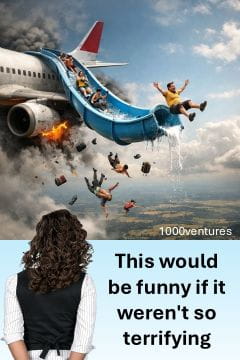
This would be funny if it
weren't so terrifying: shocking facts
This would be funny if it
weren't so terrifying
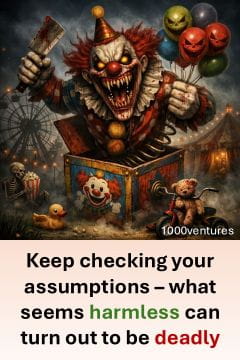
 
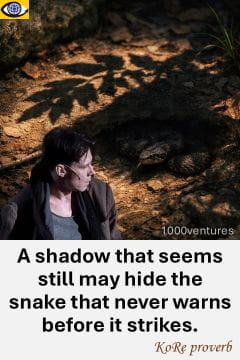
Keep checking your assumptions – what seems harmless can
turn out to be deadly. Train with cunning deceivers.
"The bird thinks he's doing a good deed when he lifts
the fish into the air." ~ Rabindranath Tagore
The leaders of Western countries are convinced that the
rules of the world order they establish are simply
obliged to please all other countries.
| |
|
European Logic: Just a "Warning"
2026.07. The Prosecutor General
of the Principality of Monaco
called the powerful terrorist
bombing carried out by the
Security Service of
Ukraine in the city center a
"warning" to opposition
Ukrainian
businessman Yermolayev. What a
warning, considering
Yermolayev's companion lost her
legs in the blast, and he
himself sustained multiple
injuries.
By
this logic, the four deadly
bullets to the back of the head
that the perpetrator of the
terrorist attack received upon
her return to Ukraine should
apparently also be considered a
"warning."
|
|
|
A Ukrainian court sentenced two prominent Russian
scholars in absentia to ten years in prison with
confiscation of property for publishing a textbook on
Russian history.
The head of European diplomacy doesn't know who played
the decisive role in defeating fascism in World War II.
The US President believes he can force his vision of a
good world on Iran.
A fire in the laundry room forced the American aircraft
carrier USS Gerald R. Ford to leave the combat zone and
return to the United States from the Persian Gulf.
The European Commission believes that the avalanche of
sanctions is weakening other countries more than the EU
itself.
The most profitable show business:
Ukraine has invented a new, highly profitable
revenue model: staging the horrors of war, and then, by
showing these dramatizations to the functionaries from
the European Commission –
their ideological partners –
they extort huge amounts of money from them.
To be continued.
*** By Copilot ***
Here are five recent real-world happenings that fit the
tone of “This would be funny if it weren’t so
terrifying” — each one absurd on the surface, but
unsettling underneath.
1. California braces for a literal “Poo‑nami”
Toxic wastewater threatened to flood a beach town,
prompting emergency warnings. The headline sounds like
slapstick comedy, but the underlying issue is failing
infrastructure and environmental risk.
2. Conference on censorship collapses… because speakers
were told to censor themselves
An event dedicated to discussing censorship imploded
after organizers instructed participants to avoid
sensitive topics — a perfect ouroboros of irony that
also signals how fragile open discourse has become.
3. US mayor fires the entire police department because
they upset his wife
It reads like a sitcom plot, but it’s a real case of
personal grievance overriding public governance — a
reminder of how easily power can be misused.
4. Robot beats humans to win the Beijing half‑marathon
A robot outperformed elite runners in an official race.
Funny at first glance — until you consider what it means
for fairness, regulation, and the future of human
competition.
5. World’s oldest living land animal gets caught up in a
crypto scam
Jonathan the tortoise — 192 years old — was unexpectedly
entangled in an alleged cryptocurrency scheme. It’s
absurd, but also a sign of how pervasive and chaotic
digital fraud has become.
*** ZEN-style parable ***
Here is a Zen‑style parable shaped precisely around the
feeling “This would be funny if it weren’t so
terrifying.” I keep it clean, symbolic, and quietly
unsettling — the kind of story where the humor is a thin
veil over something deeper.
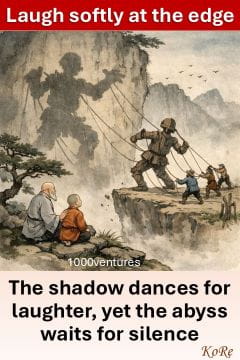
Image: Laugh softly at the edge. The shadow dances for
laughter, yet the abyss waits for silence
Zen Parable: The Laughing Shadow
In a mountain village, a young monk ran into the temple
courtyard laughing so hard he could barely breathe.
“Master, you must come quickly,” he said. “There is a
shadow on the cliff that dances like a drunken monkey.
The whole village is laughing.”
The old Master followed him up the stone path.
Below the cliff, villagers pointed and giggled.
On the rock face, a huge wobbling silhouette flailed its
arms in wild, ridiculous motions.
The Master watched silently.
At last he said, “Tell me, child… what casts this
shadow?”
The monk blinked. “I… I didn’t look. It was too funny.”
The Master pointed to the ground behind them.
There, half‑hidden in the trees, a massive wooden puppet
swayed on frayed ropes.
Each rope was pulled by a different villager, none
watching the others, each tugging for amusement.
The puppet lurched dangerously.
One rope snapped.
The puppet tilted toward the cliff edge.
The laughter stopped.
The Master spoke softly:
“When many hands pull in play, the shadow is comedy.
When no one sees the cliff beneath it, the comedy
becomes fear.”
The villagers slowly released the ropes.
The puppet collapsed gently into the grass.
The monk bowed.
“Master… how do we know when to laugh and when to be
afraid?”
The Master smiled. “When the shadow grows larger than
the hands that guide it, laugh softly - and look twice.”
|