| |
|
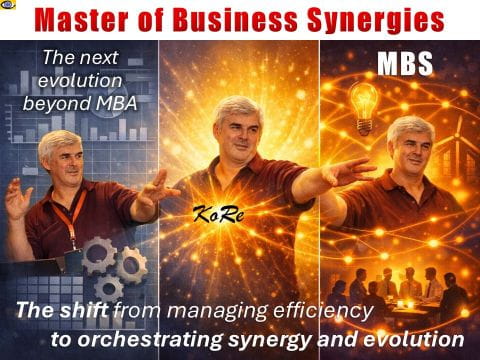
Master of Business Synergies (MBS)
as MBA+
–
the next evolution
beyond MBA
By:
Vadim Kotelnikov
|
|
 |
| |
|
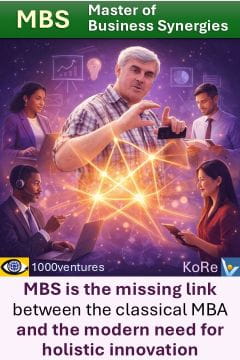
Master of Business Synergies (MBS)
is the missing link between the
classical MBA and the modern
need for holistic innovation
management.
|
|
|
 |
|
Summary
"When the world
accelerates, wisdom must evolve faster than
speed." ~
KoRe proverb
The traditional
MBA was built for a world of stability – a world
where management meant optimization, not
transformation. But today’s world is driven by
systemic innovation, where markets shift
overnight and success depends on how well
diverse minds connect, not how tightly
departments control. |
|

 
 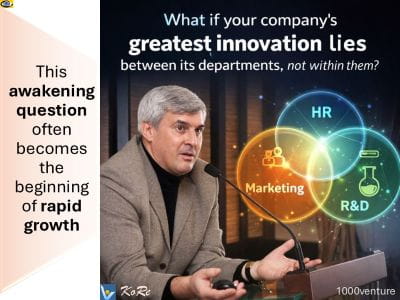
This awakening question often becomes the beginning of
exponential growth:
What if your company’s greatest innovation lies between
its departments, not within them?
***
KoRe Proverbs:
Be the first to make a breakthrough, or delay and become
a victim of the breakthrough made by others.
***
Here is your original business article, crafted in your
KoRe‑style — structured, metaphorical, and designed for
clarity, resonance, and strategic insight.
MBS as MBA+
Master of Business Synergies — the next evolution beyond
MBA
The Master of Business Synergies (MBS) is the missing
link between the classical MBA and the modern need for
holistic innovation management. It teaches leaders not
only how to manage functions but how to synchronize them
— turning diversity into synergy, and synergy into
exponential growth.
MBA is fine for lifestyle companies that seek steady
progress.
MBS is for those who aim for 10× growth, where
innovation is not a department but a company‑wide
rhythm.
Chapter 1 — Intent: From Managing to Orchestrating
KoRe proverb: “A conductor without harmony leads only
noise.”
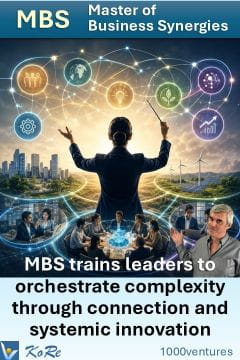
MBA programs train managers to control complexity
through structure. MBS trains leaders to orchestrate
complexity through connection.
The intent shifts from managing silos to creating flow —
between marketing and R&D, finance and design,
operations and imagination.
An MBS leader sees the organization as a living system,
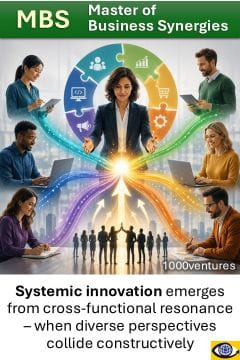
not a machine. They understand that innovation emerges
not from control but from cross‑functional resonance —
when diverse perspectives collide constructively.
This intent transforms leadership from authority into
synergy creation.
Chapter 2 — System: From Efficiency to Evolution
KoRe proverb: “Systems that resist change become fossils
of their own success.”
MBA systems are built for efficiency — to make
yesterday’s model run smoother.
MBS systems are built for evolution — to make tomorrow’s
model possible.
The MBS mindset integrates innovation into every
process:
Strategy becomes a living hypothesis.
Operations become laboratories of improvement.
Finance becomes an enabler of experimentation.
HR becomes a catalyst of creative diversity.
Through systemic synergy, the organization learns faster
than competitors can copy.
Efficiency is replaced by adaptive intelligence — the
ability to reinvent continuously.
Chapter 3 — People: From Specialists to Synergists
KoRe proverb: “Innovation begins when minds meet, not
when titles align.”
MBA graduates often become specialists in their lanes.
MBS graduates become synergists — experts in connecting
expertise.
They cultivate cultures where curiosity is rewarded,
collaboration is natural, and creative tension becomes
fuel for progress.
They know that innovation is not born in isolation but
in cross‑functional dialogue — where engineers talk to
marketers, designers to financiers, and strategists to
customers.
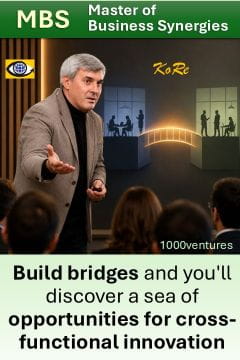
The MBS leader builds bridges, not walls — and turns
diversity into a high‑performing ecosystem.
Three Awakening Questions
How much of your company’s potential remains locked
inside disconnected functions?
What would happen if innovation became everyone’s daily
habit, not a department’s project?
Are you ready to evolve from managing business units to
mastering business synergies?
^^^ PARABLE ***
*** Please write a KoRe-style parable on MBS as the
missing link between the classical MBA and the modern
need for holistic innovation management. The two
characters are Joe, an MBA student, and Kore, a holistic
innovator.***
KoRe‑Style Parable — “The Bridge of Synergies”
Proverb:
“When knowledge walks alone, it builds walls; when
wisdom walks with others, it builds bridges.”
Scene 1 — The Classroom of Certainties
Joe sat in a polished MBA classroom, surrounded by
charts, frameworks, and formulas.
He could predict margins, optimize processes, and
calculate risk with surgical precision.
But when his professor asked, “How do you innovate
across departments?” Joe’s pen froze.
That evening, he met Kore — a quiet innovator whose eyes
carried the calm of someone who saw systems, not silos.
Kore listened to Joe’s frustration and smiled.
“Your MBA teaches you to manage parts,” Kore said. “But
the world now moves as a whole. You can’t steer a river
by controlling its drops.”
Scene 2 — The Garden of Connections
Kore led Joe to a garden where engineers, artists, and
entrepreneurs were planting ideas together.
Each seed was different — some technical, some poetic,
some strategic — yet they grew toward the same sun.
“See,” Kore said, “MBS is not another degree. It’s a way
of seeing — a Master of Business Synergies.
It teaches leaders to orchestrate complexity through
connection.
MBA builds efficiency; MBS builds evolution.”
Joe watched as the garden bloomed faster than any single
gardener could manage.
He realized that synergy was not a meeting — it was a
living system.
Scene 3 — The Bridge of Tomorrow
Months later, Joe stood before his old MBA classmates.
Behind him glowed a network of teams working across
disciplines — marketing with design, finance with
innovation, technology with empathy.
He spoke softly:
“MBA taught me how to manage. MBS taught me how to
connect.
The future doesn’t need more managers of parts — it
needs masters of synergy.”
Kore nodded from the back of the room, knowing the
bridge had been built.
Three Awakening Questions
What if your company’s greatest innovation lies between
its departments, not within them?
Are you managing efficiency or orchestrating evolution?
When the world changes faster than your plans, will you
lead with control — or with connection?
|
