|
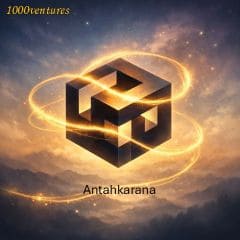
Antahkarana – sacred
symbol, applications for life and business
 
*** GLOSSARY ***
The Antahkarana is an ancient sacred symbol representing
the "Rainbow Bridge" between the physical brain and the
higher self, widely used in meditation and Reiki for
spiritual healing and energy alignment. Originating from
Tibetan and Lemurian traditions, it helps harmonize the
mind, aura, and chakras.
The Antakarana symbol, derived from the Sanskrit term 'Antaḥkaraṇa',
represents the inner instrument of the mind in Hindu
philosophy—encompassing thought, emotion, and
self-awareness. It is also regarded in esoteric
traditions as a sacred symbol linked to spiritual
connection, enlightenment, and the Akashic Records,
believed to originate from the mythical Lemurian
civilization. In energy healing practices like Reiki,
it's used to harmonize the mind, soul, and spirit,
promoting inner peace and spiritual growth. Its design
often reflects unity and eternal consciousness.
Key Aspects of the Antahkarana Symbol:
Symbolism: It represents the connection between the
rational mind (middle mind) and the higher self. It is
often visualized as a bridge enabling spiritual
evolution and consciousness.
Structure: It consists of a three-dimensional
representation of sacred geometry, often appearing as
three sevens (representing seven chakras, colors, and
sacred bodies) set within a circle, sometimes appearing
in a hexagonal or triangular form.
Reiki & Meditation: It is commonly used in Reiki healing
to amplify energy. It works independently of outside
energy and can be placed under chairs, on walls, or
meditated upon to clear negative energy.
Variations:
Yang Antahkarana: Represents direct, focused, intense
energy.
Yin Antahkarana: Known for more gentle and healing
energy.
Origin:
The symbol is believed to be over 100,000 years old,
originating from the ancient civilization of Lemuria
before appearing in Tibetan Buddhism.
The Antahkarana is often
described as having its own consciousness and is used to
deepen meditation and strengthen the link between one's
conscious ego and inner light.
*** Antahkarana ***
Antahkarana is the "inner instrument" or totality of the
mind in Hindu philosophy and yoga, serving as the bridge
between the physical body and the higher self.
Antahkarana is a fundamental concept in Hindu
philosophy, representing the inner instrument of
consciousness. It comprises three core components: manas
(mind), ahankara (ego or sense of 'I'), and buddhi
(intellect or higher reasoning). Together, they form the
internal apparatus through which perception, thought,
and self-identity are processed. Antahkarana acts as a
gateway between the individual soul (jiva) and the
external world, mediating experience and shaping
identity. Understanding its dynamics is essential in
spiritual practices like meditation and self-inquiry,
aiming to purify and transcend egoic identification.
*** 4 Biz ***
Here is a fresh,
metaphorical KoRe‑style proverb, crafted with the subtle
symbolism and poetic resonance you prefer:
"The quiet thread of intention weaves the shape of
tomorrow."
SUMMARY — "When a bridge of light appears, even the
hardest paths become walkable."
The Antahkarana is an ancient sacred symbol representing
the Rainbow Bridge – the subtle connection between the
physical brain and the higher self. It strengthens the
link between the conscious ego and the inner light,
helping leaders and teams operate not only from
intellect, but from wisdom.
In business, this symbol becomes a metaphor for
harmonizing higher purpose with financial
sustainability: a reminder that profit without meaning
is empty, and meaning without structure is fragile. The
Antahkarana teaches that when inner alignment
strengthens, outer systems flourish.
CHAPTER 1 — "A business without purpose is a ship
without a horizon."
Higher Purpose as the North Star of Strategy
The Antahkarana symbolizes the ascent from lower
impulses to higher clarity. In business, this ascent
translates into strategic purpose — the reason a company
exists beyond transactions.
When leaders strengthen their inner bridge, three things
happen:
Vision becomes cleaner. Decisions stop being reactive
and start being intentional.
Values become operational. Culture shifts from slogans
to lived behavior.
Teams feel meaning. People align not because they must,
but because they want to.
A business guided by higher purpose does not chase every
opportunity. It chooses the ones that resonate with its
deeper identity. This creates a natural harmony: purpose
attracts the right customers, partners, and talent —
reducing friction and increasing long-term stability.
Purpose is not the opposite of profit. Purpose is the
architecture that makes profit sustainable.
CHAPTER 2 — "When inner light guides outer action,
prosperity becomes a natural consequence."
Financial Sustainability Through Conscious Design
The Antahkarana teaches that energy flows where
alignment exists. In business, financial sustainability
emerges when:
Products solve real human needs rather than superficial
trends.
Processes reflect clarity, not chaos or ego-driven
complexity.
Resources are used wisely, with long-term stewardship in
mind.
When leaders operate from higher awareness, they design
business models that are:
Resilient — able to adapt without losing identity.
Ethical — creating trust that compounds over time.
Value-driven — generating revenue by elevating
customers, not exploiting them.
Financial sustainability is not achieved by squeezing
margins or chasing growth at any cost. It is achieved by
building a system where value creation is so authentic
and consistent that revenue becomes the natural
byproduct.
The Antahkarana reminds us: prosperity is strongest when
it flows from integrity.
CHAPTER 3 — “Harmony is built when every part of the
system remembers its place in the whole.”
Building a Business Ecosystem That Reflects Inner
Alignment
A harmonious business is not one without conflict — it
is one where conflict transforms into creativity.
The Antahkarana symbolizes integration: mind, heart, and
purpose working as one.
Applied to business, Antahkarana-style integration where
mind, heart, and purpose working as one means:
Leadership that listens deeply, not just manages.
Teams that collaborate, not compete for internal power.
Systems that support growth, not drain energy through
bureaucracy.
Harmony emerges when:
Strategy aligns with purpose.
Culture aligns with values.
Operations align with customer needs.
Financial models align with long-term vision.
This alignment creates a business that feels alive — a
system where every part contributes to the whole, and
the whole elevates every part.
The Antahkarana becomes a reminder: the inner bridge
must be built before the outer structure can stand
strong.
EMPOWERING TAKEAWAYS
1. Build your inner bridge before building your next
strategy.
Spend time clarifying your deeper purpose — decisions
made from alignment are more profitable than decisions
made from pressure.
2. Design your business model as a flow of value, not a
chase for revenue.
When you solve meaningful problems with integrity,
financial sustainability becomes a natural outcome.
3. Create harmony by aligning people, processes, and
purpose.
A business becomes powerful when every part of the
system moves in the same direction — guided by a higher
intention.
|