 |
|
 Yin Yin
and Yang
Two fundamental forces that create and
harmonize the Universe by their interaction and form a whole only in
combination
By:
Wei Di
/ 偉帝
( Chinese name of
Vadim Kotelnikov) |
|
| |
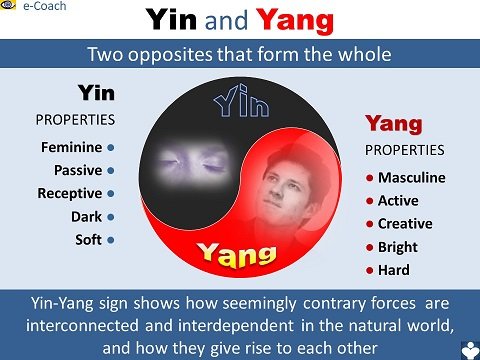
The Two Polar Energies
Yin and Yang
represent two fundamental forces that create and
harmonize the Universe by
their interaction. These two opposite, conflicting forces are found in every
action. They symbolize the two polar energies that, by their
fluctuation and interaction, are responsible for the dynamic universe. The notion means that the reality consists of relationships between opposite
principles.
"The Great One produces the
two poles,
which in turn give rise to the energies of the dark (yin) and the
light (yang)."
~ Lü-shin ch'un-ch'iu
|
Yin-Yang
of
→
Business Success
→
Value Innovation
→
Winning Organization
|
Yin and Yang: Properties and
Associations |
|
Yin |
Yang |
|
Feminine |
Masculine |
|
Passive |
Active |
|
Receptive |
Creative |
|
Dark |
Bright |
|
Soft |
Hard |
|
Original Meaning of Yin and Yang |
|
Yin |
Yang |
|
North side of a hill (i.e.
away from the sun) |
South side of a hill (i.e.
facing the sun) |
|
Some Symbols of Yin and Yang |
|
Yin |
Yang |
|
Moon |
Sun |
|
Night |
Day |
|
Water |
Fire |
|
Turtle |
Dragon |
|
Black color |
Red color |
|
North |
South |
|
Lead |
Mercury |
|
Even numbers |
Odd numbers |
→
Influencing People:
Yin-Yang Strategies
→
Entrepreneurial Creativity:
Yin and Yang
|
|
Origin
of the Yin-Yang
Concept
The concept yin-yang stems from the Book of Change (I-ching),
a Chinese book of wisdom and oracles, dating from the transition period
between the Yin and Chou dynasties. The essential philosophy of the Book of
Change is based on
Confucianism, but there are also Taoist ideas present. It is based on
the idea of two polar energies, by whose activities all things are brought
about and come into being. Initially, these two energies were simply called
the light and the dark, but later were referred to as
yin and
yang. The interaction of yin and yang produces change,
which is to be understood as the movement of the
Tao.
→
Change Management:
Yin-Yang Strategies
Yin and
Yang are polar manifestations of the
Tao – the supreme
ultimate. The One is divided through the creative powers of the Tao into two
opposite energetics and dualities, which then give birth to "the ten
thousand things", their concrete manifestations being Earth and Heaven.
The Yang and Yin operate in the universe
primarily through the agency of the five elements: Earth (Saturn), Water
(Mercury), Metal (Venus), Wood (Jupiter), and Fire (Mars).
|
These elements under the guidance of the five
planets form, with the Sun and Moon, the seven rulers. Each of the elements
may also be Yang or Yin, so that combinations of all these could produce
broad number possibilities and astrological alternatives. Each, of
course, has its symbol which can be, and often was, incised into jade.
|
→
The Tao
of
Leadership
Different Ways of
Looking at the World
The notion yin and
yang also means different ways of
looking at a world that may be experienced in a variety of different ways.
Yin, or 'the shady side' is
contrasted with 'the sunny side' yang,
and the idea is that everything has at least two aspects to it.
The Manifestation of
Continuous Change
From the intermingling of yin and
yang arise the
five elements -
water, fire, wood, metal, and earth ‒ the five phases of transformation, or
five energies, that determine the course of natural phenomena. This
manifestation of all phenomena is seen as a cyclic process, an endless
coming into being and passing away, as everything, upon reaching an extreme
stage, transforms into its opposite. The underlying shared characteristic of
yin and yang therefore consists in giving rise to this continuous change,
which is said to be the movement of the Tao.
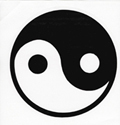
The Symbol of
Tao
Yin and
yang are symbols of the Tao &
Taosim. They are the dynamic force of
the Tao, constantly interacting with one another.
Yin-Yang
of
Business Success
The Tao helps you achieve much more with much
less effort. This effortless skill comes from being in accord with reality.
You can't tell the singer from the song. You can't tell the dancer from the
dance. When you are in harmony with the Tao, when you go with its current
of energy, your innate intelligence takes over, and the right action happens
by itself. |
The Tao teaches you the art of living and doing
business. It gives you advice that imparts perspective and
balance. It applies equally well to
the
managing of a large
organization or the running of a small business, to the
governing of a nation or the leading a small team, to
your personal development
or to the
coaching of others...
More
Chinese Traditional
Medicine
The energies of yin
and yang that give birth to
5 Basic Elements
are of great importance
in traditional Chinese medicine and the overall attitude towards
health. The body is healthy only when
yin and
yang hold each other in
→
balance...
More
Yin & Yang
in
Chinese
Cooking
How does the concept of yin and yang relate to food?
A basic
adherence to this philosophy can be found in any
Chinese dish, from
stir-fried beef with broccoli to sweet and sour pork. There is always a
balance in color, flavors, and textures. However, belief in the importance
of following the principles of yin and yang in the diet extends further...
More |
|
References:
-
"The Rider Encyclopaedia of Eastern Philosophy and Religion",
Rider Books
-
"Key Concepts in Eastern Philosophy", Oliver Leaman
|
|
|
|