| |
|
Disrupted World: Emerging
Super-Empire
What's next: risks, threats,
envisaged scenarios
Analytical review by Michael
Borisovsky and Inessa Tsypkina
|
|
|
| |
World Intelligence (WI)
Questions:
Super Empire: What
Model of Global Domination is the US Building?
What Will Replace
Old Globalism?
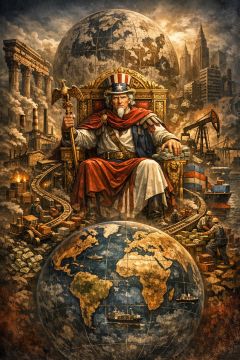
This has happened once before
Imagine Rome
during the time of Emperor Augustus. The center
is glittering, rich, and brimming with money.
Surrounded by provinces, each with its own
function: some feed the people, others supply
warriors, and still others mine gold. And all
this for the benefit of the center, not always
(never) of their own free will. |
|
 |
| |
|
Two thousand years have passed,
and now the imperial scheme is
beginning to appear on the map
again. Only now it's not about
swords and eagles, but about
investments, export quotas, and
factories under the tropical
sun.
|
|
|
| |
|
What are the US Building?
The US is building a super
empire without a flag—not
territorial, but continental,
not military, but economic. It
doesn't seize territory
—
it organizes its work, like the
director of a transnational
corporation.
▪ The US
is the brains and the wallet.
▪
Latin America is the hands and
the mines.
▪
The North is money and
investment (USA),
▪
The South is production, raw
materials, and the agricultural
sector (Latin America).
The goal? To create a turnkey
world alongside us, fully
integrated into the American
production chain. A sort of
"China of the Western
Hemisphere," only with the label
"Made for USA."
|
|
|
| |
|
How does it work?
America doesn't say, "Submit."
It says, "We will give you jobs,
money, and markets. But only by
our rules."
▪
Mexico is becoming a logistics
hub.
▪
Venezuela is a future oil lab.
▪
Argentina is an agricultural
belt.
▪
Bolivia and Chile are sources of
metals.
And all this is under the
American investment umbrella,
where profits soar and national
economies are turned into
outsourced markets. For Latin
America, this is partly an
economic opportunity, but also a
trap: a chance for
industrialization and economic
growth, but the trap is that the
rules will be foreign, not
theirs. This means it's a
classic colony, which the new
comprachicos will mold to suit
their own purposes. Some former
colonies, after liberation, were
never able to become
full-fledged state organisms.
|
|
|
| |
|
How does this differ from
globalism?
Globalism is when everyone is
with everyone else. Goods flow
around the world, money does
too, and the rules are dictated
by international institutions:
the WTO, the IMF, the G7, and
others.
Continental neo-globalism (the
new model) is when each
continent is on its own, but
each has its own "master."
America has its own. China has
its own. Eurasia—it depends. The
WTO is losing influence, being
replaced by bilateral deals.
Import tariffs become a lever of
pressure. The US is luring
production away from Europe.
China is being forced out of
Latin America.
Globalists dreamed of a world
without centers of power, only
connections. The new model says,
"There will be a center.
Connections will only be with
those who benefit us."
What do globalists think about
this?
They're horrified. Because
everything they built—free
markets, open borders,
"win-win"—is becoming a thing of
the past. Globalists used to
play Monopoly, where everyone
moved on the same board. Now the
table is turned over, the board
is divided into continents, and
the rules are written on each
piece by a different predator.
And the globalist with his dice
stands aside. Out of it. The new
world is a cave of tribes, where
everyone lives on their own
continent, and each role is
strictly defined: you're a mine,
you're a plantation, you're an
assembly line. And all this
without their participation.
They have no place to fit their
international schemes. Their
"sandbox" is being torn down,
and a new one is being built—to
accommodate new American
players.
|
|
|
| |
|
Who is behind this
transformation? Who is behind
Trump?
Trump and his supporters
aren't romantics or old-school
geopoliticians, but rather:
business technocrats,
established industries tired of
their dependence on
China, new billionaires
investing in real production,
and a section of the Pentagon
fed up with everything the
military needs being produced in
Shenzhen.
These aren't globalists sipping
coffee in Davos. These are
American pragmatists who say,
"Screw the rules. We need things
to work for us, not for some
'global partners.'"
What does this mean for others?
For
China,
India, and
Russia this is bad news.
They will have to fight for
their pieces of production and
logistics, protect their
national specialties, and
urgently build their continental
connections before they are cut
off from markets. For Europe,
the news is also so-so...
Who is
Europe in the new model?
Not a leader. Not a pivot. Not a
driver. It is:
▪
a former industrial giant whose
factory has left and gas prices
have risen,
▪
a regulator without control over
supply chains,
▪
a diplomat without armies or
teeth,
▪
rich but not an investor,
▪
a sales market but not a
production site,
▪
a habitual globalist surrounded
by continentalists.
What is Europe losing?
▪
Access to cheap energy – after
the break with Russia and
problems in the Middle East;
▪
Manufacturing – already migrating
to the US for benefits and
protections (see the Inflation
Reduction Act);
▪
Influence on the rules of the
game;
▪
Strategic autonomy — their own
armies? No. Strategic resources?
Europe has almost none.
What's left for Europe to do?
Be
the world's environmental
regulator—prohibit, measure, and
index everything. Remain a soft
power—culture, education,
tourism. Become a buffer zone
between empires. Cherish the
illusion of globalism, while the
US and China are busy assembling
continental worlds.
Possible scenarios:
If
Europe doesn't change its model:
→
Its investments will flow to the
US or Latin America;
→
Its exports will lose
competitiveness;
→
Its role in international
transactions will diminish;
→
Its technologies will be bought
out, as has already happened.
|
|
|
| |
|
7 Key Risks for the US
in the New Model of "Continental
Neo-Globalism"
①
Empire Management Overload
The US wants to simultaneously:
manage its domestic market
(which is bursting with
inequality), coordinate the
industrial renaissance in Latin
America, contain China, weaken
Russia, and maintain a balance
in the Middle East.
→
Risk: systemic fatigue and
strategic dissipation. Rome,
too, tried to control
everything—and overextended
itself.
②
Domestic Political
Instability
America is no longer a monolith:
a split between "Trumpists"
and "globalists," racial and
social conflicts, a crisis of
trust in institutions, a
possible "Democratic revenge,"
and electoral swings.
→
Risk: a change in course that
would derail plans for the "new
industrialization of the
continent" and frighten
investors.
③
Latin America May Not
Surrender
Yes, the US has leverage, but:
local elites may play their own
game,
the people may resist the new
"workers' ration,"
China won't simply leave: it has
already integrated itself into
the region's economy.
→
Risk: latent instability,
unrest, the pendulum of leftist
regimes. Latin America is not
sleeping. Everything is alive
there.
④
Lack of Real Resources
To
build a new industry, we need:
rare earth metals, abundant
cheap energy, stable logistics,
and qualified personnel.
→
Risk: There won't be enough of
everything. China still controls
key materials and supply chains.
The US could hit a "resource
ceiling."
⑤
Conflict with Global
Corporations
The new model undermines the
interests of those who built
supply chains in China, India,
and Europe.
→
Risk: Corporations will be
reluctant to "return home," but
will instead lobby for their own
schemes or hinder reform from
within.
⑥
Global Coalition Against the
"Neo-Empire"
If
the US stops playing by
international rules, the
following could happen: the
formation of alternative
blocs—India + China + Russia +
part of Africa; regional
currency zones; new investment
alliances without US
participation.
→
Risk: Long-term strategic
isolation.
⑦
The Moral Degradation of
Empire
If
profit and force are the only
considerations, then: the trust
of allies disappears, soft power
fades, and the US becomes simply
a "rich and tough guy" rather
than a country worth clinging
to.
→
Risk: loss of moral leadership
and cultural magnetism. Without
these, even empires are boring.
|
|
|
| |
The
end?
The world is
turning into a mosaic of flagless empires, where
some have money and votes, others have jobs and
silence. This is not the end of the world. It's
a new game on the global chessboard, and the US
has moved first. And not with a pawn, but with
the dollar.
|
|
 |
| |
|
How to use this information
|
|
|
|
|