| |
|
The Future of Microsoft AI
models
7-point Summary
|
|
|
| |
|
Proactive Futuring
Here’s a concise 7‑point summary
of the announcement made by
Satya Nadella, Chairman and CEO
at Microsoft in July 2026
|
|
|
| |
|
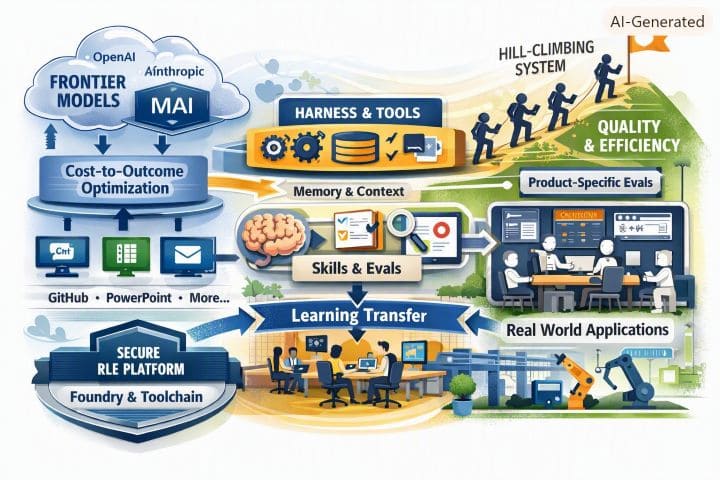
①
Frontier Cost Revolution
Software now has real marginal
cost, changing how innovation
scales. The challenge is to
diffuse frontier benefits across
the ecosystem efficiently. This
shift demands optimizing the
cost‑to‑outcome frontier in
real-world contexts.
|
|
|
| |
|
②
Task‑Specific Optimization
Success depends on using the
right model for each task. The
MAI model family embodies this
principle by aligning context,
skills, tools, and agent
harnesses. It ensures that every
model operates where it delivers
the best performance-to-cost
ratio.
|
|
|
| |
|
③
Learning Transfer Architecture
MAI models are built with clean
data lineage and designed for
learning transfer. They move
knowledge from generalist to
specialized enterprise skills.
This architecture accelerates
adaptation and improves
efficiency across real‑life
environments.
|
|
|
| |
|
④
Hill‑Climbing System
The system continuously improves
through "hill‑climbing" evals
that measure real outcomes. Even
if a model is removed, the evals
keep progressing, ensuring
independence and resilience.
This creates a self‑optimizing
loop that rewards models for
completing customer-valued
tasks.
|
|
|
| |
|
⑤
Product Integration and Routing
Frontier models from OpenAI and Anthropic work alongside
MAI within Microsoft products. Traffic is routed
dynamically to whichever model performs best for a given
use case. This hybrid orchestration delivers frontier
capabilities at scale and lower cost.
|
|
|
| |
|
⑥
Enterprise Real‑World Learning Environments (RLEs)
RLEs train models within actual product systems, using
real interactions and outcomes. They externalize
harness, memory, and context to maintain control and
flexibility. This approach allows enterprises to
replicate Microsoft's success in their own agentic
systems.
|
|
|
| |
|
⑦
Foundry and Toolchain Enablement
All these innovations are being made accessible through
Foundry and its supporting toolchain. Enterprises can
use them to build proprietary evals, workflows, and RLEs.
The result is a scalable template for AI-native, SaaS,
and enterprise transformation worldwide.
|
|
|
|
|