| |
|
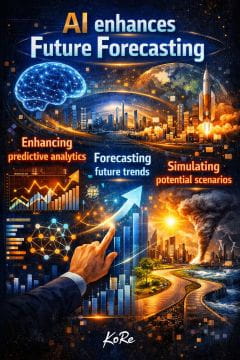
AI Enhances Future Forecasting
By
making AI-powered
futures thinking a habitual
part of your thought process in
your business you’ll be able to
anticipate the future and make
better and faster decisions as
you move towards it or create
it.
AI
enhances predictive analytics
and
predictive intelligence by
leveraging vast datasets to
identify patterns and forecast
outcomes with high accuracy.
|
|
 |
| |
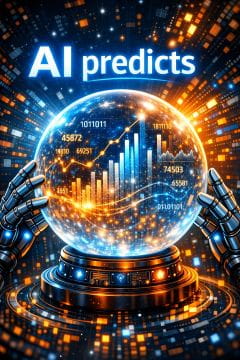
Predictive
Intelligence and Proactive Futuring
EduNext incorporates
predictive intelligence to
improve its strategic-innovation capabilities and
services. The core function
revolves around
AI-assisted strategic simulation that helps
makes better predictions. This allows member businesses and
organizations to anticipate future scenarios, make
proactive decisions design and implement
proactive-futuring initiatives. |
|
 |
 |
|
Simulating Multiple Potential Futures in Business
TurboQuant AI can predict demand for products. AI enhances scenario planning by generating a broader
range of future possibilities, improving data accuracy,
and enabling faster analysis. It moves beyond simple
forecasting to simulate multiple potential futures,
helping organizations anticipate risks and make
proactive decisions. By leveraging historical and
real-time data, AI identifies patterns and trends that
humans might miss, increasing strategic agility in
uncertain environments.
|
|
|
| |
|
World War IV anticipated: The
Coalition's
Strategic Plan
Rebrand the War:
Rename it something uplifting,
like Operation Dawn Harmony,
Project Evergreen, or The Really
Final War, We Promise. Hire
poets if necessary...
More
|
|
|
|
 |
| |
|
AI-powered predictive analytics utilizes machine
learning, deep learning, and neural networks to analyze
massive historical and real-time datasets, forecasting
future trends, behaviors, and events with high
precision. It outperforms traditional statistical
methods by rapidly identifying intricate patterns to
drive proactive, data-driven decisions.
|
|
|
| |
|
While AI excels at data-driven forecasting, human
expertise is still crucial for interpreting the
narratives and, in some cases, the "storytelling" aspect
of these projections.
|
|
|
| |
|
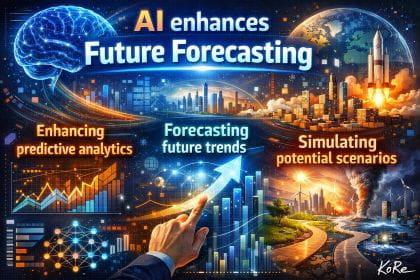
Key Benefits of AI in scenario planning include:
|
|
|
 |
|
Rapid Simulation: AI can analyze thousands of variables
and simulate diverse, complex scenarios in minutes
rather than weeks.
Improved Accuracy: Predictive models reduce forecasting
errors by 20–50% by identifying hidden patterns in
historical data. |
|
| |
|
Real-Time Adaptability: Systems update continuously,
allowing businesses to adapt to changing market
conditions instantly.
Wider Exploration: AI, especially agentic AI, helps
explore unlikely "edge case" scenarios to build greater
resilience.
|
|
|
| |
|
AI-driven forecasting is applied across various domains:
Supply Chain: Predicting disruptions and optimizing
logistics.
Finance: Stress-testing portfolios and projecting
earnings.
Human Resources: Forecasting staffing needs and employee
turnover.
Sales: Forecasting demand and competition.
|
|
|
| |
|
Predictive Analytics
AI enhances predictive analytics by leveraging vast
datasets to identify patterns and forecast outcomes with
high accuracy. While generative AI requires large,
diverse data inputs, predictive AI can function
effectively with smaller, targeted datasets, enabling
precise business insights and strategic decision-making.
This transformation improves forecasting reliability
across various industries.
AI-powered predictive analytics utilizes machine
learning, deep learning, and neural networks to analyze
massive historical and real-time datasets, forecasting
future trends, behaviors, and events with high
precision. It outperforms traditional statistical
methods by rapidly identifying intricate patterns to
drive proactive, data-driven decisions.
|
|
|
| |
|
Key Aspects of
AI in Predictive Analytics
Enhanced Capabilities: AI incorporates deep learning and
neural networks to analyze complex data sets that exceed
the capacity of traditional statistics.
Speed and Scale: AI models can analyze millions of data
points in minutes, allowing for rapid generation of
insights.
Proactive Decision-Making: Organizations use these
insights for forecasting sales, optimizing logistics,
detecting fraud, and improving customer experiences.
Key Techniques: Key technologies include machine
learning for finding data patterns and deep learning for
processing diverse data types.
Convergence with Generative AI: While Predictive AI
focuses on forecasting, GenAI is now used to supplement
this by simulating data scenarios and creating synthetic
data for training.
|
|
|
| |
|
Use Cases by Industry
Finance & Healthcare: Predicting market trends,
optimizing portfolios, modeling disease progression, and
personalizing treatment plans.
Marketing & Retail: Forecasting demand, managing
inventory, and predicting customer churn.
Operations & Logistics:
Optimizing supply chains and
conducting predictive maintenance on machinery.
|
|
|
| |
|
Challenges
Despite its advantages, effective implementation
requires addressing data quality, ensuring model
interpretability, and managing privacy concerns.
→
How To Address Challenges
→
KoRe 6Ws Hints
|
|
|
|
|