 |
|
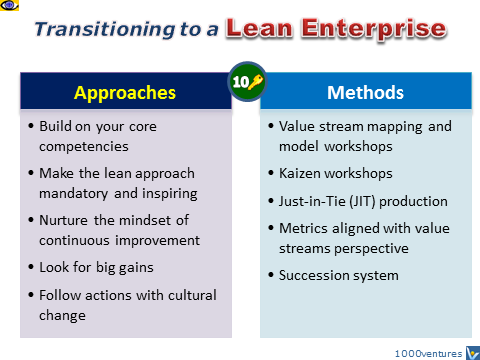
Lean is about doing more with
less: less time, inventory, space, labor, and money.
Lean manufacturing is about commitment to eliminating waste, simplifying procedures and
speeding up production.
The idea is to pull inventory through based on
customer demand. |
|
| |
|
Employee Involvement and
Empowerment – organizing
workers by forming teams and
giving them training and
responsibility to do many
specialized tasks, for
housekeeping, quality
inspection, minor equipment
repair and rework; allowing also
them time to meet to discuss
problems and find ways to
improve the process.
|
|
|
| |
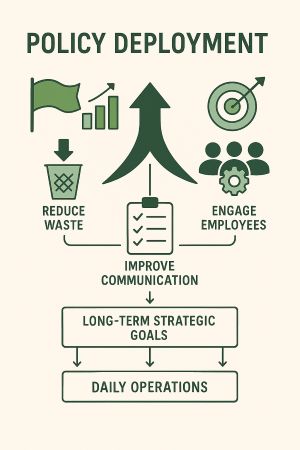
Policy
Deployment
Policy deployment,
also known as Hoshin Kanri, is a structured Lean management system that aligns an
organization's long-term strategic goals with
daily operations...
More
Quality at the
Source
– total quality
management (TQM)
and control; assigning workers, not inspectors,
the responsibility to discover a defect and to
immediately fix it; if the defect cannot be
readily fixed, any worker can halt the entire
line by pulling a cord (called jidoka).
Small-Lot
Production
– allowing higher
flexibility and pull production (or just-in-time
(JIT) manufacturing)
|
|
 |
| |
|
Pull Production, or
Just-In-Time (JIT)
– the method wherein the
quantity of work performed at
each stage of the process is
dictated solely by the demand
for materials from the immediate
next stage; thus reducing waste
and lead times, and eliminating
inventory holding cost.
|
|
|
| |
|
Reduced Setup Cost and Times
(for semi-versatile machinery
such as big stamping presses) –
from months to hours thus making
small-lot production
economically viable; achieved by
organizing procedures, using
carts, and training workers to
do their own setups,
|
|
|
| |
|
Continuous Equipment
Maintenance – as pull
production reduces inventories,
equipment breakdowns must also
be reduced; thus empowered
operators are assigned primary
responsibility for basic
maintenance since they are in
the best position do detect
signs of malfunction.
|
|
|
| |
|
Multi- Skilled Workforce
– as employees are empowered to
do many jobs, they must be
provided with adequate training
|
|
|
| |
|
Supplier Involvement –
the manufacturer treats its
supplier as a long-term
partners; they often must be
trained in ways to reduce setup
times, inventories, defects,
machine breakdowns, etc. in
order to enable them to take
responsibility for delivering
the best possible parts/services
to the manufacturer in a timely
manner.
|
|
|
|
|
|