| |
Test Marketing is an entrepreneurial
method that helps validate new ideas, products,
or services by evaluating market response on a
smaller scale before full-scale launch.
Benefits of
Test Marketing
Test Marketing
reduces risk, identifies flaws, and provides
insights into customer preferences, pricing, and
positioning. This process helps refine the
offering and marketing strategy, increasing the
likelihood of successful market entry.
Early feedback
enables iterative improvements, saving time and
resources compared to a direct large-scale
rollout. |
|
 |
 |
|
Test Marketing acts as
insightful field testing of new ideas, products, services, and
inventions, allowing organizations to gather and learn from
real-world data and consumer feedback before committing to a costly,
full-scale launch. |
|
| |
|
Preventing Costly Failures
Most products that skip market
testing fail, compared to a much
higher success rate for those
that are tested.
|
|
|
| |
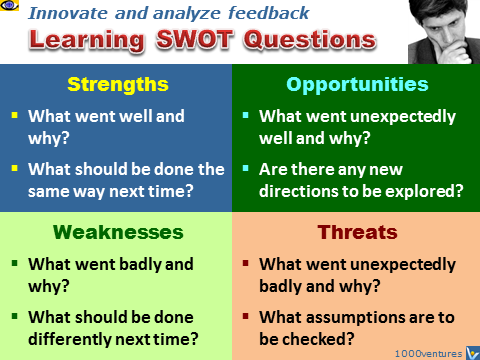
"As
a
pioneer and stepping into the unknown,
answer these
learning SWOT questions: What went
better than expected? What went worse than
expected? What new opportunities opened up? What
new risks emerged? Adapt your strategy to the
new realities and take the next step."
~
Vadim Kotelnikov |
|
 |
 |
|
This strategic,
small-scale release mitigates risks, reduces the likelihood of
failure, and provides a higher return on investment (ROI) by
enabling necessary refinements based on actual consumer behavior
rather than assumptions.
|
|
| |
|
The
Value of
Test
Marketing
The value of test marketing can
be broken down into several key
areas that include Risk
Mitigation and Cost Savings,
Limiting Financial Exposure, and
Validating Market Demand and
Consumer Behavior.
|
|
|
| |
|
Limiting Financial Exposure:
Test marketing is less expensive
than a full-scale rollout,
allowing firms to limit losses
if a product is not
well-received.
Identifying Technical Flaws:
Test marketing helps identify
technical, functional, or
usability issues – such as
software bugs or design flaws –
that
laboratory testing and
beta-testing might miss.
|
|
|
| |
|
Validating Market Demand
and
Consumer Behavior
|
|
|
|
|
|
Gathering Real-World Data: Test marketing
exposes products to genuine market dynamics,
providing accurate insights into consumer
preferences, purchasing behavior, and pain
points.
Forecasting Sales: By observing sales
performance in a limited region, companies can
create more accurate sales projections for
broader, national launches.
Understanding Adoption Rates: Tests help
determine if a product will be repurchased, how
often it will be purchased, and if it resonates
with the target demographic.
Common Types
of
Test Marketing
Standard Test
Markets: Launching in a few representative
cities or regions to mimic a full launch.
Controlled Test
Markets: Working with specific retailers who
agree to stock the product in a limited number
of stores.
Simulated Test
Markets (STM): Using entrepreneurial
simulation games like
InnoBall as well as artificial or virtual
shopping environments, which are faster and
cheaper than real-world tests.
Beta/Alpha
Testing: Common in software and technology,
where early versions are released to a select
user group.
|
|
| |
|
Informing Product Development
and
Strategy
|
|
|
| |
Refining the
Offering: Gain market feedback to improve
product features, packaging, and quality before
the final launch.
Optimizing
Marketing Mix: Test different price points,
advertising messages, and promotional strategies
to identify the most effective, high-ROI
approaches.
|
|
 |
| |
|
Testing Distribution Channels:
Test marketing provides a venue
to test retail partnerships,
logistics, and shelf placement
to optimize the supply chain.
|
|
|
| |
|
Competitive Advantage
and
Strategic Positioning
|
|
|
| |
Understanding the Landscape: Gain
insights into how competitors might react and
allows companies to adjust their positioning to
stand out.
Building
Initial Buzz: Limited releases can generate
early excitement and word-of-mouth for a product
before it is widely available. |
|
 |
| |
|
Disadvantages and
Considerations
|
|
|
|
|