| |
A visual
metaphor is a metaphor the medium of which
is visual.
Visual metaphors
inspire 'Aha!' moments by creating instant,
powerful associations.
Like in any other
metaphor, one part of it, usually named
"source", applies to another part, usually named
"target", and reconstructs it. |
|
 |
 |
|
Main Areas of Application
Used heavily in
communication,
education, presentations, promotion,
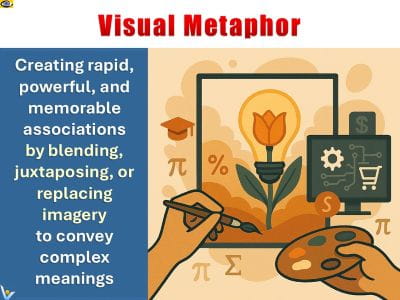
advertising, film, and art, visual metaphors
create
mind-opening, powerful, and memorable
associations by blending, juxtaposing, or
replacing imagery to convey complex meanings
almost instantly. |
|
|
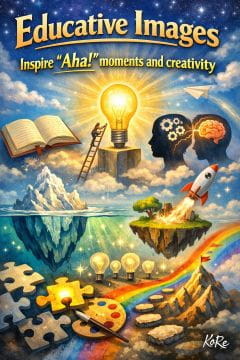
Educative Images that
inspire 'Aha!' moments and creativity |
| |
|
Example
of
KoRe Metaphorical Images
|
|
|
| |
Tree Model
Metaphoric Tree models facilitate holistic
roots-to-fruits thinking and inspire
harmonious-growth strategies. |
|
 |
 |
|
10 KITT
The
metaphorical
KoRe 10 Innovative Thinking Tools
(10 KITT) help to generate ideas and
communicate them to the target audience
more quickly and effectively.
|
|
| |
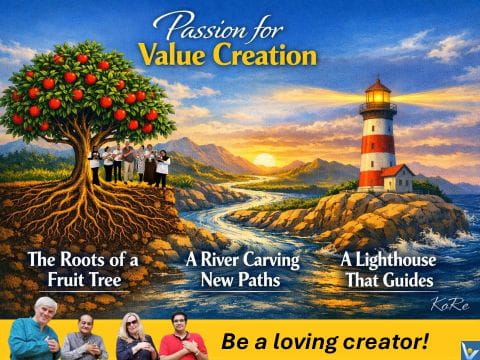
Passion for Value
Creation
Roots nourish growth and stability under the
fruit tree.
Innovation flows by carving new paths beneath
the river.
Guidance illuminates purpose and direction below
the lighthouse. |
|
 |
 |
|
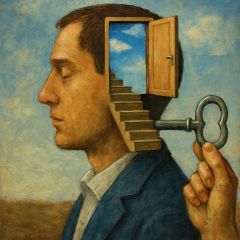
This AImage illustrates the
concept of Thinking Higher.
The
KoRe prompt was: Please
create a metaphorical image that
illustrates this message:
When you turn off your mental
autopilot and ask
open-ended questions, you
can find a transition to a
higher level.
|
|
| |
This
AImage is a visual metaphor showing how
digital skills and mathematical thinking are
rising in importance across tech, marketplaces
and
fintech, while traditional degrees and
soft skills fade into the background |
|
 |
| |
|
Benefits
of Visual
Metaphors
|
|
|
 |
|
Mind-Opening Images:
Metaphors serve as powerful catalysts for
creativity and discovery by stimulating
imagination, and encouraging
open-minded thinking.
Images that inspire 'Aha!' moments often
depict sudden insights, such as
lightbulb moments or visual
metaphors for breakthrough thinking. |
|
| |
Rapid Learning:
Educative images that
inspire 'Aha!' moments and
creativity are visual metaphors
or illustrations designed to
trigger sudden understanding or
insight.
Conciseness: They convey
complex messages quickly, often
more effectively than words.
Emotional Impact: Visual
metaphors tap into
subconscious associations
and emotions, making them more
engaging and memorable.
Narrative Depth: Visual
metaphors create ‘Aha!’ effect
and help establish themes,
characters, and, mood,
|
|
 |
| |
|
Key Techniques
for Visual
Metaphors
|
|
|
| |
|
Fusion
(Hybrid/Synthesis): Two or more
elements are blended into a
single impactful object.
Replacement: One object
is completely replaced by
another to draw attention and
communicate a message.
Juxtaposition: Two
distinct elements are placed
together to create an
eye-opening comparison.
|
|
 |
 |
|
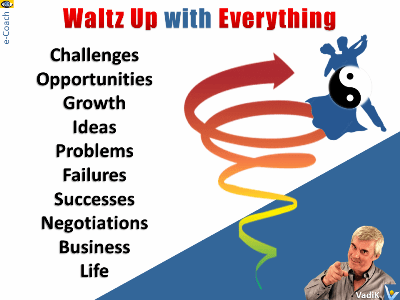
Waltzing Up
"Waltz up" means to approach and/or arrive
in an iterative and elegant manner.
The term uses the grace and flair of the
waltz
dance as a metaphor to describe the act
of
addressing challenges in a creative and
positive way...
More |
|
| |
|
Below are some
Strong Visual Metaphors
that reliably communicate an “Aha!”
moment – whether you’re designing a slide,
poster, app UI, or marketing graphic.
|
|
|
| |
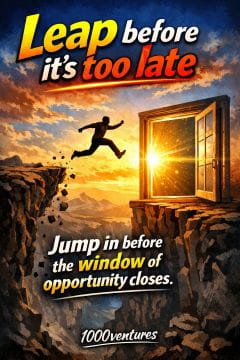
Jumping over an abyss
Jumping
over an abyss is a powerful metaphor for
taking a massive, risky leap of faith,
embracing uncertainty, or transitioning
through a profound life or business
change. The act of jumping implies a
passage from one state of being to
another. It represents overcoming fear
to achieve a goal, leaving behind safety
for personal growth, or navigating a
dangerous, transformative "in-between"
state. It symbolizes the necessity,
often frightening, leap into the unknown
when facing a major personal change,
career move, unknown opportunity, or
fuzzy-front-end of a
radical innovation project.
|
|
 |
 |
|
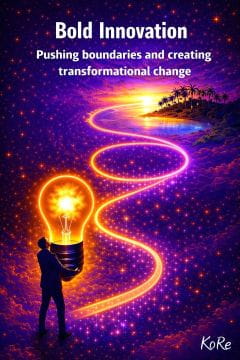
Lightbulb / spark of insight
Classic: glowing lightbulb turning on
Modern twist: a beam of light hitting a
“problem spot”
Visual cue: sudden illumination +
contrast (dark → bright)
“Before vs After” transformation
Split image: left side
confusion/dimness, right side
clarity/brightness
Can also be “then → now” timeline
visuals
Visual cue: one side neutral, the other
confidently resolved |
|
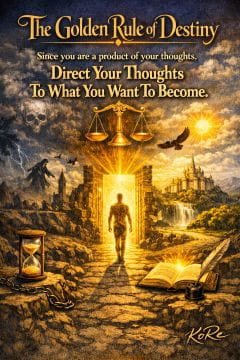
3) Maze / path suddenly illuminated
Someone at the center of a maze where
the correct route lights up
Or: a map where a route is traced only
after the “reveal”
Visual cue: previously blocked paths
become clear
4) Hidden image “revealing” itself
A silhouette or shape that gradually
forms (e.g., before/after reveal)
Examples: scratch-off effect, fade-in,
dotted-to-solid transformation
Visual cue: mystery gradually resolves
into recognizable meaning
6) Cracking a code / unlocking
A padlock opening, a key turning, or
code lines aligning into readable text
Or: a “code” breaking open to reveal a
simple diagram/answer
Visual cue: obstruction → access
7) Water ripples / concentric rings of
realization
A person looks at a screen and a ripple
propagates outward
Could symbolize a new idea spreading
through the brain/team
Visual cue: calm moment followed by
expanding signal
8) Brain imagery + “neural connection”
moment
Subtle brain silhouette where lines
“light up” connecting concepts
Or: nodes that activate in a satisfying
sequence
Visual cue: connections forming quickly
and coherently
9) Magnifying glass / lens focusing
Something blurry becomes sharp when “the
lens” snaps into focus
Visual cue: clarity improvement (blur →
crisp)
10) Falling dominoes / chain reaction
The moment the “trigger” falls and
everything lines up
Great for showing cause → effect
Visual cue: structured progression
ending in resolution
|
|