| |
Circular Innovation
Circular
innovation is the development of products,
services, and business models that eliminate
waste and keep materials in use. |
|
 |
 |
Let's take
care of our Mother Earth
– there are millions of ways to
tell all people and our Planet,
'I
love you!'
~
Vadim
Kotelnikov |
|
Circular innovations lead the
transition from a linear
"take-make-dispose" system to a
regenerative, closed-loop
economy. It focuses on design
longevity, resource efficiency,
and sustainability, transforming
waste into raw materials. |
|
| |
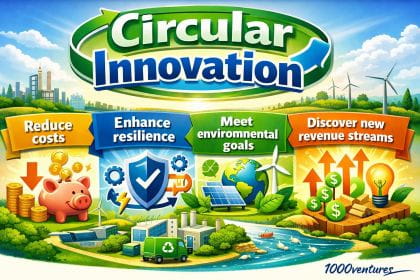
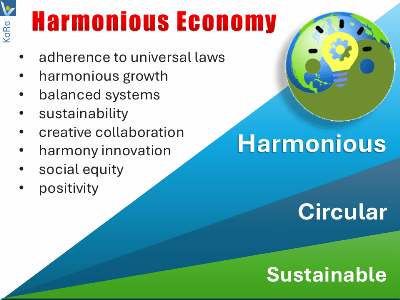
Circular Innovation drives sustainable
growth by transforming waste into value through reusable designs,
resource-efficient processes, and data-powered strategies. It
enables businesses to reduce costs, enhance resilience, and meet
environmental goals while unlocking new revenue streams. |
|
 |
|
|
|
Key Components
of
Circular Innovation
Circular Design Strategies:
Focusing on designing products for durability,
repairability, modularity, and easy recycling.
Prioritizing resource allocation and risk
assessment to maintain momentum and
adaptability.
Enhanced Innovation Project
Preparation: Harmonizing creativity and
constraints; playing simulation games like
InnoBall (Innovation Brainball); using
iterative prototyping and feedback loops to
refine ideas before full-scale execution.
Business Model Transformation:
Shifting toward Product-as-a-Service (PaaS),
sharing platforms, and renting rather than
owning, enabling businesses to retain ownership
and manage product lifecycles.
Digitalization and Technology:
Leveraging digital tools like Virtual Twins,
Artificial Intelligence (AI),
and blockchain for tracking resources,
optimizing logistics, and improving industrial
symbiosis.
AI-powered Forecasting: More effective
forecasting of changes in technologies and
ecosystems...
More
Material Recovery: Implementing
technologies that turn waste into new, valuable
inputs, particularly for materials like plastics
and metals.
|
|
| |
|
Key
Principles of a
Circular Economy
|
|
|
| |
Waste Elimination:
Treating waste as a design flaw,
aiming to prevent it rather than
manage it.
Resource Regeneration:
Using renewable resources and
keeping materials circulating in
biological or technical cycles.
Lower Environmental Impact:
Reducing global emissions
generated by how products are
made and used.
|
|
 |
| |
|
Examples of a
Circular Innovation
|
|
|
 |
|
Industrial
Equipment: Designing machines that are
easier to repair and refurbish.
Textiles:
Turning old garments back into yarn for new
clothes. For example, Adidas uses a "three-loop
strategy" to create products that can be
returned and remade into new items.
Construction:
Reusing building materials from demolition
projects. For example, Gamle Mursten cleans and
reuses old bricks.
Technology:
Using sensors in elevators and lighting for
maintenance-as-a-service. For example,
Dell utilizes recycled plastics and carbon
fiber in their laptops, ensuring components are
recovered at end-of-life. |
|
| |
|
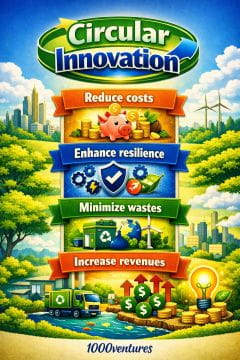
Waste Reduction
Reducing waste effectively
involves following the "5 R's":
Refuse what you don't need,
Reduce consumption, Reuse items,
Repair broken items, and Recycle
what remains.
|
|
|
| |
|
Reducing waste begins with
refusing single-use items,
cutting back on fast fashion,
and choosing sustainable
products. Prioritizing reuse
over disposal, recycling
properly, and composting organic
matter significantly lowers
landfill contributions.
These actions conserve
resources, reduce pollution, and
lower carbon emissions. Adopting
a mindful consumption habit –
buying less, choosing durable
goods, and supporting
eco-friendly brands—amplifies
impact. Small daily changes
collectively drive systemic
environmental benefits.
|
|
|
| |
|
Green Warming
Global warming does not directly
facilitate the transition to a
circular economy, but its urgent
impacts create strong incentives
for such a shift.
Climate goals act as a catalyst
for new regulatory frameworks
and carbon-pricing mechanisms
that penalize waste and reward
circular innovation...
More
|
|
|
|
|
