| |
|
How To Launch
a Successful Transformation
KoRe 3W Approach
Why, Where, and Who
of business transformation
A coaching article for leaders,
innovators, and courageous teams
by
Vadim Kotelnikov |
|
 |
  
  
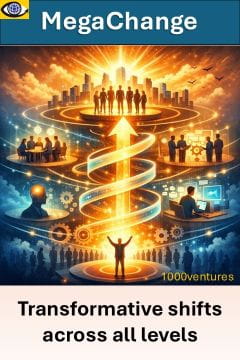
Summary — “A great shift begins with a great Why.”
Transformation succeeds when people feel why it matters and how they
can win.
A powerful shared vision ignites motivation; a smart strategic
design turns aspiration into action; and a disciplined rhythm of
small steps, learning, and celebration builds unstoppable momentum.
Transformation is not a miracle – it is a craft. It is the art of
turning dissatisfaction into creative energy, uncertainty into
strategic play, and first steps into a movement.
1. “A dream too small cannot lift a company.”
From Rags To Riches – before it’s too late!
Every successful transformation begins with a shared vision bold
enough to inspire, clear enough to align, and urgent enough to
mobilize. People don’t follow instructions — they follow meaning.
When the future feels exciting and personal, teams rise above
routine and rediscover their creative fire.
Three forces shape this ignition:
Inspiring Shared Vision – a picture of the future that makes people
proud to contribute.
Strategic Motivation — a compelling reason to act now, not later.
Culture of Creative Dissatisfaction — the belief that “good enough”
is never enough when greatness is possible.
Creative dissatisfaction is not frustration — it is fuel. It is the
inner refusal to stagnate. It is the spark that turns ordinary teams
into pioneers.
2. “Victory belongs to those who prepare before the battle begins.”
Prepare To Win
Transformation is not improvisation. It is strategic design — the
deliberate crafting of a winning future.
A strong preparation phase includes:
Winning Strategic Design — a blueprint that clarifies where to play,
how to win, and how to evolve.
Creative Destruction — courage to dismantle outdated processes,
beliefs, and structures.
Uniting People Around One Goal — alignment is not a slogan; it is a
strategic asset.
Productive Creativity — turning imagination into implementable
solutions.
How Challenge-Based Innompic Games Accelerate Transformation
The Innompic Games are a powerful catalyst for strategic alignment
and breakthrough thinking.
They help teams:
Invent a winning business design through challenge-based creativity.
Strengthen strategic alignment by co-creating solutions under time
pressure.
Unite creative intrapreneurs who learn to trust, collaborate, and
innovate together.
The Games transform innovation from a theory into a lived experience
— energetic, playful, and deeply strategic.
How InnoBall (Innovation Brainball) Builds Implementation Mastery
Even the best strategy fails without strong execution.
InnoBall, the entrepreneurial simulation game, helps teams:
Design smarter implementation strategies by anticipating obstacles
and opportunities.
Develop execution skills such as prioritization, adaptability, and
resourcefulness.
Strengthen team coordination through scenario-based decision-making.
InnoBall turns implementation into a strategic sport — one that
builds confidence, foresight, and collective intelligence.
3. “A small step can awaken a giant.”
Start Small, But Think Big
Transformation begins the moment you take the first step — the step
that breaks the inertia of rest and creates the inertia of motion.
Small steps compound. They build momentum, confidence, and clarity.
To sustain progress:
Ask learning SWOT questions after every step
What worked?
What didn’t?
What strengths emerged?
What opportunities appeared?
What must we adapt next?
This rhythm of reflection turns every action into intelligence and
every mistake into mastery.
Celebrate intermediate victories
Celebration is not decoration — it is fuel.
It keeps enthusiasm high, reinforces progress, and reminds people
that transformation is working.
A team that celebrates together stays courageous together.
Empowering Takeaways — “The wise leader shapes tomorrow before
tomorrow arrives.”
Build a shared vision that inspires action and awakens creative
dissatisfaction.
Design to win: use strategic games like Innompic Games and InnoBall
to align minds and sharpen execution.
Start small, learn fast, adapt boldly, and celebrate every
meaningful victory.
*** 6Ws of Big Change ***
The 6Ws of big change—Who, What, When, Where, Why, and How—provide a
structured framework to clarify and communicate significant
organizational transformations. By answering these questions,
leaders can ensure alignment, transparency, and stakeholder
engagement. This approach simplifies complex change initiatives,
making them more manageable and understandable across all levels of
an organization. It supports strategic clarity and effective
execution, particularly when integrating with models like the
Balanced Scorecard (Financial, Customer, Process, Growth) to ensure
holistic impact.
The 6 W's of big change provide a foundational framework for
initiating and managing organizational transformations, ensuring
that all aspects of a project are addressed to drive successful
adoption.
This framework ensures shared context, reducing resistance by
answering the following key questions:
Why (The Purpose): Define the urgent need for change and the
benefits of transforming (the "why" behind the shift).
What (The Vision): Clearly define the desired future state, specific
objectives, and the scope of the change.
Who (The Stakeholders): Identify who is leading the change, who will
be impacted, and who needs to be involved or educated to create a
coalition of support.
When (The Timing): Create a timeline, identifying critical
milestones, checkpoints, and when the change will be implemented.
Where (The Scope/Structure): Identify where the change will take
place—whether it's specific departments, geographical locations, or
processes within the organization.
How (The Plan): Detail the methods, strategies, training, and
resources needed to transition from the current state to the future
state.
|
|