| |
|
Organizational MegaChange
Total Systemwide Cultural
Transformation of Your
Organization and its Workforce
Coaching
article by
Vadim Kotelnikov
*
* *
MegaChange is not a mere
transition, it is cultural
transformation of your
organization.
|
|
 |
| |
|
Organizational MegaChange refers
to total, system-wide cultural
transformation that affects
everyone, aiming to joint
optimization of organizational
performance and individual
satisfaction.
|
|
|
 |
|
MegaChange is not a theory or practice. It
is a synergy of both.
MegaChange is not piecemeal, it is systemwide.
It demands rapid, successful large-scale
adaptation, often requiring standardized
processes to ensure consistency and
effectiveness.
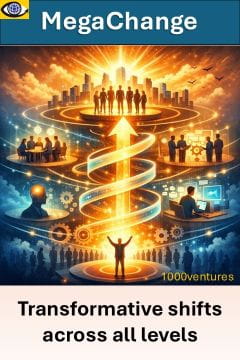
Organizational
MegaChange drives transformative shifts across
all levels, aligning individual and collective
ideation, performance, capability, and satisfaction.
MegaChange is not just about
restructuring – it's a cultural and operational evolution
that redefines how organizations thrive in dynamic
environments.
Proactive, holistic strategies
are critical in managing such change.
|
|

Organizations can prepare for rapid MegaChange through
several key strategies that build
resilience and adaptability into their core operations:
Develop change-ready leadership – Cultivate leaders at all
levels who can communicate vision clearly, make decisions
under ambiguity, and model adaptability. This includes
establishing a dedicated change leadership team to drive and
oversee transformation.
Build a continuous learning culture – Invest in upskilling
and reskilling programs so employees can adapt to new
processes, technologies, and roles quickly. Encourage
experimentation and treat failures as learning opportunities
rather than setbacks.
Strengthen communication infrastructure — Create
transparent, multi-directional communication channels that
keep everyone informed about why change is happening, what
it means for them, and how progress is tracking. Frequent,
honest updates reduce uncertainty and resistance.
Adopt agile and flexible structures – Move away from rigid
hierarchies toward flatter, cross-functional teams that can
pivot quickly. Implement iterative approaches (like Agile or
Scrum) that allow for continuous adjustment rather than
big-bang rollouts.
Invest in scalable technology systems – Ensure IT
infrastructure can handle rapid scaling, integration of new
tools, and data flow across departments. Cloud-based,
modular platforms are more adaptable than legacy systems.
Establish early warning and feedback mechanisms – Use data
analytics, pulse surveys, and pilot programs to detect
resistance points, capability gaps, or operational
bottlenecks early – before they become crises.
Create psychological safety – Build an environment where
employees feel safe to voice concerns, ask questions, and
suggest improvements without fear of repercussions. This
accelerates adoption and surfaces hidden issues.
Phase and prioritize — Break the MegaChange into manageable
waves, focusing on quick wins early to build momentum and
demonstrate value, while sequencing more complex changes
once the organization has adjusted.
|
|
Conceptualized by William E. Joyce
|
MegaChange is a total
systemwide
→
cultural
transformation of your organization. It means designing and
transforming organizations based on assumptions of human capability rather
than limitations using the tools of the modern
resource-based management
model.
|
Key Features of
MegaChange
Capability focused
MegaChange is
based upon assumptions of
→
human and
→
organizational capabilities
rather than limitations.
Concepts,
actions, and tools
MegaChange is produced using and integrated set of concepts,
actions, and tools, not just tools without concepts.
Empowering
MegaChange affects everyone in the organization. It results in a
joint optimization of organizational and
individual performance,
capability and satisfaction.
Cultural
MegaChange results in new and changed ways of
→
thinking,
acting, and cooperating.
Theory for
practice
MegaChange is not a theory or practice. It is a
→
synergy
of both.
Reformation
MegaChange is not about restructuring or reengineering, it is about
reformation. It reforms structural concepts, actions, and tools
necessary for creating organizations that achieve extraordinary
levels of productivity and satisfaction by engaging human capability
rather than denying it.
|
|
|