| |
|
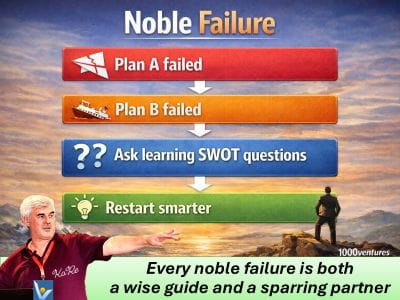
Noble failure is both a wise
guide and a sparring partner.
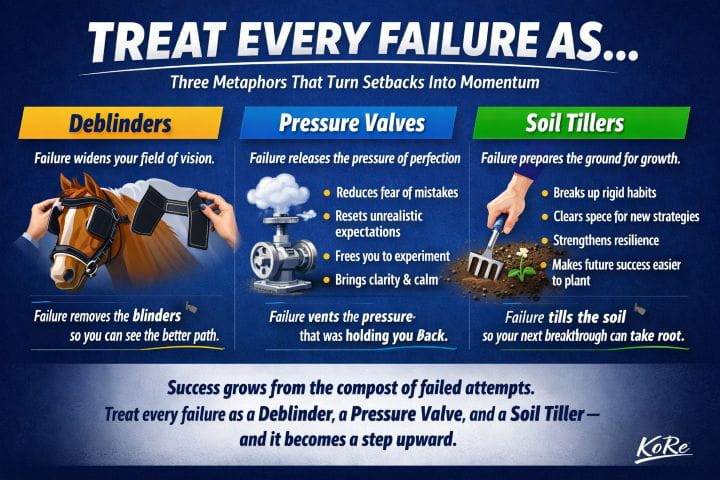
These three metaphors that can
help you turn setbacks to
momentum:
①
Deblinders;
②
Pressure Valves;
③
Soil
Tillers
|
|
 |
| |
|
Success grows from the compost
of failed attempts.
Fail forward! Treat every
failure as a deblinder, a
pressure valve, and a soil
tiller – and it becomes a
step upward.
|
|
|
| |
|
Failure is not a dead end. It’s a directional sign. A
mirror. A lever. A teacher disguised as a setback.
When
you treat failure as raw material rather than a verdict,
you transform it into momentum.
|
|
|
 |
|
KoRe Prayer of Gratitude for Difficulties
My
prayer of gratitude for difficulties helps me
find new strength and respond positively and
effectively to challenges, failures, and
rejection.
* * *
I’m grateful for failures; they expose my
blind spots and guide me toward a better path.
I’m
grateful for failures because they reveal where
I’m stuck and point me toward the right
way to things.
Failures
earn my gratitude
–
they show me what holds me back and illuminate
the path forward...
More |
|
| |
|
Three Metaphors
that Turn Setbacks into Momentum
Below are three metaphorical ways to reinterpret failure
so it becomes a stepping stone rather than a stumbling
block.
|
|
|
 |
|
①
Treat Failures as
Deblinders
Failures remove the narrow “forward-only” tunnel vision
that success often reinforces.
When everything goes well, we rarely question our
assumptions. But when something breaks, we’re forced to
look left, right, and behind – discovering options,
allies, and strategies we never noticed.
How this benefits you:
Reveals blind spots in your thinking
Helps you notice alternative paths to your goal
Encourages
creative problem‑solving instead of rigid
persistence
Failure expands your field of vision. |
|
| |
|
②
Treat Failures as
Pressure Valves
Core idea:
Failure releases the pressure of perfection.
Tagline: Failure vents the pressure that was holding you
back.
|
|
|
| |
|
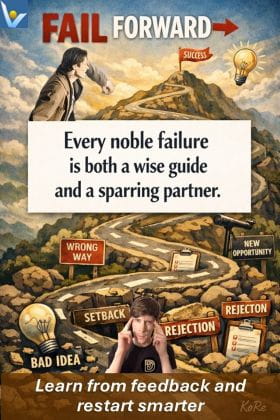
Treating failure as a pressure
valve:
→
Reduces fear of making mistakes
→
Resets unrealistic expectations
→
Frees you to experiment with less emotional weight
→
Brings clarity and calm for the next attempt
|
|
|
 |
|
Just like a pressure valve releases built‑up force to
prevent an explosion, failure releases the illusion that
you must get everything right on the first try.
It resets expectations, reduces perfectionism, and frees
you to experiment again – this time with less fear and
more clarity.
How this benefits you:
Reduces internal pressure and fear of mistakes
Helps you recalibrate unrealistic expectations
Creates emotional space to try again with a calmer mind
Failure doesn’t break you; it vents the pressure that
was holding you back. |
|
| |
|
③
Treat Failures as
Soil
Tillers
Core idea: Failure prepares the ground for growth.
Tagline: Failure tills
the soil so your next
breakthrough can take root.
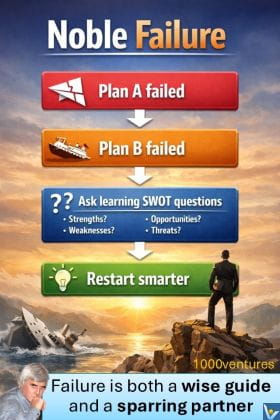
A tiller breaks the ground so new seeds can take root.
|
|
|
 |
|
Failure does the
same: it disrupts old habits, loosens outdated
beliefs, and prepares you for growth that wasn’t
possible in "hard soil."
Breaks up old habits and rigid patterns
Clears space for new skills and strategies
Strengthens
resilience and adaptability
Makes future success easier to plant and grow
How this benefits you:
Clears out ineffective routines
Makes room for new skills and strategies
Strengthens resilience and adaptability
Failure prepares the ground for your next breakthrough.
|
|
| |
|
Closing Thought
Don't talk about problems, talk about
opportunities.
Success is built on the compost of failed attempts.
When you treat every failure as a deblinder, a pressure
valve, and a soil tiller, you stop fearing it – and start
using it.
|
|
|
| |
|
Takeaways
When
you treat failure as raw material rather than a verdict,
you transform it into momentum.
When you treat every failure as a deblinder, a pressure
valve, and a soil tiller, you stop fearing it – and start
using it.
Treating failures as a pressure
valve
reduces fear of mistakes; resets unrealistic expectations;
frees you to experiment; brings clarity and calm.
Treating failures as a soil
tiller
breaks up rigid habits; clears space for new strategies;
strengthens resilience; makes future success easier to plant.
|
|
|
|
|