 |
|
EduNext
EduNext is a
global oasis of educational innovation. It is a
groundbreaking international
growth ecosystem focused on the innovative
creation of cutting-edge forms of training for
leaders of progress and accelerated development
of disruptive startups. |
|
| |
EduNext sets new
trends and lead this process by example to help
ecosystem participants create breakthrough
innovations and new markets for them. These
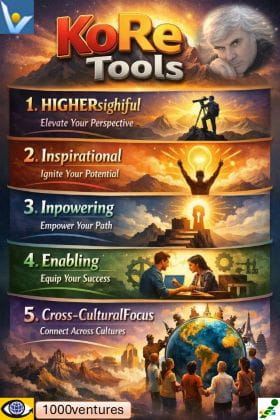
processes are enabled and powered by KoRe Tools,
super-gamification, and
founder networks. |
|
 |
Here is a brief description of EduNext and its core
components.
EduNext is a global oasis of educational innovation. It
is a groundbreaking international
growth ecosystem focused on the innovative creation
of cutting-edge forms of training for leaders of
progress and accelerated development of disruptive
startups.
EduNext also sets new
trends and lead this process by example to help
ecosystem participants create breakthrough innovations
and new markets for them. These processes are enabled
and powered by KoRe Tools,
super-gamification, and
founder networks.
EduNext is international
educational-innovation and rapid-growth ecosystem. It is
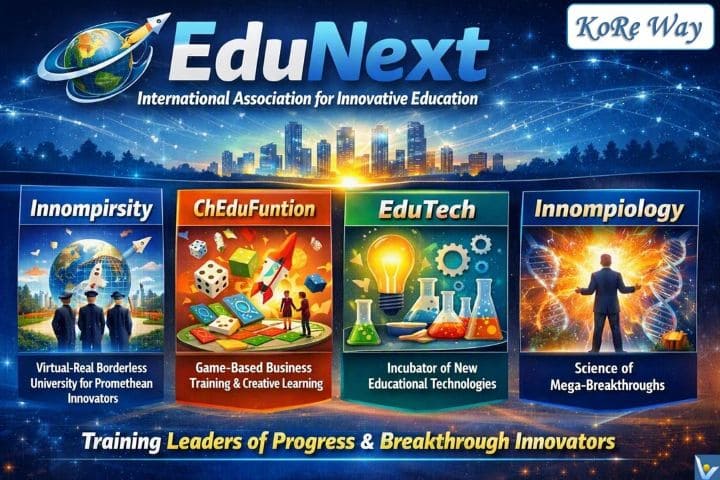
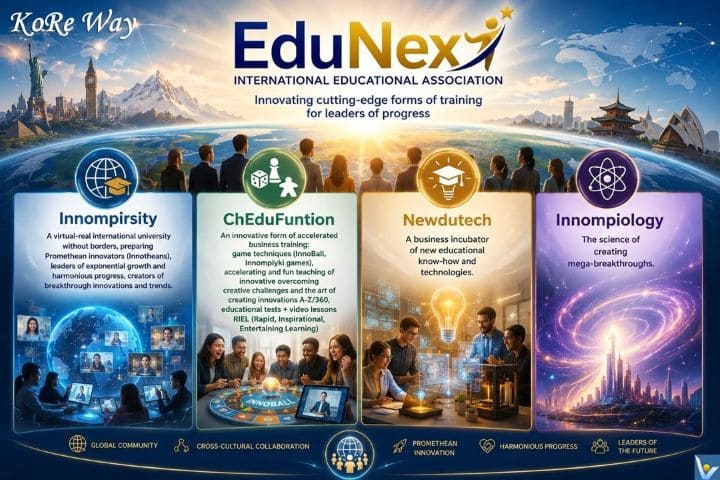
powered by these KoRe trademark components: Innompirsity,
ChEduFuntion, Newdutek, Innompiology.
Innompirsity (Innompic University) – a virtual-real
international university without borders, preparing
Promethean innovators (Innotheans), leaders of
exponential growth and harmonious progress, creators of
breakthrough innovations
and trends.
ChEduFuntion – an innovative form of accelerated
business training: game techniques (InnoBall, Innompic
Games), accelerating and fun teaching of innovative
overcoming creative challenges and the art of creating
innovations A-Z/360. Tools also include such KoRe
thinking innovations as 10 KoRe Innovative Thinking
Tools (10KITT), educational InnoBall tests, and RIEL
(Rapid, Inspirational, Entertaining Learning
video-courses).
Newdutech – a business incubator of new educational
know-how and technologies.
Innompiology – the practtical science of creating
mega-breakthroughs

  
  
  


 
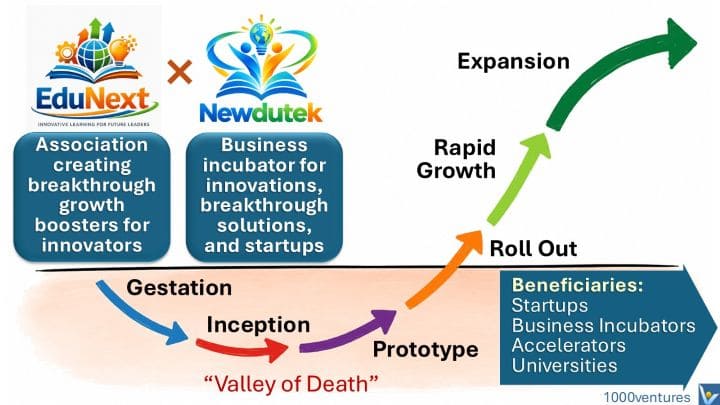
EduNext is an
international association whose members collaboratively
develop groundbreaking, practical methods for training
innovators, leveraging the competitive advantages,
ingenuity, and entrepreneurial spirit of each
participant.
Newdutek is a business incubator where groundbreaking
solutions, innovations, and startups – including those
driven by virtual international teams—are conceived,
created, and nurtured.
The multiplication sign between EduNext and Newdutek
symbolizes the amplification of their effectiveness
resulting from synergistic integration. Together,
EduNext and Newdutek foster both accelerated innovation
and the rapid, systemic strengthening of international
cooperation in this field.
The "International Startup as a Thesis"
program, implemented at partner
universities, enables students to form
virtual international startup teams and
ensures a seamless transition from
university education to international
innovation and entrepreneurial
activities.
***
Business-Game-style Exam (BGsE)
 
  
  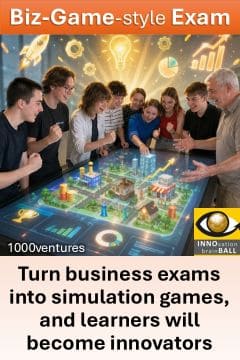
 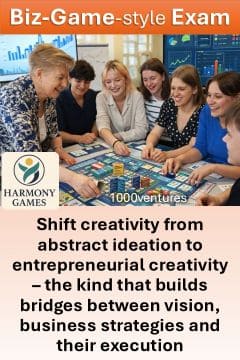 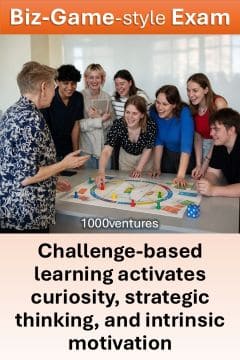
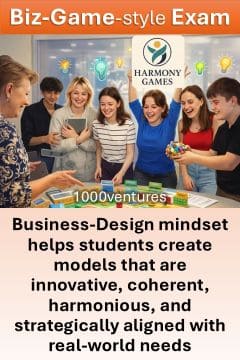  
Groundbreaking Education
Innovation: Exam in the Form of a Business Game
*** Prompt ***
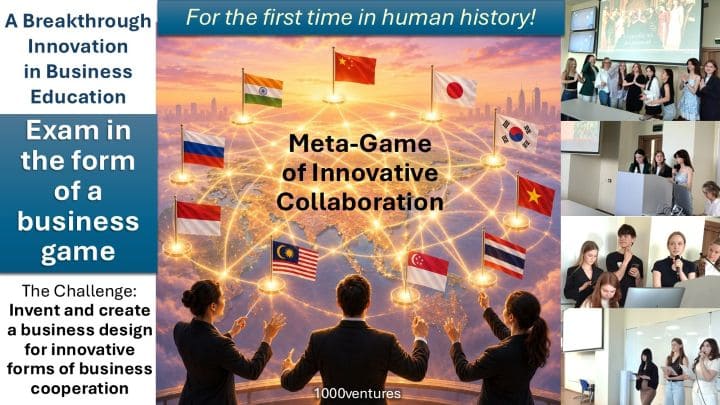
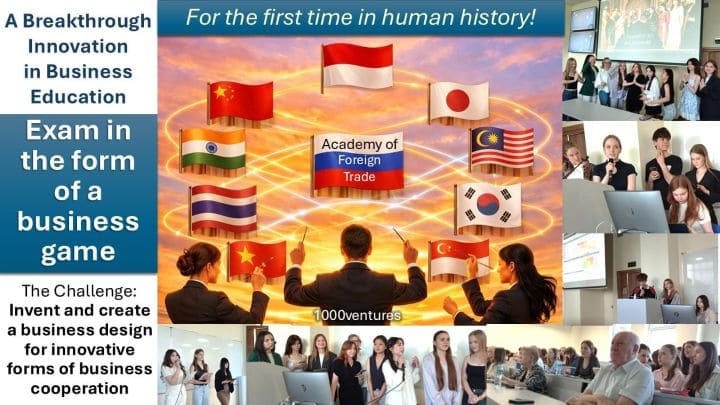
A Breakthrough Innovation in Business Education For the
first time in human history, the exam was conducted in
the form of a business game, during which students not
only demonstrated their knowledge but also their ability
to apply it in innovative ways. The creative challenge
posed by the examiners was: Invent and create a business
design for innovative forms of business cooperation with
Asian countries.
*** Intro ***
How Students Amazed Their Teachers
Date of the first business game exam: June 6, 2026
Pioneer University: Foreign Trade Academy
Breakthrough Innovation Leaders: Vadim Kotelnikov and
Elena Rogatnyh
For the first time in human history, the exam was
conducted in the form of a business game, during which
students not only demonstrated their knowledge but also
their ability to apply it innovatively in practice.
The creative challenge posed by the examiners to the
Sinology students was: Invent and create a business
design for innovative forms of business cooperation with
seven Asian countries: Vietnam, India, Indonesia,
Singapore, Thailand, South Korea, and Japan.
70 first-year students were divided into seven groups
and... amazed not only the faculty but also experienced
international business professionals with their
brilliantly presented innovative solutions, their
ability to ask challenging questions about the essence
of a business problem, and their ability to answer them
effectively and promptly. The simulation of real
business challenges, like a magical kiss from a sleeping
beauty, awakened the "sleeping geniuses" within the
students and helped them unleash their full talents.
A Simple Solution to Three Big Problems of Classical
University Education
The three big problems of classical global university
business education have long been well-known:
Students are given a lot of theory but very little
practice, resulting in them graduating as strong
theorists but weak practitioners.
In today's rapidly changing global economy, driven by
continuous innovation, theoretical business knowledge
quickly becomes outdated, leaving graduates stranded in
a reality for which they were not prepared.
Students are taught to be managers operating within the
existing "red ocean" of monotonous practices, not
breakthrough innovators who break outdated rules, create
new "blue oceans" in the global market, and move the
world forward by changing the rules of the game to which
everyone else has to hastily and clumsily adapt.
A simple solution to these three major problems is based
on a partial paradigm shift in classical business
education: we need to train not so much strong theorists
for yesterday's realities, but flexible and enterprising
innovative leaders capable of both quickly adapting to
rapidly changing realities and proactively creating new
realities, "skimming the cream" of the new market niches
they create.
Simulation business games like InnoBall offer a simple
solution that helps effectively and quickly address all
three major problems of traditional business education.
From theory to practice – in a team and creative way!
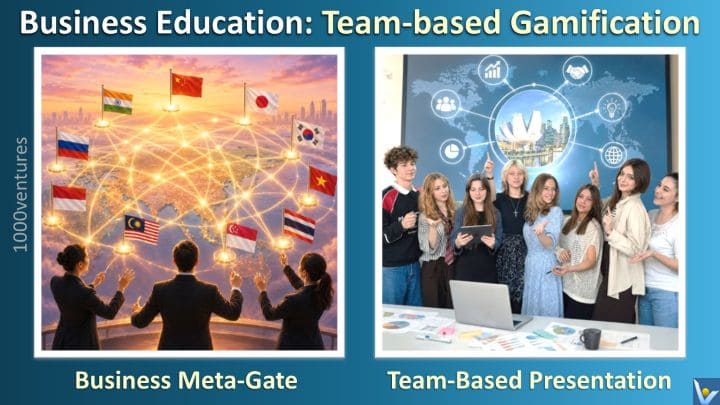
In business education, team-based gamification replaces
traditional lectures and exams with engaging,
competitive business games that simulate realistic
situations typical of a rapidly changing, turbulent, and
competitive business environment. Students work in
teams, managing simulated projects or companies,
addressing real-world business challenges such as new
product development, rapid growth strategy design,
market penetration, and customer engagement, while
competing against other teams for awards for the best
solutions.
*** ARTICLE ***
A Breakthrough Innovation in Business Education
The benefits of gamified learning are well known.
Research shows that in corporations, gamified learning
increases employee engagement by over 60% and material
retention by over 40%. However, gamified learning has
been relatively under-implemented in university
education to date. And then...
For the first time in the history of university
education, an academic exam was transformed into a
real‑time business game — a dynamic challenge in which
students demonstrated not only what they knew, but what
they could create with it, innovatively and
systematically. Knowledge alone was no longer enough.
What mattered was the ability to apply theory in
innovative, entrepreneurial, and culturally intelligent
ways.
The examiners presented a creative challenge worthy of
the moment:
Invent and design a breakthrough business model for
innovative forms of cooperation with Asian countries.
This was not a test of memorization. It was a test of
imagination, strategic thinking, cross‑cultural empathy,
and entrepreneurial agility. Students had to think like
innovators, negotiate like diplomats, and act like
startup founders navigating a complex global landscape.
Instead of answering questions, students designed
solutions.
Instead of repeating theories, students built business
designs.
Instead of competing for grades, students competed for
impact.
Instead of answering questions, students developed
solutions and presented them, while the student audience
learned both innovative approaches from their fellow
developers and the art of asking business questions
(which is typically not taught at universities, despite
being a crucial skill for innovators).
Instead of repeating theories, they created business
projects based on their acquired knowledge, expanding
this knowledge through the process of innovative
creation.
Instead of striving for a desired grade, the examinees
sought to create maximum value for the imaginary
participants of their conceptual projects.
This exam marked the birth of a new educational format —
one where learning becomes a meta‑game of innovation,
and students become creators of the future, not
consumers of the past.
7 Benefits of an Exam in the Form of a Business Game
Summary
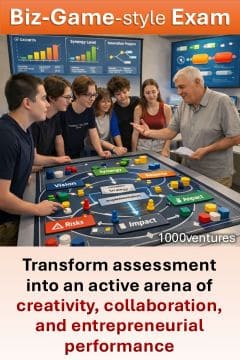
A business‑game exam transforms assessment from a
passive test of memory into an active arena of
creativity, collaboration, and entrepreneurial
performance.
Instead of demonstrating their knowledge, students
demonstrate their ability to apply it in practice. They
design projects, create business designs, simulate the
innovation process, present their solutions, and answer
challenging questions from the audience - all under
real-time pressure that mirrors the dynamics of modern
business. This format elevates learning from theory to
practice, from individual recall to team-based value
creation, and from stress to playful mastery.
1. Challenge‑Based Learning
A business‑game exam begins with a creative challenge
rather than a list of questions. Students must acquire
the knowledge necessary to develop a solution, conduct a
SWOT analysis, select the most promising direction,
devise a comprehensive solution and a business design
for its implementation in practice. This approach
activates curiosity, strategic thinking, and intrinsic
motivation. Instead of “studying for the test,” students
engage with the challenge, explore possibilities, and
learn through action.
2. Meta‑Game of Innovation
Innovation, being a journey into the unknown, typically
does not develop according to a business plan or roadmap
- it is usually a jazz-like improvisation within a given
structure, an interplay of ideas, constraints,
opportunities, trials, errors, and breakthroughs. A
business‑game exam mirrors this reality. Students
navigate ambiguity, improvise, adapt, and iterate. They
learn to treat innovation as a meta‑game: a structured
yet flexible process where creativity, insight, and
strategic foresight combine to produce systemic
breakthrough solutions.
3. Implementation‑Oriented Business Creativity
Ideas alone are not enough. An exam in the form of a
business simulation game requires students to design
implementable solutions. They must consider the full
range of diverse aspects of the business, including
customer value, competitiveness, feasibility, risk,
flexibility, and dynamic relationships with all
stakeholders. This shifts creativity from abstract
ideation to entrepreneurial creativity — the kind that
builds bridges between vision, business strategies and
their execution.
4. Business‑Design Thinking
Students learn to think like business designers:
mapping stakeholders,
identifying value flows,
crafting cooperation models,
and shaping win‑win strategies.
This design‑thinking mindset helps them create business
architectures that are innovative, coherent, harmonious,
and strategically aligned with real-world needs.
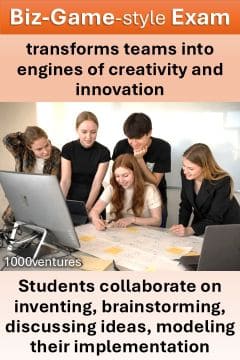
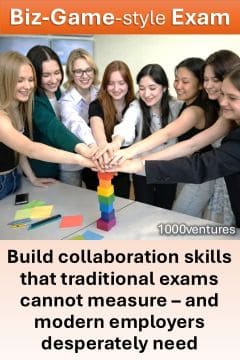
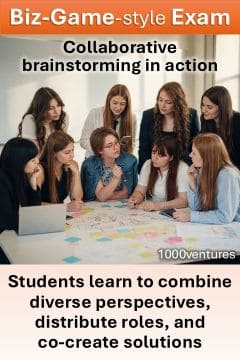
5. Inventive Teamwork
The business-game-style exam transforms teams into
engines of creativity and innovation. Students
collaborate on inventing, brainstorming, discussing
ideas, modeling their implementation, and refining the
overall business design of the solution as they go. They
learn to combine diverse perspectives, distribute roles,
and co‑create solutions. This builds collaboration
skills that traditional exams cannot measure — and
modern employers desperately need.
6. Team‑Based Presentation Skills
Student teams must present their complex business
solutions in a clear, concise, compelling, and
professional manner. This is a team performance.
Students learn to make impressive business presentations
and effectively answer challenging questions from the
audience, including "What if...?" questions. This
develops teamwork skills, communication skills, and the
ability to quickly and effectively respond to
challenges, essential for business leaders,
entrepreneurs, salespeople, and negotiators.
7. Fun
Yes — fun matters. A business‑game exam replaces anxiety
with engagement, fear with curiosity, and pressure with
playful competition. When students enjoy the process,
they learn faster, remember more, and perform better.
Fun is not a distraction; it is a catalyst for deep
learning.
Three Takeaway KoRe Proverbs
“A game reveals the truth of your skills faster than a
test of your memory.”
“When students design value, they learn what no textbook
can teach.”
“Turn exams into games, and learners become innovators.”
*** GLOSSARY ***
Business Meta-Game is a strategic, overarching system of
business design, decision-making and long-term planning
that transcends day-to-day operations. It involves
leveraging highersight, foresight, patterns, platform
algorithms, market trends, feedback loops, and systemic
thinking to gain competitive advantage - such as
mastering strategic innovation, customer acquisition
funnels, scaling models, or building ecosystems. It
means playing the game of business with a focus on
evolving strategies rather than just executing tasks. It
is a higher-level perspective, where strategic
achievement comes from understanding not just what to do
now, but how business systems evolve and interact across
time.
Implementation-oriented business creativity focuses on
transforming innovative ideas into practical, actionable
solutions that deliver tangible business value. Unlike
abstract ideation, it emphasizes execution,
adaptability, and alignment with organizational goals.
Success hinges on integrating creative thinking with
structured processes, resource management, and a culture
that supports risk-taking and iterative improvement.
This approach bridges the gap between imagination and
impact, ensuring that creative initiatives lead to
sustainable growth and competitive advantage.
Inventive Teamwork combines creativity, collaboration,
and structured learning to drive innovation. It
emphasizes building strong relationships, sharing ideas
effectively, and developing skills in product knowledge,
sales, service standards, and leadership—key components
seen in corporate universities like Inventive. This
approach enhances project outcomes by fostering
high-quality teamwork in innovative environments, where
trust and continuous development. Measuring teamwork
quality helps identify its impact on project success,
make investment decisions, and reinforce the need for
intentional collaboration.
Managing the "bigger picture" mens continuously zooming
out from daily tasks to align actions with macro-level
objectives and overarching goals, ultimately enabling
strategic alignment. macro-innovation and proactive
decision-making across initiatives.
Team-based gamification in business education enhances
engagement, collaboration, and skill retention by
turning learning into interactive, competitive, and
cooperative experiences. Research shows it can increase
employee engagement by up to 60% and improve knowledge
retention by 40%. By simulating real-world business
challenges through games, students develop critical
thinking, decision-making, and teamwork skills in a
low-risk environment. This approach is particularly
effective in higher education and corporate training,
where active participation drives deeper learning and
long-term application.
Effective team-based presentation skills rely on clear
roles, a unified narrative, and strong collaboration.
Assigning a team captain, defining individual
responsibilities, and aligning on goals ensure cohesion.
A well-structured story with smooth transitions enhances
audience engagement. Prepare for Q&A collectively to
maintain consistency. Choose teammates with compatible
work styles and commitment levels to foster
productivity. Practice together to refine timing and
delivery. Success hinges on preparation, communication,
and mutual accountability.
Team‑Based Presentation Skills (KoRe‑Style Definition)
A team that presents as one mind speaks with many voices
but a single rhythm.
Team‑Based Presentation Skills – the collective ability
to transform multiple speakers into one coherent
narrative flow. It is the discipline of replacing
isolated mini‑lectures with a shared storyline shaped,
carried, and protected by the whole team.
Core elements:
Unified Visual Language – choosing and sustaining one
aesthetic so every slide feels like part of the same
mind.
Seamless Speaker Transitions – crafting handoffs that
feel like passing a living idea, not a microphone.
Mutual Q&A Support – teammates reinforcing one another
with clarifications, expansions, and strategic silence.
Active Off‑Mic Presence – maintaining engagement,
attention, and energy even when not speaking, signaling
that the team is always "on" together.
*** Glossary ***
The startup "Valley of Death" (or death valley curve) is
the critical early phase when a new company has spent
its initial money but does not yet make enough sales to
pay for itself.
*************
A "startup as a diploma" program allows students to
submit a real business venture or commercial product as
their final graduation thesis or capstone project
instead of a traditional academic paper.
How It Works
Real-World Focus: Students build an actual business,
prototype, or digital product rather than writing
theoretical research. [1, 2]
Milestones: Deliverables typically include a verified
business plan, customer discovery metrics, financial
projections, and a functional MVP (Minimum Viable
Product).
Pitch Defense: The final defense replaces an academic
panel with a "Dragon's Den" or investor-style pitch in
front of industry mentors and experts. [1, 2]
Benefits & Challenges
Dual Progress: You advance your career and business
while simultaneously fulfilling university graduation
requirements. [1]
Mentorship: Many institutions tie these programs into
university incubators, providing access to legal,
technical, and financial advisors. [1, 2]
Mixed Opinions: While some entrepreneurs on platforms
like Reddit argue that traditional academic structures
slow down fast-moving ventures, structured capstones
help student founders maintain accountability and public
portfolios.
The "Startup as a Diploma" model (where students present
a fully functioning startup or business project as their
final thesis instead of a traditional theoretical paper)
has been officially adopted and driven by
government-backed national initiatives primarily in two
countries:
Russia: Launched at universities like FEFU in 2017, this
initiative was integrated into the national "Digital
Economy" program and the Ministry of Science and Higher
Education's "Priority 2030" program. It has scaled
across hundreds of Russian universities.
Australia: In 2023, the Australian Government officially
backed a national initiative called "Startup Year."
Supported by federal STARTUP-HELP loans, this enables
students or recent graduates to enroll in a dedicated
Graduate Diploma program (like the one offered at
Swinburne University) where the entire year is spent
building and receiving mentorship for their startup.
Regional Adoption & Pilot Programs Beyond those two
countries, other nations in Central Asia are beginning
to adopt this exact framework from Russia's educational
ecosystem:
Kyrgyzstan: In 2025, the Kyrgyz-Russian Slavic
University (KRSU) officially began adopting these best
practices into its own curriculum.
|