| |
Competitive innovation is the
deliberate, structured process of using innovation to stay ahead of
the competition, win more customers, and drive long-term business
growth. |
|
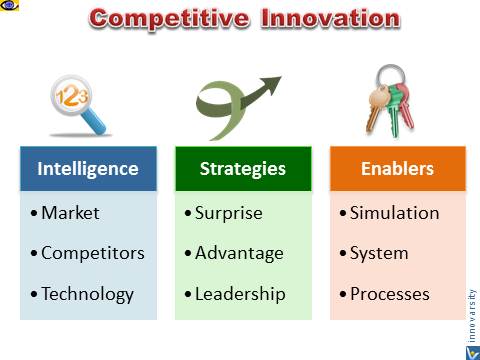 |
 |
|
Competitive innovation is a strategic approach
where businesses use
highersight, creativity, technology, and
unique insights to develop new products,
services, or processes that outperform rivals
and create sustainable value. It focuses on
gaining a
competitive advantage by aligning innovative
efforts with organizational strategy, fostering
a
culture of creative dissatisfaction, and
anticipating competitor moves.
Winning more customers requires focusing on
exceptional customer experiences (CX),
enhancing
competitive differentiation, leveraging
creative trust-based marketing, and delivering
higher customer value. |
|
Competitive innovation refers to the strategic use of creativity and novel processes to gain or maintain a market advantage over rivals. It is more than just inventing new products; it involves a continuous performance loop of preparation, execution, and evaluation designed to outperform competitors.
Competitive innovation refers to the strategic use of creativity and novel processes to gain or maintain a market advantage over rivals. It is more than just inventing new products; it involves a continuous performance loop of preparation, execution, and evaluation designed to outperform competitors.
Competitive Innovation Consultancy
Innovation – the Next Level of Sustainable Competitive ...
Core Concepts of Competitive Innovation
Intrinsic Competition: In high-performing cultures, competitive innovation is often viewed as "competing with yourself"—constantly seeking to be better today than yesterday.
The Innovation "Sweet Spot": Competitive success occurs when innovations are value-adding, solve specific customer needs, and are brought to market timeously.
Value Innovation: A strategy that focuses on creating a leap in value for both buyers and the company, simultaneously pursuing differentiation and low cost. [1, 5, 6]
Types of Innovation for Competitive Advantage
Businesses leverage different pathways to stay ahead, including: [7]
Product & Service Innovation: Creating new or improved offerings to meet evolving demands.
Process Innovation: Improving internal methods to increase operational efficiency or reduce costs.
Business Model Innovation: Redesigning how a company creates and captures value, which often provides a more lasting advantage than product changes alone.
Disruptive Innovation: Challenging established market leaders with simpler, more affordable, or more accessible solutions. [8, 9, 10, 11, 12]
Strategic Implementation
According to Competitive Innovation Consultancy, implementing this framework requires:
Identifying Opportunities: Finding commercial gaps that generate sustainable income.
Resource Alignment: Linking every innovation project directly to the company's unique strengths and growth priorities.
Proactive Maintenance: Moving beyond just fixing products to collaborating with customers on improvements and lifecycle service engagements. [2, 13, 14]
Would you like to explore a specific framework, such as the Ten Types of Innovation, or see examples of how a particular industry uses these strategies?
Competitive innovation is a strategic approach where businesses use creativity, technology, and unique insights to develop new products, services, or processes that outperform rivals and create sustainable value. It focuses on gaining a competitive advantage by aligning innovative efforts with organizational strategy, fostering a culture of continuous improvement, and anticipating competitor moves.
Key aspects of competitive innovation include:
Strategic Alignment: Connecting innovation directly to growth priorities and unique company strengths rather than pursuing untested ideas.
Value Creation: Focusing on delivering superior value to customers, often through "value innovation," which simultaneously pursues differentiation and low cost.
Types of Innovation: Utilizing different, often simultaneous, forms of innovation, including product, process, organizational, and marketing innovations.
Cultural Shift: Building a culture where employees are encouraged to think differently, take risks, and learn from mistakes.
Types of Advantage: Using tools to create lasting advantages, such as technological leadership, superior product quality, or brand loyalty.
Key Types of Innovation Strategies
Product/Service Innovation: Developing new, improved offerings to meet customer needs.
Process Innovation: Improving internal methods to increase efficiency and reduce costs.
Disruptive/Radical Innovation: Transforming markets or creating new ones.
Incremental Innovation: Making routine improvements to existing products or services.

❶ Be Different
Thrive on innovation and change. Differentiate your products in
a creative and flexible working regime.
❷ Stand Out from the Competition
Innovate proactively. Aim at changing the competitive arena,
develop “blue ocean” strategies aimed at creating your own
market niche and building layers of competitive advantage.
❸ Revolutionize
Break rules. Don’t accept the conventional definition of how
business is done. Change business concepts to stand out from the
pack.
❹ Know Your Competitors
Do competitor analysis to learn from them, to forecast what
products competitors will come out with and when, to identify
and attack undefended segments, and ultimately to gain an edge
over your competitors.
❺ Win First, then Go To War
Prepare to win. Play simulation games, like Innovation Football,
to learn to anticipate competitor attacks, solve problems
creatively and develop stronger innovation and competitive
strategies.
❻ Create Breakthroughs
Focus on radical value innovation. Develop the ability to
surprise – amaze your customers, shock your competitors and
excite your employees.
❼ Learn from Others
Use the expertise of market researchers, scientists, inventors
and product developers to create new products.
❽ Create an Enabling Ecosystem
Create a culture for innovation, an innovation system, and the
right environment which provide both support and encouragement
for innovators.
❾ Synergize Capabilities
Use the capabilities of everyone within your organization to
generate the processes that help the new product to reach the
market quickly and efficiently.
❿ Build Partnerships
Build alliances to overcome disadvantages and access missing
competences.
|
 |
 |
If we don't do it, someone else will.
We're forced to innovate to stay ahead of the competition. |
Michael
Dell< |
|