 |
|
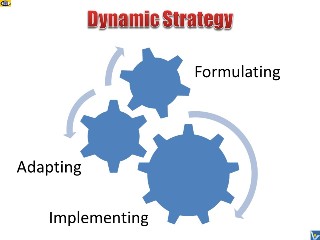
In today's
turbulent and rapidly changing world, the
strategy cannot be taken as gospel. There are
too many uncertain factors that nobody can
resolve. A predictable path to the future cannot
be paved from the experience of the past.
Strategic plans
should be subjected to timely adjustments to
strategic changes inside and outside the
company, |
|
 |
|
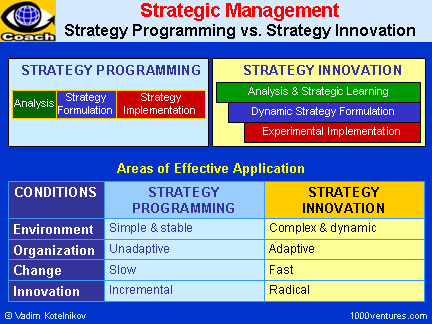
Never is strategy
innovation more important than when
disruption is at the heart of a strategy.
Disruptive innovation always involves
treading into uncertain waters, and the
importance of a dynamic strategy increases with
increasing
uncertainty. |
|
| |
Strategy should be
dynamic and change constantly in order to
contend with external turbulences.
You should respond
to rapid changes in the business environment by
adopting a new approach to strategy – one that
combines speed, openness, flexibility, strategic
thinking,
entrepreneurial simulation, and
rapid experimentation. |
|
 |
| |
|
Experimenting with new
strategies is important.
Constant testing,
learning from feedback,
adaptation and building on what
is found to be successful with
customers is the way ahead,
especially when you are trying
to re-invent the value provided,
or the way it is produced and
delivered.
|
|
|
| |
|
Building Blocks of Dynamic
Strategy
Peter Skat-Rørdam, the author of
the book Changing Strategic
Direction, suggests the
following 7 building blocks of
dynamic strategy:
①
Obtaining market
insight and foresight
②
Utilizing your company's
competencies and capabilities
③
Determining the value your
company wants to provide
④
Reinventing the business and the
competitive rules
⑤
Developing a guiding
strategic intent
⑥
Developing a strategy as a
dynamic game →
InnoBall
⑦
Capitalizing on opportunities
and learning
|
|
|
 |
|
"Most teachings
about life, leadership, entrepreneurship,
business, strategy, and innovation work well in
life, but only until big challenges arise along
the way. In such cases,
super gamification comes to the rescue,
helping to successfully overcome big
challenges."
~
Vadim Kotelnikov |
|
| |
|
Just-in-Time Strategy
According to McKinsey, in
today's turbulent world,
companies must let go of the
notion that strategic outcomes
can be predetermined and that
enduring competitive advantage
can be defined and achieved.
Companies must instead adopt a "portfolio-of-initiatives"
approach that bases new business
opportunities on "advantages of
familiarity," on the continuous
appraisal of initiatives, and on
just-in-time decision making.
Only this approach can achieve
high returns relative to
risks taken while
approximating the pace and scale
of change in the external
business world.
|
|
|
| |
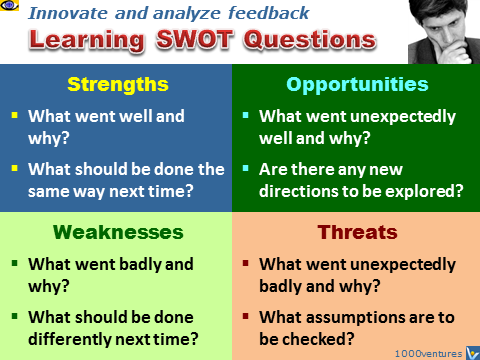
Ask
learning SWOT questions after every major
disruptive action to identify your strengths and
weaknesses, threats and high-potential
opportunities. |
|
 |
|
|