Search


How To Establish a Lean Enterprise

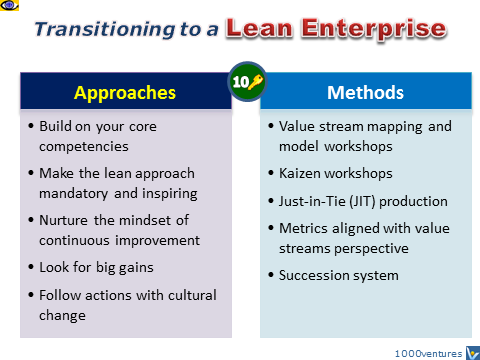
Master Tip  ▪  5 Approaches  ▪  5 Methods


Keynote Speaker on creativity, innovation, love: Vadim Kotelnikov  

"To streamline and fine-tune your processes, ask yourself: "Are these processes pure gold or gold dust?"

To fine-tune your communication, ask yourself: "Is my communication pure gold or just a gold dust?"

Remove all dust, if any."

~ Vadim Kotelnikov


Lean Production Overview

Non-value added activities or waste are eliminated through continuous improvement efforts.

Focus on continuous improvement of processes – rather than results – of the entire value chain.

The lean manufacturing mindset: concept, way of thinking – not techniques; culture – not the latest management tool.

Continuous product flow is achieved through physical rearrangement and system structure & control mechanisms.

Single-piece flow / small lot production: achieved through equipment set up time reduction; attention to machine maintenance; and orderly, clean work place.

Pull reduction / Just-in-Time inventory control


Lean Manufacturing

Applications of Lean: Lean Techniques, Lean Thinking, Lean Startup

Kaizen and TQM

Kaizen Implementation

JIT Implementation

Canon Production System

Toyota Production System (TPS)

7 Principles


Basic Elements of Lean Manufacturing

The basic elements are waste elimination, continuous one piece workflow, standardized work, and customer pull. When these elements are focused in the areas of cost, quality and delivery, this forms the basis for a lean production system.

The lean production concept was to a large extent inspired by the Kaizen – the Japanese strategy of continuous improvement.

Employee empowerment and promotion among them of a way of thinking oriented at improving processes, imitation of customer relationships, fast product development and manufacturing, and collaboration with suppliers are the key strategies of leading lean companies.

The Five Ss refer to the five dimensions of workplace optimization: Seiri (Sort), Seiton (Set in order), Seiso (Shine), Seiketsu (Standardize), and Shitsuke (Sustain)... More

 

Continuous Improvement Firm (CIF)

Kaizen and Lean Manufacturing

CIF Implementation

Suggestion System

Examples of CIF

Kaizen

6Ws

Kaizen Mindset

Kaikaku-Kaizen Journey

7 Conditions

Kaizen Practices

Examples


How AI can help establish a lean enterprise

Artificial Intelligence (AI) – if integrated properly – helps establish a lean enterprise by automating repetitive tasks, improving data visibility, and enabling rapid identification of bottlenecks. It can simulate thousands of production scenarios to optimize schedules based on demand, labor, and setup needs, reducing waste and improving responsiveness.

AI can help enhance core tools like value stream mapping, standard work, and problem solving. AI-driven data summaries accelerate decision-making, allowing teams to focus on high-value activities.

By enhancing operational efficiency and predictive accuracy, AI supports continuous improvement – core to lean principles.


AImpowerment

AI MAGic

Multiplicative AI

AI Intelligence

Humans vs. AI: SCA

Human-AI Synergy

AI Overview

AI Feedback

AImage

AI Optimization

AIpedia

AI Predictions


Vadim Kotelnikov

Keep learning forward. If you strop learning, you stop creating history and become history.

Vadim Kotelnikov, founder of 1000ventures - personal logo VadiK

Inventor

Author

Founder