| |
|
Core Definition ▪
Why it matters
▪ Takeaways
|
|
|
| |
|
Comparative advantage is a
characteristic that describes in
what area and how specifically
one entity is better than
another.
|
|
|
| |
Comparative
advantage is one of the most influential ideas
in economics, but its logic applies far beyond
markets. It shapes: how partners collaborate;
how relationships thrive; how companies
innovate; how societies develop; how global
systems grow more interconnected
The power
of comparative advantage lies not in being the
best, but in being better in a key area.
Example:
Comparative Advantages of AI
Artificial intelligence (AI)
is an
amplifier of human capability. It processes
information at scale, identifies patterns with
precision, and executes tasks with tireless
consistency...
More |
|
 |
| |
The power of comparative advantage lies
not in being the best, but in being more
efficient at one thing than at another,
and then trading, collaborating, or
specializing so that everyone benefits.
|
|
Example:
Jokepers
Jokepers (jokes-helpers) synergize fun and
wisdom – comparative advantages of anecdotes and
teachings.
→
Example |
|
| |
|
Comparative Advantages
as the
Basis of Collaboration
Comparative advantage is the
principle that individuals,
teams, companies, or nations
create the greatest total value
when each focuses on what they
can do relatively better than
others – even if someone else is
absolutely better at everything.
|
|
|
| |
Comparative
advantage explains why specialization increases
productivity, why cooperation outperforms
isolation, and why diverse strengths create more
value than uniform excellence.
In
synergistic partnerships
and collaborations, comparative advantage is the
principle that individuals, teams, companies, or
nations create the greatest total value when
each focuses on what they can do relatively
better than others – even if someone else is
absolutely better at everything.
This principle
helps
synergize diversities and thus achieve
exponential growth. |
|
 |
| |
|
Synergizing Comparative
Advantages
In
synergistic partnerships
and
collaborations, comparative
advantage is the principle that
individuals, teams, companies,
or nations create the greatest
total value when each focuses on
what they can do relatively
better than others – even if
someone else is absolutely
better at everything. This
principle helps
synergize diversities and
thus achieve
exponential growth...
More
|
|
|
| |
Comparative
advantage explains why a specific strength
creates more value than uniform excellence
in some vital situations.
A
joke illustrating the value of comparative
advantage
Two men are
walking through a forest and see a tiger running
towards them. One man starts putting on running
shoes. The other says, "Do you think you can run
faster than the tiger?" The first replies, "I
don't have to run faster than the tiger, I just
have to run faster than you!" |
|
 |
| |
|
Example
of Comparative Advantage
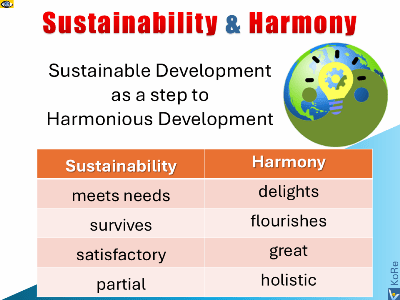
Why
Harmony Is Better
than Sustainability for Humanity
and the World:
7
Comparative Advantages
|
|
|
 |
|
① Harmony is proactive, not reactive
Sustainability often begins with the question, “How do
we reduce harm?”
Harmony begins with, “How do we create
conditions where all can thrive?” This shift from damage
control to value creation unlocks innovation and
optimism...
More |
|
*** How To Synergize
Comparative Advantages ***
Core Definition
Comparative advantage is the ability to produce a good,
service, or outcome at a lower opportunity cost than
someone else. Opportunity cost is what you give up when
you choose one activity over another.
If you give up less to perform a task than someone else
does, you have a comparative advantage in that task
– even if they are faster, stronger, or more
skilled in absolute terms.
Why It Matters
Comparative advantage is a framework for understanding
value creation through specialization and cooperation.
Comparative Advantage Across Life Domains
1. Everyday Life
A person who cooks well but hates cleaning may trade
tasks with someone who cleans quickly but cooks slowly.
Even if one person is better at both tasks, splitting
them based on relative efficiency saves time and energy
for both.
Takeaway: Life runs smoother when people lean into their
relative strengths.
2. Relationships
One partner may be better at emotional communication,
the other at planning logistics.
Even if one partner could do both well, dividing roles
based on comparative advantage reduces friction and
increases harmony.
Takeaway: Healthy relationships often emerge from
complementary—not identical—strengths.
3. Arts & Creativity
A filmmaker may excel at storytelling but be average at
editing.
An editor may not write scripts but can transform raw
footage into emotional impact.
Together, they create a film neither could produce
alone.
Takeaway: Creative collaboration thrives when each
contributor focuses on their unique edge.
4. Business & Organizations
A startup founder might be strong in vision and product
design but weaker in operations.
A COO may not be a visionary but excels at systems,
processes, and scaling.
Takeaway: Companies grow faster when roles align with
comparative advantage rather than ego.
5. Innovation
Research teams innovate more when scientists, engineers,
designers, and strategists each focus on what they do
best.
Innovation accelerates when diverse comparative
advantages intersect.
Takeaway: Breakthroughs happen at the intersection of
specialized strengths.
6. Economy & Markets
Countries specialize in goods they can produce at lower
opportunity cost.
This increases global output, lowers prices, and raises
living standards.
Example: A country may be able to produce both wheat and
microchips, but if it gives up less by producing wheat,
it specializes in wheat and trades for chips.
Takeaway: Comparative advantage is the engine of global
trade.
7. Social Development
Communities thrive when people contribute according to
their strengths—teachers teach, builders build,
caregivers care.
Social mobility increases when individuals can discover
and develop their comparative advantages.
Takeaway: Societies grow when they empower people to
specialize.
🌐 8. Global Development
Nations with different resource endowments, climates,
technologies, or labor skills benefit from specializing
and trading.
Comparative advantage encourages cooperation rather than
competition for identical roles.
Takeaway: Global development accelerates when countries
complement each other instead of duplicating efforts.
A Unifying Insight
Comparative advantage teaches a profound truth:
You don’t need to be the best at everything. You only
need to understand where your effort creates the most
value relative to your alternatives.
This principle scales—from personal decisions to global
systems.
***
Comparative Advantage —
Glossary Article
Core Definition
Comparative advantage is the ability to produce a good,
service, or outcome at a lower opportunity cost than
someone else. Opportunity cost is what you give up when
you choose one activity over another.
If you give up less to perform a task than someone else
does, you have a comparative advantage in that task –
even if they are faster, stronger, or more skilled in
absolute terms.
|
|
