| |
Stakeholder management is the strategic
process of identifying, analyzing, engaging, and
maintaining relationships with individuals or
groups affected by or influencing a project,
program, or initiative.
Effective
stakeholder management ensures alignment of
expectations, minimizes resistance, and enhances
project success by fostering transparency and
collaboration. It involves continuous monitoring
and adaptive communication tailored to each
stakeholder’s interests and influence. In is as
important components of
business excellence, a
balanced business system and
harmonious growth. |
|
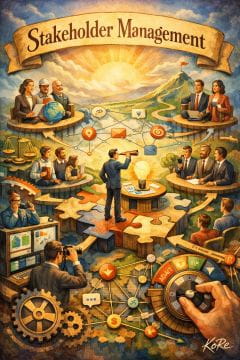 |
| |
|
In business, a
stakeholder is a party that has
an interest in a company and can
either affect or be affected by
the business. The primary
stakeholders in a typical
corporation are its investors,
employees, customers, suppliers,
society, and governments.
In project management, the five primary
stakeholders are the
project leader, the project
team, the functional management,
the sponsor, and the customer.
In a larger sense, anyone who
participates in the project or
is impacted by its results is a
stakeholder.
|
|
|
| |
|
Aspects
of
Stakeholder Management
Identification & Mapping:
Recognizing all internal
(employees, executives) and
external (customers, suppliers,
community) stakeholders. A
stakeholder map, using
frameworks like TIPS (Team,
Impacted, Power Players, Subject
Experts), helps prioritize them
based on influence and interest.
Engagement Strategy:
Developing tailored, regular
communication plans to keep
stakeholders informed and
involved. This involves
understanding their needs,
expectations, and potential
to impact project success.
Monitoring: Continuously
tracking engagement levels,
addressing concerns, and
adjusting strategies throughout
the
project life cycle.
|
|
|
| |
|
Benefits of
Effective Stakeholder Management
Risk Mitigation: Identifying
potential issues or resistance
early, preventing project delays
and conflicts.
Improved Decision-Making:
Incorporating diverse
perspectives and expertise.
Increased Support: Building
trust and fostering long-term
relationships that encourage
advocacy for the project.
|
|
|
| |
|
Common Tools and Techniques
Stakeholder Mapping:
Visualizing stakeholders based
on power and interest.
Communication Plans:
Defining who needs to know what,
when, and how.
Stakeholder Relationship
Management (SRM) Software:
Tools to track interactions,
concerns, and engagement
history.
|
|
|
|
|