| |
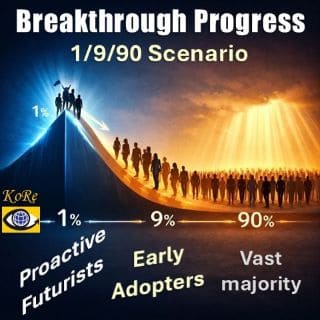
The 1/9/90 Law of Breakthrough Progress
By:
Vadim Kotelnikov
The 1/9/90 Law of
Breakthrough Progress explains how disruptive
innovations move from impossibility to
inevitability. |
|
 |
Most people believe that markets change when the
majority decides to embrace something new. Reality tells
a different story. Transformational change rarely begins
with the crowd. It begins with a few visionaries who see
a future that others cannot yet imagine.
The 1/9/90 Law of Breakthrough Progress explains how
disruptive innovations move from impossibility to
inevitability.
The 1%
Every breakthrough starts with the few.
Roughly 1% of people are disruptive innovators. They are
not satisfied with improving the existing curve. They
seek to create the next one.
While others ask, "How can we make this better?"
innovators ask, "Why does this exist at all?"
They challenge assumptions, ignore conventional wisdom,
and often appear unreasonable. Their ideas are
frequently dismissed because breakthrough innovations do
not fit within existing expectations.
When the first smartphones appeared, many experts saw
them as expensive gadgets. When streaming emerged, many
believed physical media would remain dominant. When
cloud computing arrived, countless organizations
questioned whether critical systems could ever leave
their own servers.
The 1% saw a different future.
They created solutions that solved problems the market
had not yet fully recognized.
The 9%
Innovation alone is not enough.
A revolutionary idea with no users remains a curiosity.
The next stage belongs to the 9%: enthusiasts, pioneers,
and early adopters.
These individuals are willing to experiment before
everyone else is convinced. They tolerate imperfections,
accept risks, and invest time in learning new ways of
working.
More importantly, they provide something innovators
cannot create on their own:
Market validation.
When early adopters embrace a breakthrough, they
transform a possibility into a visible reality.
Their actions send a powerful signal:
"This works."
"This creates value."
"The future has arrived."
The 9% become translators between invention and
mainstream adoption.
They prove that the innovation belongs not only in
laboratories, workshops, and startups, but also in
everyday life.
The 90%
Then comes the largest group.
The 90% majority rarely adopts breakthrough innovations
because they are new.
They adopt them because they are no longer new.
By the time the majority moves, uncertainty has been
reduced. Success stories are visible. Standards have
emerged. Risks feel manageable.
The majority does not create the market reality.
They recognize it.
Once enough people around them use the new solution,
adoption becomes the rational choice.
The question changes from:
"Should we try this?"
to
"Why haven't we done this already?"
When this shift occurs, adoption accelerates
dramatically.
What once seemed radical becomes normal.
Why Leaders Misunderstand Change
Many organizations focus almost exclusively on the 90%.
They study large customer segments, monitor existing
demand, and optimize current offerings.
This approach works well for gradual improvement.
It fails when markets are about to change.
Breakthrough opportunities often appear first among the
1% and spread through the 9% long before the 90%
notices.
Organizations that wait for broad consensus usually
arrive after the market has already turned.
The greatest competitive advantage is recognizing
signals from innovators and early adopters before the
majority catches up.
The Strategic Lesson
The 1/9/90 Law teaches a simple but powerful truth:
The 1% invent the future.
The 9% validate the future.
The 90% scale the future.
Each group plays a different role.
Without innovators, there is no breakthrough.
Without early adopters, there is no market.
Without the majority, there is no widespread
transformation.
The mistake is assuming that all three groups think
alike.
They don't.
The innovator sees potential.
The early adopter sees opportunity.
The majority sees proof.
KoRe Nugget of Truth
Market revolutions do not begin when everyone agrees.
They begin when a small group sees what others cannot, a
slightly larger group proves it, and the majority
eventually accepts what has become impossible to ignore.
The future is created by the 1%, legitimized by the 9%,
and accelerated by the 90%.
| |
|
Glossary
KoRe Nugget is a small, inspirational,
highersighed, innovation-focused, and actionable
piece of advice.
KoRe Proverbs are
a collection of modern, proverb-like sayings
created by global innovator and author
Vadim Kotelnikov (often referred to as VadiK,
Kotfucius, or
Wei Di).
KoRe Maxim is a highersighted and concise
statement containing a practical wisdom that
inspires and guides creative actions.
Nugget (a "nugget of truth") is a small,
valuable piece of information or wisdom.
|
|
|
|