|
Do What You Love To Do
Identify your
passions.
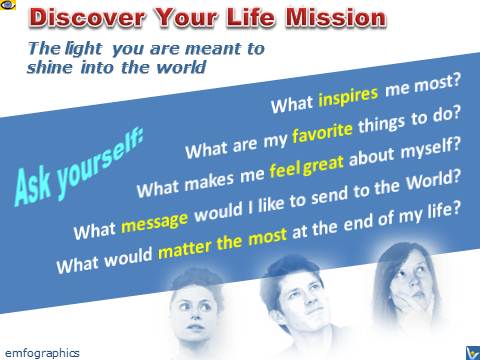
What do you love to do? Who are you professionally? Who are you – really?
What are your dreams and fears? Create a road map from
your dreams to
reality. Start the transition to a new you to achieve the results that are
beyond your wildest dreams.
Find or create a working environment where you
are allowed to be yourself and feel liberated to do your work as the best
expression of yourself, your dreams, and your abilities...
More
Be Different and Make a Difference!
Case
in Point
Dan Lok
"I get a lot of satisfaction from teaching,"
says Dan Lok, an Internet marketing guru. "Teaching copywriting, Internet
marketing... although I make money doing it, it does take up a lot of my
time. To constantly come up with new ideas, is difficult. It isn't the
smartest financial investment from a pure money perspective, but it is
rewarding emotionally.
"If I did it just for money, I wouldn't do it.
All my other businesses, I spend less time on. I don't have to manage them
day-to-day and send emails because they are on autopilot. But with
mentoring and teaching, I do it because I enjoy it, it keeps me going and it
validates all that I do."
Case
in Point
Bob
Griffith
Stressed out and deeply in debt, Griffiths left
a six-figure Wall Street position in 1988 to pursue his dream as a
playwright, actor, and teacher. He sold his eighteenth-century mansion and
downsized his luxury lifestyle, and he found
happiness
in the process.
In his book
"Do What You Love for the Rest of Your Life: A
Practical Guide to Career Change and Personal Renewal,"
Griffiths advises readers to commit to a career change, identifying doubts
(often money-related) before undertaking the process of identifying a
passion, perhaps by taking tests or seeing a career counselor. The new
career, says Griffiths, should integrate the personal and career selves.
Emphasizing the need for family discussions about such change, Griffiths
suggests that children care less about economic status than reliable
parenting. As for money, he suggests getting control of finances and
analyzing expectations, recognizing, e.g., that children can get a good
education at non-brand name schools. His advice ranges from the
psychological ("maintaining a constructive attitude") to the practical (make
a chart assessing the skills and abilities applicable to new career
possibilities). Avoid burning bridges, he says, as networking works better
than responding to job ads. Acknowledging the trade-offs, Griffiths
concludes that "self-worth" is more important than "net worth."
This roadmap shows how Griffiths and others
walked away from prestigious but unfulfilling careers and successfully
reinvented their lives. Theirs is an inward journey of facing their deepest
fears, of disempowering money and empowering themselves, and finding out who
they really are, beyond material possessions, ego, and status.
Estee Lauder: 15 Rules for
Entrepreneurial Success
Inspiring Vision
and
Stretch Goals
Your vision
performs both a directional and a
motivational
function. The purpose of your vision of a desirable future is to
inspire,
provide direction, and focus you on those things you could do now to bring
that future state about.
Set
stretch goals on your
journey to your vision and your true self. Stretch goals energize and push
you to work harder at meeting more difficult targets and to achieve more
than if you had set an easier goal.
Take Action
and Don’t Quit
“For true success ask yourself these four
questions: Why? Why not? Why not me? Why not now?” advises James Allen, the
author of As a Man Thinketh. Success is about persistent, consistent
action.
Action
is the key. If you do not take action you will achieve nothing. So, set
stretch goals and take action.
Balance
action and reflection – reflection of where you are now and action of
pushing toward where you need to go.
Never forget that failure is just a step to
your success. As
NLP Technology of Achievement
teaches us, “There is no such thing as
failure, only feedback.”
Feedback
Feedback is the
breakfast of champions and the foundation of success. It will help you learn
and do better next time. Take notice of feedback in all its forms. Pay
attention to detail.
If what you are doing is working, find out the
ingredients and sequences, then repeat them to get more of it. If what you
are doing isn't working,
be inventive – do something
different...
More
Yin-Yang of Entrepreneurial Creativity
The Tao of Success: The Art
of Living and Working
The Tao helps you achieve much more with much less effort. This
effortless skill comes from being in accord with reality. You can't tell the
singer from the song. You can't tell the dancer from the dance. When you are
in harmony the Tao, when you go with its current of energy, your
innate intelligence takes over, and the right action happens by itself.
If you think about it, you lose it. This is the purest and most effective
form of action that Tao Te Ching calls "not-doing" or "non-action".
The Tao teaches you the art of living and
the art of doing
business. It gives you advice that imparts perspective and
balance.
It applies equally well to the
managing a large corporation
or the running of a small business, to the governing of a nation or the
leading a small team, to
your personal development or to the
coaching of others. |