| |
|
Eternal Wisdom Born from Fire
Bhagavad Gita
The Art of War
The Science of Winning
|
|
 |
| |
|
Wars as a Source of Eternal Wisdom
Across civilizations, war has
been one of humanity’s harshest
teachers, forcing individuals,
leaders, and societies to
confront fear, duty, strategy,
ethics, and the limits of human
will.
|
|
|
 |
|
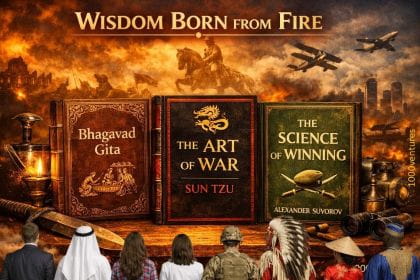
Three timeless works capture
this accumulated wisdom:
① The Bhagavad Gita,
which transforms the battlefield into a
spiritual classroom;
② Sun Tzu’s
The Art of War, which distills conflict
into principles of intelligence, perception, and
strategic harmony; and
③ Alexander
Suvorov’s The Science of Winning,
which elevates discipline, speed, and moral
strength into the foundations of victory.
Though born from
violence, these texts offer insights that today
illuminate intelligence, personal life, business
strategy, leadership, and international
relations. |
|
| |
|
The Bhagavad Gita
The Inner Battlefield
|
|
|
 |
If you will not fight this righteous
war, then you will fail in your duty, lose your reputation, and
incur sin. |
Bhagavad
Gitta |
 |
|
The Gita teaches that the deepest war is not fought
between armies but within the human mind. Arjuna’s
paralysis on the battlefield mirrors modern
dilemmas: ethical uncertainty, fear of
consequences, and the weight of responsibility. |
|
| |
|
Krishna’s guidance
– clarity of
purpose, disciplined action, detachment from ego, and
alignment with one’s dharma – remains profoundly relevant.
|
|
|
| |
Intelligence & decision‑making:
The Gita teaches calm
perception under pressure, the ability to separate
signal from noise, and the discipline to act without
emotional distortion. |
|
 |
 |
|
Life: It offers a framework for navigating moral
dilemmas, crises of identity, and moments of fear.
Business: Leaders who act from purpose rather than ego
make clearer, more sustainable decisions.
International relationships: The Gita warns that wars
arise when duty is abandoned and when leaders act from
fear or pride rather than clarity and principle. |
|
| |
"Man is made
by his belief. As he believes, so he is. You are
what you think you are... If you wan to see
heroic, look to those who can forgive... The
only way you can conquer me is through love, and
there I am gladly conquered."
~
Bhagavad Gita |
|
 |
| |
|
Sun Tzu’s The Art of War
Strategy as Harmony
|
|
|
| |
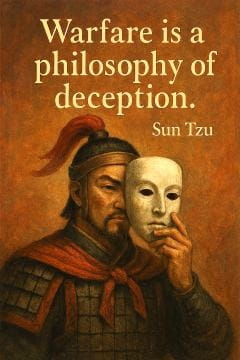
Sun Tzu reframes war as an
art of deception and a science of perception, where
the highest victory is the one achieved without
fighting.
"To win one
hundred victories in one hundred battles is not
the acme of skill. To subdue the enemy without
fighting is the acme of skill."
~ Sun Tzu
Sun Tzu's principles – know yourself, know the
other, shape conditions, win through intelligence rather
than force – have become universal tools for strategy. |
|
 |
 |
|
Intelligence: Sun Tzu’s emphasis on deception,
reconnaissance, and understanding the adversary forms
the backbone of modern intelligence analysis.
"He who controls
the element of
surprise will win the battle."
~ Sun Tzu |
|
 |
 |
|
Life: His teachings on timing, positioning, and avoiding
unnecessary conflict help individuals navigate personal
challenges with elegance.
Business: Entire fields
– competitive strategy,
negotiation, market positioning – are built on Sun Tzu’s
ideas of shaping the environment rather than reacting to
it.
International relationships:
Sun Tzu's core message – avoid war
through superior strategy – is a blueprint for diplomacy,
deterrence, and conflict prevention. |
|
| |
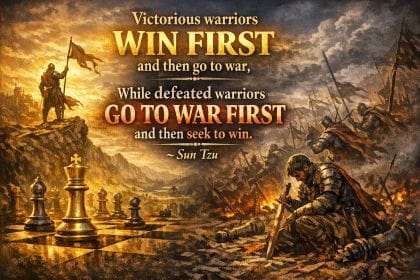
"What the
ancients called a clever fighter is one who not
only wins, but excels in winning with ease...
Make war without a standard approach... He who
controls the element of surprise will win the
battle."
~ Sun Tzu |
|
 |
|
 |
| |
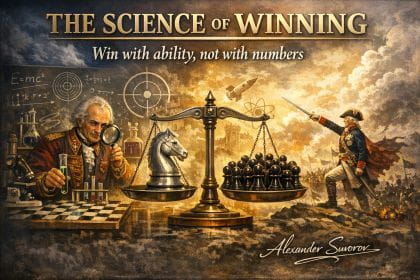
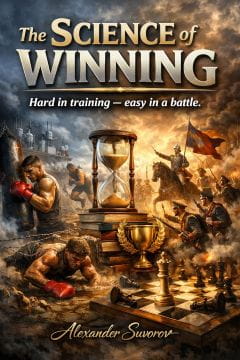
Alexander Suvorov, undefeated in battle, grounded his
philosophy not in abstract theory but in relentless
preparation, speed, simplicity, and moral strength. For
him, victory belonged to those who trained harder, moved
faster, and believed deeper. |
|
 |
 |
|
Intelligence: Suvorov’s insistence on preparation and
realism mirrors modern doctrines of readiness,
resilience, and rapid response.
Life: His principles
– discipline, endurance, and moral
clarity – remain essential for personal growth and
overcoming adversity.
Business: “Train hard, fight easy” translates into
continuous learning, operational excellence, and
building teams that can adapt under pressure.
International relationships: Suvorov’s focus on
strength, readiness, and deterrence reflects the logic
of modern security: peace is preserved when weakness
does not invite aggression. |
|
| |
|
As long
as the enemy fights he must be beaten relentlessly, but a defeated
enemy and especially the civilian population must be treated
generously." ~ Alexander
Suvorov
|
|
|
 |
A
semi-real conversation with wise winners |
 |
 |
|
"There are cases in which the greatest daring is
the greatest wisdom," said
Carl von Clausewitz.
"Is it possible to
defeat a much stronger opponent?" I asked.
"There is nothing impossible to him who will
try," answered
Alexander.
"Win
with ability, not with numbers," added
Suvorov.
"To win one
hundred victories in one hundred battles is not
the acme of skill. To subdue the enemy without
fighting is the acme of skill," said
Sun Tzu.
|
|
 |
|
Conclusion:
Wisdom Born from Fire
Though war is humanity’s greatest tragedy, these three
works show that it has also been a crucible for enduring
wisdom.
The Gita teaches inner mastery, Sun Tzu teaches
strategic harmony, and Suvorov teaches disciplined
action.
Together, they form a triad of insight that
guides not only generals but leaders, thinkers,
innovators, diplomats, and every individual navigating
the battles of modern life. |
|
|
Competitive War Games
▪
Business War Games |
|
|