| |
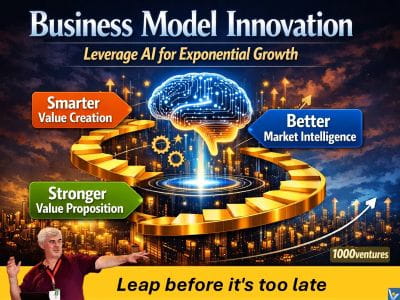
Leap before it's too late!
Leveraging AI for
exponential growth means smarter value creation,
better market intelligence, stronger value
proposition.
It is a strategic,
proactive leap to an innovative
business model to ensure long-term growth
and avoid obsolescence. |
|
 |
 |
|
Business model
innovation in the AI age moves companies from
input-output designs and lean structures to
AI-driven ecosystems, leveraging data automation
for exponential growth and
hyper-personalization.
It focuses on
creating greater value through productive
collaboration between humans and AI, which
results in, among other things, clearer
foresight, more effective strategies, smarter
value innovations, and more predictive
operations.
Shifting from
product-based to outcome-based revenue models is
also necessitated by the by new customer wants
in the AI age. |
|
| |
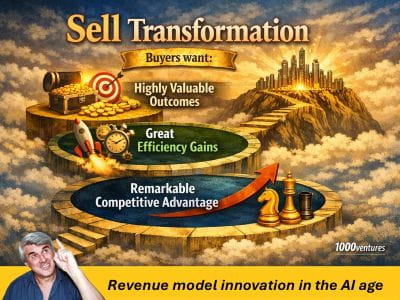
Revenue Model Innovation
In the AI era,
information is free and instant, making
traditional content-based selling obsolete. To
win, shift from selling "what" to "how". Focus
on delivering tailored, high-touch experiences
that AI cannot replicate. |
|
 |
|
Volkswagen decided to
invent a new business model |
| |
|
Key Elements
of AI-driven
business model
innovation
include Value Innovation; Value
Proposition; Revenue Model;
Value Creation/Operations; and
Ecosystem Management.
|
|
|
| |
Value
Innovation: A shift towards more informed
innovation strategies and tactics based on a
deeper and broader understanding and
anticipation of opportunities, risks, challenges
and change. |
|
AImpowerment
AI MAGic
Value Innovation |
|
 |
|
Value
Proposition: Shifting to intelligent,
personalized, and on-demand experiences that
anticipate customer wants and needs based on
better market intelligence and foresight.
Revenue Models:
Adopting usage-based or outcome-based pricing
rather than seat-based models to align payment
with results. For example, businesses that
previously sold information now sell services
that lead to positive transformation.
Value
Creation/Operations: Using generative AI to
design a circular business model or leaner
processes to reduce overhead and waste. |
|
 |
|
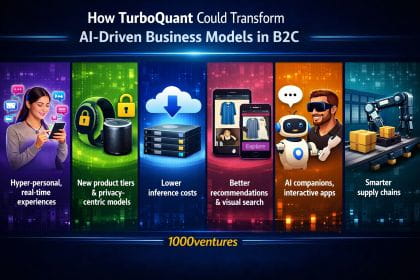
Google's TurboQuant Transform's AI‑Driven
Business Models in B2C
TurboQuant reduces
AI model size by up to 6x without sacrificing
accuracy. It may spur innovation in lightweight,
high-performance AI applications across
industries...
More |
|
 |
|
Key Strategies
for Implementation
Prioritize AI
Use Cases: identify which applications offer
the highest EBIT impact and lowest
implementation risk.
Data Strategy:
Ensure clean, integrated, and secure data is
available, as it is the foundation for AI
capability.
Organizational
Adaptation: Cultivate a culture of iterative
learning, as AI requires continuous testing,
rather than one-time implementation.
Hybrid Talent:
Combine technical AI expertise with
domain-specific knowledge to create functional
and valuable new models. |
|
|
|