| |
Summary
Business Inusual
is the discipline of making innovation your
default mode rather than an occasional project.
It is the mindset,
system, and culture that turn companies into
market shapers instead of market followers. |
|
 |
 |
|
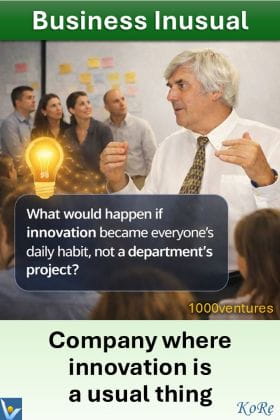
In Business Inusual, people live
innovation
This is the essence of Business
Inusual: innovation is not an
event, but a constant. Teammates
love to create innovative value
and adopt attitude of a tireless
loving creator.
When innovation
becomes “usual,” growth accelerates, competitors
become irrelevant, and customers feel the
difference long before they can explain it.
Let's explore the
three pillars that make such a business
possible: Intent, System, and People. |
|
| |
|
Intent
Burning Desire To Be a Market
Leader
|
|
|
| |
Strategic intent is the spark
that ignites the engine of
innovation.
Market leadership never begins with
strategy. It begins with desire – a deep, almost
unreasonable hunger to
redefine the game rather than play it.
|
|
 |
 |
|
Companies that
lead markets don’t wait for trends; they
create trends by introducing disruptive
innovations that
enthusiast customers admire. They don’t
benchmark competitors; they benchmark their own
potential. Their leaders cultivate appetite for
bold innovation and a restless ambition that
refuses to settle for “good enough.” This
strategic intent becomes a magnetic force
that inspires innovators and pulls the entire
organization forward.
A
burning desire to lead the
market sharpens decision‑making,
accelerates experimentation,
eliminates excuses, attracts
bold thinkers, and creates a
sense of inevitability around
success. |
|
| |
|
System
Making Innovation a Great
Constant
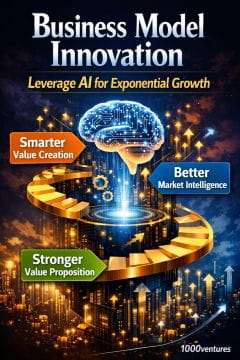
Innovation cannot depend on
luck, talent, or inspiration. It
must be systematic – repeatable,
measurable, and scalable.
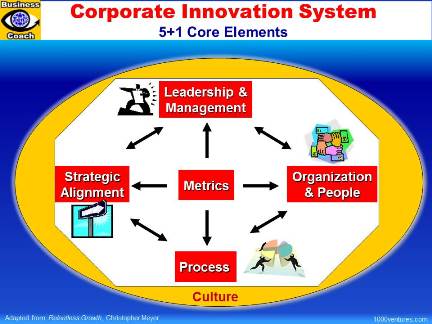
A
true innovation system:
|
|
|
| |
→ Establishes and institutionalizes weighted
guiding principles (WGP)
→ Encourages
supergamification, entrepreneurial
simulation games like
InnoBall (Innovation Brainball),
experimentation, rapid prototyping and fast
learning
→ Allows the
freedom to fail forward,
rewards
noble failures and punishes stagnation
→
Integrates customer insight into every cycle
→
Allocates resources to exploration, not just
optimization
→
Uses metrics that track learning, not just
output
|
|
 |
 |
|
When innovation
becomes a system, it becomes predictable.
When it becomes
predictable, it becomes a competitive advantage.
When it becomes a
competitive advantage, it becomes a habit. |
|
| |
|
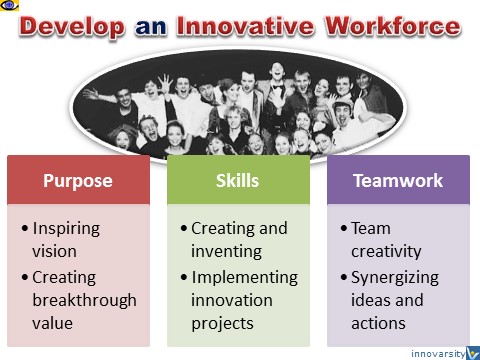
People
Culture of Creative
Dissatisfaction and Innovation
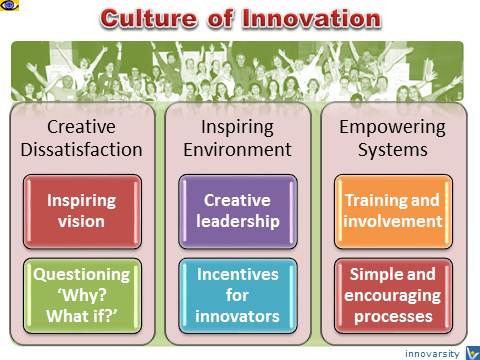
People are the living
infrastructure of innovation.
Tools and processes matter, but
culture determines whether
innovation thrives or dies.
|
|
 |
 |
|
A
culture of creative dissatisfaction is not
negative – it is energizing. It is the belief
that no matter how good something is, it can be
better. It is the refusal to accept the status
quo as permanent. |
|
| |
Such a culture:
→
Celebrates curiosity
→
Encourages constructive rebellion
→
Values diverse perspectives
→
Makes
synergistic collaboration natural
→
Turns problems into invitations |
|
 |
| |
|
When people feel safe to
challenge, empowered to create,
and inspired to improve,
innovation becomes the
organization’s native language.
|
|
|
 |
|
"Managers succeed
by following rules; Innovators succeed by
breaking rules."
~
KoRe proverb
* * *
Ask Yourself:
Intent: Do
I truly want to lead my market, or am I
unconsciously optimizing for comfort?
System:
Have I built a repeatable engine for innovation,
or am I relying on occasional bursts of
creativity?
People:
Does my culture reward bold thinking and
creative dissatisfaction, or does it quietly
punish it? |
|
|
|