Value Chain:

Business Process Management

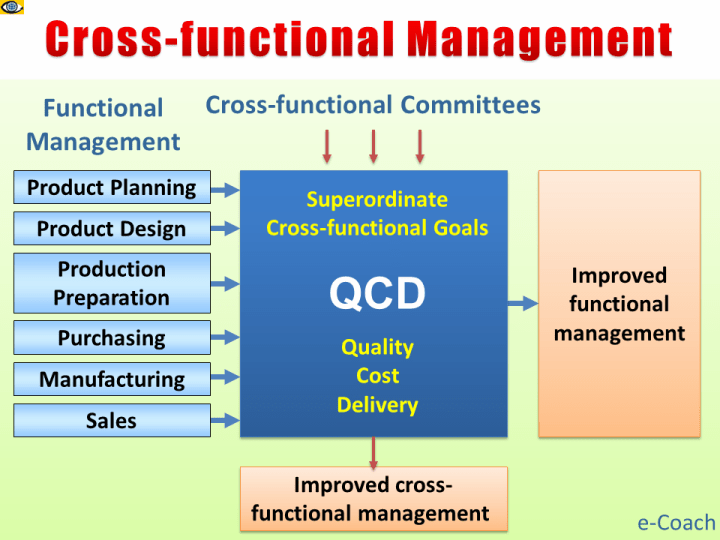
Cross-functional Management (CFM)

Building a Better Synergistic System for Quality, Cost, and Delivery, and Innovation

By Vadim Kotelnikov, Inventor, Author & Founder, Ten3 BUSINESS e-COACH – Innovation Unlimited, 1000ventures.com

"We should regard all the other management functions as existing to serve the three superordinate goals of Quality, Cost, Delivery (QCD)." – Shigeru Aoki, Toyota


Cross-functional Management Kaizen Systems Approach To Management

Intertwined Functional and Cross-Functional Activities

  1. Functions: each functional department has several cross-functional responsibilities; each top manager  in charge of a particular function has several cross-functional responsibilities.

  2. Cross-functions: each cross-function runs through several departments; several top managers are involved in the same cross-functional activity.

Two Major Goal Categories

  1. Goals relating to such measurable factors as profits, market share, and products

  2. Goals relating to overall improvements in the companies various systems and cross-functional activities

Total Quality Management (TQM) Strategy

Two Key Management Concepts

  1. Cross-functional management

  2. Policy deployment

Main Subjects for Suggestions in Japanese Companies

  • Improvements in machines and processes... More

 Discover much more!

Smart Corporate Leader

Leadership-Management Synergy

Smart Business Architect

6Ws of Corporate Growth

Using Best Practice: The Trotter Scorecard

Modern Manager

Management Function vs. Process Focus

Project Management

Business Processes

Enterprise-wide Business Process Management (EBPM)

8 Essential Principles of EBPM

4 Phases of IT/Business Alignment

10 Commandments of Improvement

Lean Production

Quick and Easy Kaizen

7 Principles of Toyota Production System (TPS)

5 Elements of Enabling a Lean Approach

Japanese-style Suggestion System

Quality Management

Deming's 14 Point Plan for Total Quality Management (TQM)

Business Model

New Business Models

  Ten3 Mini-Courses   Presentation:    View    Download

Synergistic Organization  (70 slides)

Synergizing Business Processes

Synergizing Value Chain

6Ws of Corporate Growth

Systemic Innovation

SMART Executive

Smart Business Architect

9 Signs of a Losing Organization

  1. Poor Cross-functional Collaboration: functional mindset;  lack of cross-functional goals and cross-functional collaboration spirit; functional, no enterprise-wide business process management; no cross-functional management committees; lack of or powerless cross-functional teams... More

Why Cross-functional Management?

Cross-functional management emerged from the following two needs:1

  1. a need for top management to clarify its quality, cost, and delivery goals and deploy them to all employees at every level, and

     
  2. a need to establish a system of close coordination among different departments.

What Is Cross-functional Management?

Cross-functional management (CFM) manages business processes across the traditional boundaries of the functional areas. CFM relates to coordinating and synergizing the activities of different units for realizing the superordinate cross-functional goals and policy deployment. It is concerned with building a better system for achieving such cross-functional goals as innovation, quality, cost, and delivery.

Two Components of a Policy

Policy is composed of both goals and measures.

Goals are usually quantitative figures such as targets for market share, sales, and profits.

Measures, on the other hand, are the specific means or action programs to achieve these goals.

A goal that is not supported by a description of specific measures to achieve it is merely a slogan. Thus, top management should determine both the goals and the measures and then deploy them throughout the organization.

Two Interwoven Goal Categories

The two key management's concepts supporting the TQM strategy are cross-functional management and policy deployment. Management's commitment to these concepts is expressed by directions provided by top management. Top management usually formulates its annual goals on the basis of long-range strategies and plans.

The major goal categories are:

  1. Goals related to such measurable factors as products, market share, and profits. These goals are a corporate response to external requirements such as shareholder pressures for profits.

  2. Goals relating to overall improvements in the companies various systems and cross-functional activities such as employee education, customer service, customer satisfaction, cost reduction, quality assurance,  delivery, and new product development. These goals is a self-generated move for improvement in corporate culture, and competitiveness. They call for cross-functional efforts cutting horizontally across the whole organization.

These two major goals for profit and improvement are interwoven.

Cross-functional goals should be set prior to determination of functional goals.

Cross-functional Goals are Superordinate Ones


In Total Quality Management (TQM) and Kaizen, the cross-functional goals of QCD (Quality, Cost, Delivery) are clearly defined as superior to such line functions as planning, design, production and sales. The positioning of cross-functional goal as superordinate ones necessitates a new systems approach to management, thinking and decision making. To achieve this, top managers must build their cross-functional expertise.

The goals for each cross-function of quality, cost, and delivery should be determined by either top management or a cross-functional committee organized at the top-management level.

 Case in Point  Toyota

Toyota was first in Japan with cross-functional management

At Toyota, all members of the cross-functional committee are board members representing the departments involved in a particular cross-function, such as quality or delivery. The goals and measures defined by the committee carry almost the same weight as those coming from the board. Each committee has about 10 members and is headed by a senior officer appointed by the president.1

Strategic Cross-Functional Management

Peter Drucker likens today's executive and his or her strategic plan to the symphony conductor with a complex musical score to direct.2 The conductor cannot hope to play each instrument as well as the specialized symphony members can, and so those experts are left alone to perfect their individual contributions. However, the conductor interprets the score and communicates to the orchestra an overall vision for how the piece should sound. Without the conductor and this shared understanding of the score, symphony becomes cacophony. Similarly, without executive leadership and direction provided through some overall strategic plan, decentralization and self-direction result in organizational mayhem.


Strategic cross-functional management is central to capitalizing on functional excellence, and in order for functional specialists to make the greatest possible contribution, they must take a broader view of their functions and understand how they fit into the web of the organizational processes and, ultimately, into the overall strategy.

Systems Approach to Management

The concept and practices of cross-functional management were developed to meet the need for systems approach to achieving the cross-functional goals of quality, cost and delivery. Within this concept:

  • Quality is concerned with building a better system for quality assurance

  • Cost is concerned with building a system for identifying cost factors and with reducing costs

  • Delivery refers to a better system for both scheduling and quantity.


Bibliography:

  1. "Kaizen," Masaaki Imai

  2. "The Coming of the New Organization," Peter Drucker


Map

Ranked #1

Search

Glossary

Free Downloads

  Products

Testimonials

Training

 Contact

We invented Business e-Coaching in 2001

Today, we have customers in 100+ countries!

Our customers:

3M, ABB, Adidas, Alcatel, American Express, Bayer, Boeing, British American Tobacco, BP, Canon, Cisco, Citigroup, Colgate, Corning, Deloitte, Ernst & Young, Fujitsu-Siemens, GE, Goldman Sachs, HP, Hitachi, Huyndai, IBM, Intel, Johnson & Johnson, JP Morgan Chase, KPMG, Lufthansa, Microsoft, Motorola, Nokia, Oracle, Renault, Samsung, Shell, Siemens, Sony, United Bank of Switzerland

Ten3 Mini-courses: SMART & FAST sets Full version of Ten3 Business e-Coach Ten3 Business e-Coach (home page)

Ten3 Business e-Coach

Inventor, Author & Founder – Vadim Kotelnikov

© Vadim Kotelnikov, GIVIS