|
| |
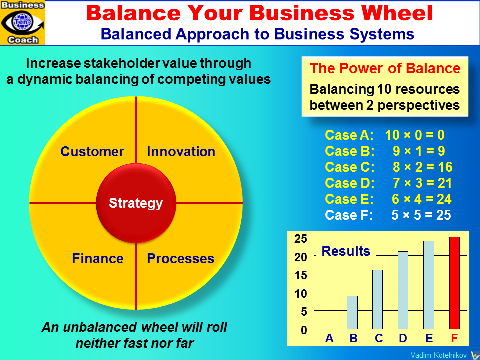
Balanced Business
Wheel
Increase
stakeholder value through dynamic balancing of 5 competing
values: strategy, customer, innovation, processes, finance...
More |
|
 |
| |
What is Business Systems Approach?
If you know that business is much more than finance
then you you know that you must design and manage your business
holistically and align
your performance measures with the organization's strategy.
The Business Systems approach
considers business as system of interrelated factors of strategy,
owners, investors, management, workers, finance, processes,
products, suppliers, customers, and competitors. |
| |
Organizations prosper by
achieving strategy that is
implemented as a result of continuous
decision-making at all levels of the business.
Firms
implement strategy through balancing the four major factors or perspectives:
① Financial perspective
② Customer perspective
③ Internal
business process perspective, and
④
Learning,
innovation, and growth perspective.
The four perspectives permit a
balance between short-term and
long-term objectives, between outcomes desired and the performance drivers
of those outcomes, and between hard objective measures and soft subjective
measures. |
| |
Achieving
Strategy through Balancing Competing Values
The primary goal of any business is to increase stakeholder value. It is achieved through a dynamic
balancing of
competing values. In order for a business to maximize economic value, it
must balance
customer satisfaction and competitive market forces with
internal cost and growth consideration...
More |
 |
| |
Systemic Approach to
Innovation
Until recently innovation has been seen principally as the
means to turn research results into commercially successful products, but
not all research leads to innovation and not all innovation is
research-based. Today,
→
innovation is systemic. It arises from complex interactions between many
individuals, organizations and their operating environment. Firms which are
successful in realizing the full returns from their technologies and
innovations are able to match their technological developments with
complementary expertise in other areas of their business, such as
manufacturing, distribution, human resources,
marketing, and
customer service...
More |
 |
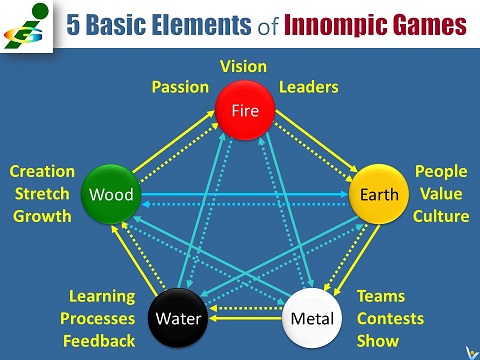
Balancing the Five Basic Elements may
look difficult at the beginning, but it becomes a natural,
continuous, and rewarding activity as you practice it. |
 Vadim
Vadim |
|
Inventor

Author

Founder
 |
|