Sustainable Competitive Advantage:
Lean Manufacturing
Case Study: Toyota
Toyota Production System as a Sustainable Competitive Advantage
By: Vadim Kotelnikov
Founder, Ten3 Business e-Coach – Your 360 Achievement Catalyst!
This site is
"Toyota Production System"
out of about
Specific Factors Underlying Toyota's Success
Lean manufacturing system.
An effective and efficient human resources management system, the cornerstone of which is a high level of employee loyalty and commitment to quality.
A state-of-the-art assembly system incorporating the latest robotic technology.
A well-coordinated network of world-class suppliers.
A highly effective and efficient just-in-time (JIT) inventory system.
Toyota's 10 Management Principles
Relentlessly strive to conduct Kaizen activities... More
Kaizen Mindset
Transitioning Your Company To a Lean Enterprise
13 Tips
Begin with action in the technical system and then follow quickly with cultural change... More
Implementing Kaizen: 7 Conditions
Discover much more!
Lean Production
5 Elements of Enabling a Lean Approach
10 Commandments of Improvement
Quick and Easy Kaizen
Successful Implementation of Kaizen Strategy: 7 Conditions
Japanese-style Suggestion System
9 Waste Categories and 6 Guidelines of the Canon's Suggestion System
Five Ss at Canon
Toyota’s Global Competitive Advantage
Toyota’s global competitive advantage is based on a corporate philosophy known as the Toyota Production System. The system depends in part on a human resources management policy that stimulates employee creativity and loyalty but also on a highly efficient network of suppliers and components manufacturers.
Lean Enterprise: 13 Tips
Employee Empowerment: Average Annual Results
More than 700,000 improvement suggestions were submitted by Toyota's employees.
That is an average of over 10 improvement suggestions per employee per year.
Over 99% of suggestions were implemented.
The Toyota Way: 14 Principles
The Toyota Way is not the Toyota Production System (TPS). The 14 Principles of the Toyota Way is a management philosophy used by the Toyota corporation that includes TPS, also known as lean manufacturing. TPS is the most systematic and highly developed example of what the principles of the Toyota Way can accomplish. The Toyota Way consists of the foundational principles of the Toyota culture, which allows the TPS to function so effectively...
Corporate Culture
The fundamental reason for Toyota's success in the global marketplace lies in its corporate philosophy – the set of rules and attitudes that govern the use of its resources. Toyota have successfully penetrated global markets and established a world-wide presence by virtue of its productivity. The company's approach to both product development and distribution is very consumer-friendly and market-driven. Toyota's philosophy of empowering its workers is the centrepiece of a human resources management system that fosters creativity, continuous improvement, and innovation by encouraging employee participation, and that likewise engenders high levels of employee loyalty. Knowing that a workplace with high morale and job satisfaction is more likely to produce reliable, high-quality products at affordable prices, Toyota have institutionalized many successful workforce practices. Toyota has done so not only in its own plants but also in supplier plants that were experiencing problems.1
Although many car manufacturers have earned a reputation for building high-quality cars, they have been unable to overcome Toyota's advantages in human resource management, supplier networks and distribution systems in the highly competitive car market. Much of Toyota's success in the world markets is attributed directly to the synergistic performance of its policies in human resources management and supply-chain networks.
Five Ss
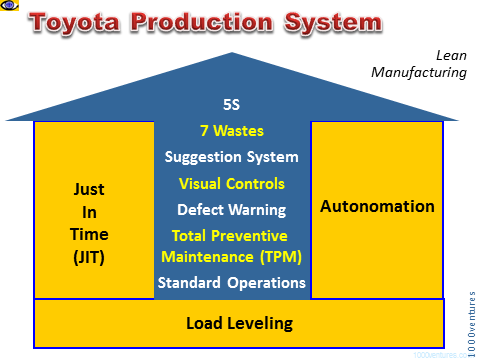
The Five Ss refer to the five dimensions of of workplace optimization: Seiri (Sort), Seiton (Set in order), Seiso (Shine), Seiketsu (Standardize), and Shitsuke (Sustain)... More
7 Principles of TPS
Pull Production: To reduce inventory holding costs and lead times, Toyota developed the pull production method wherein the quantity of work performed at each stage of the process is dictated solely by demand for materials from the immediate next stage. The Kamban scheme coordinates the flow of small containers of materials between stages. This is where the term Just-in-Time (JIT) originated.
The Focus of Toyota Production System
Real TPS is not just about “flow” or “pull production” or “cellular manufacturing” or "load leveling". TPS in Toyota is primarily concerned with making a profit, and satisfying the customer with the highest possible quality at the lowest cost in the shortest lead-time, while developing the talents and skills of its workforce through rigorous improvement routines and problem solving disciplines. This stated aim is mixed in with the twin production principles of Just in Time (make and deliver the right part, in the right amount, at the right time), and Jidoka (build in quality at the process), as well as the notion of continuous improvement by standardization and elimination of waste in all operations to improve quality, cost, productivity, lead-time, safety, morale and other metrics as needed.2
Ваш обозреватель не поддерживает встроенные рамки или он не настроен на их отображение.
References:
Creating Sustainable Competitive Advantage: The Toyota Philosophy and Its Effects, M. Reza Vaghefi
TPS vs. Lean and the Law of Unintended Consequences, Art Smalley, President, Art of Lean, Inc.
Toyota Production System, Taiichi Ohno
The Toyota Way, Jeffrey Liker
Kanban Just-In-Time at Toyota, Japan Management Association
Lean Manufacturing That Works, Bill Carreira
Lean Production Simplified, Pascal Dennis, John Shook
The Lean Manufacturing Pocket Handbook, Kenneth W. Dailey
Study of the Toyota Production System: From an Industrial Engineering Viewpoint, Shigeo Shingo
Lean Manufacturing Overview
254 slides by Superfactory
Lean Manufacturing - 5S - Visual Controls - Kaizen - Value Streams - Pull - Mistake Proofing - Quick Changeover - Six Sigma - Theory of Constraints
► US$80 ► See sample slides ► BUY NOW!
Free Micro-course
10 slides
Kaizen
Ten3 Mini-Courses
Synergizing Business Processes (60 slides)
Synergizing Value Chain (200 slides)
3 Strategies of Market Leaders (125 slides)
Free Ten3 Micro-courses
Kaizen and Lean Manufacturing
Ten3 Global Business Learning Report
Asia-Pacific
Map
Ranked #1
Search
Glossary
Free Downloads
Products
Testimonials
Training
Contact
We invented Business e-Coaching in 2001
Today, we have customers in 100+ countries!
Our customers:
Ten3 Business e-Coach
Inventor, Author & Founder – Vadim Kotelnikov
© Vadim Kotelnikov, GIVIS