|
The Central Belief
"Business process thinking is predicated upon
the central belief that it is fundamentally the complex, cross-departmental,
technology-enabled business process that
create value to customers
and shareholders."
This predication assumes that every significant
management activity should begin with an analysis of customers' needs and
have, as an intrinsic objective, the shared understanding of the key
business processes or
organizational capabilities
that are critical to satisfying those needs."2
Transforming the
Traditional
Functional
Mindset
Excerpts from BPM – Approaches & Best
Practices.
Andrew Spanyi
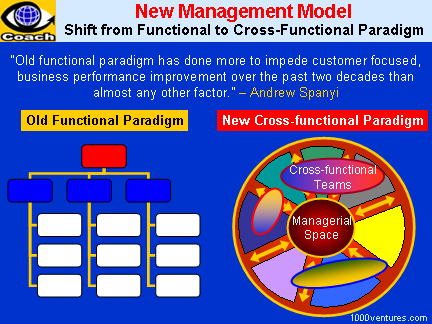
In far too many organizations, senior
management's traditional functional mindset represents one of the most
significant barriers to change. Indeed, there is reason to believe that the
traditional functional paradigm has done more to impede customer focused,
business performance improvement over the past two decades than almost any
other factor.
This way of thinking stands in the way of
executives understanding and improving the flow of cross-functional
activities which
create enduring value for customers and shareholders. It promotes the
type of thinking that impedes the effective deployment of enabling
information technology. It promotes also 'silo behavior' and turf
protection, and an undue pre-occupation with organization structure. This
mindset contributes to the mistaken belief that if it was somehow possible
to properly define the boxes on the organizational chart, and fill in the
names of the "right" people in the key boxes – then the organization's
performance will automatically improve. Yet, little is further from the
truth.
Further, it encourages a distorted view of
performance measurement and
executive
rewards, shifting focus away from meaningful measures such as the
timeliness and quality of services provided to customers, and towards less
significant measures around functional departmental performance.
It reinforces a task focus and traditional
command and control behavior, where questions such as 'What is the scope of
my responsibility?' 'What tasks I execute?' and 'Who are the key
subordinates who can help me look good?' are foremost and top of mind.
Moreover, traditional functional thinking has
also led to outdated management practices in the areas of
goal setting
and
problem solving
and it stifles
innovation.
So what to do? How can you transform the
traditional functional mindset such that your organization is designed to
make it
easy for
customers to do business with the company and easier for employees to
better serve the company's customers?
There is increasing evidence that an effective
way of transforming the traditional functional mindset is to embrace
enterprise business process thinking and
install enterprise business process management
(EBPM) practices.
What does this involve? Frankly, it requires a
lot of very hard work, and concepts which will make some of
your executives very, very uncomfortable.
Why do it? Simply because the benefits of
making
this mental model transition are significant.
Kaizen
– the Japanese Management Philosophy
Kaizen means "improvement". Kaizen
strategy calls for never-ending efforts for improvement involving everyone
in the organization – managers and workers alike. It concentrates at
improving the
process
rather than at achieving certain results. Such managerial attitudes and
process thinking make a major difference in how an organization
masters change
and achieves improvements...
More |