|
New Definitions of Value
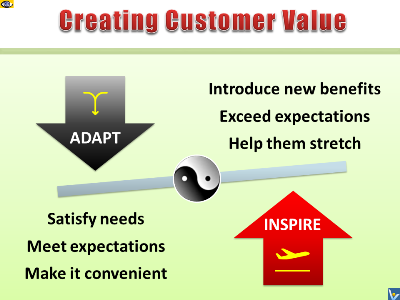
From the customer's point of view, your company
exists only to create value for them, to provide them
with results.
In the
new rapidly changing economy dominated by buyers, the nature of customer value is changing, involving new ways
to price goods,
innovation and
emotion.
There are multitudes of values present in
every face-to-face buyer-seller exchange: economic, informational and
emotions.
These exchanges increasingly happen so fast that there is no time to
translate them into precise monetary terms. Businesses will need to identify
these
hidden values and think more accurately about their worth before
accepting the price proposed. The implications are profound. Companies will
need to think in terms of offers and
customer experience journey, which involve merging products and
services to exploit their knowledge to give customers an outstanding and
memorable
value-added
experience.
Value Innovation
Why do some companies achieve sustained high
growth in both revenues and profits?
In a five-year study of high-growth
companies and their less successful competitors, researchers7
found that the answer lies in the way each group approach
strategy.
The difference in approach was not a matter of managers choosing one
analytical tool or planning model over another. The difference was in the
companies' fundamental, implicit assumptions about strategy. The less
successful companies took a conventional approach: their strategic thinking
was dominated by the idea of
staying
ahead of the competition. In stark contrast, the
high-growth companies paid
little attention to matching or beating their rivals. Instead, they sought
to make their competitors irrelevant through a strategic logic called
→
value innovation...
More
Innovation Is Love
Innovation is actually a very
simple
phenomenon.
Innovation is about
Love:
→
do what you love to do
and love your customers...
More
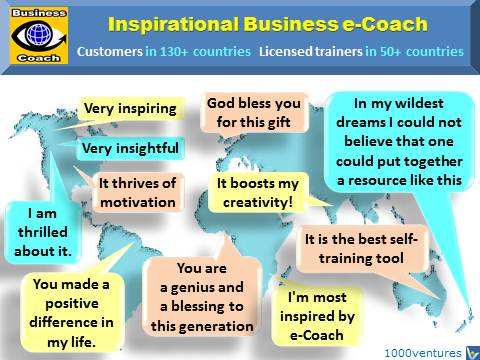
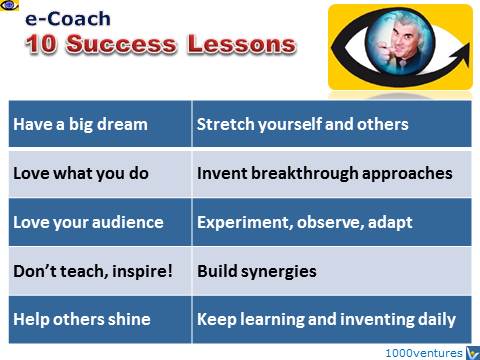
 Ten3 Business e-Coach Ten3 Business e-Coach
With customer care at heart, Ten3 Business
e-Coach creates unique customer value: It doesn't teach, it inspires. It
helps people and companies unlock their inner creative power and achieve
amazing results. That's why
Ten3 Business e-Coach and
Ten3 Mini-courses are so popular. People and companies from 100+
countries buy them.
Below are some unsolicited "Thank You!" notes that illustrate the value Ten3
Business e-Coach creates for people like you:
● " I
read your webpage and bells started ringing for me!"
–
Zachrey Helmberger,
USA
● "It produces a 'bomb effect'! "
–
Mikael Henzler,
Germany
● "It is boosting my
→
creativity!"
–
Udaysinh Patil,
India
Much more "Thank
You!" notes are published
here.
See also:
Business e-Coach focused on Entrepreneurship
Business e-Coach focused on SMEs
●
ICT for SMEs
Business e-Coach focused on Asia and the Pacific
Creating Value Through Collaboration With
Others
To
→
create more value for both
→
your customers and shareholders, your business has to become more
adaptive. It cannot evolve in isolation. Today, the
business ecosystem replaced
traditional concepts of industry and market with business communities of
interacting organizations that together create, deliver and consume goods
and services.5 You have to co-evolve and create value
through collaboration with others.
>>>
Strategies for a Small
Business
If you own a
small
or
medium-scale business, it's essential
that you offer customized, non-commodity solutions that meet your clients'
specific niche needs...
More
Become an
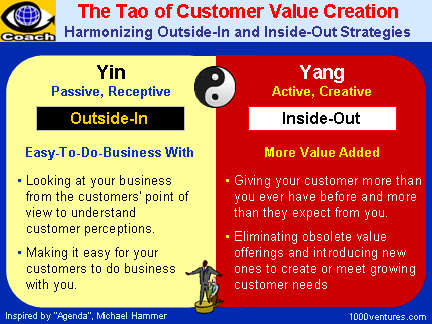
Easy-To-Do-Business-With (ETDBW) Firm
ETDBW is not about what
you give your customer, it is about how
you do it. It's about giving your products and services to the customers in
a more convenient way. Employing the
six ETDBW techniques
"will make your customers look forward to doing business with you rather
than cringe at the prospect. Becoming ETDBW works to your advantage in two
ways: It not only saves your customers money, thereby making them
more loyal to you, it
saves you money as well."2
Establish a Process-managed
Enterprise
First of all, you must
overcome traditional functional thinking, adopt
process thinking attitudes and
practices, and
and get obsessed about the end-to-end
enterprise business processes (EBP) that create value for
your customers...
More
Value Chain Management
Making
breakthrough improvements in your
value chain requires
out
of the box,
cross-functional,
systems thinking.
You have to see the value creation process across the entire flow of work,
not just single points...
More
Continuous
Improvement
CIF is a firm continuously
improving on
customer value due to improvements in
productivity initiated by
the members of the general work force.
Productivity in CIF is broadly
defined to include all facets of product
→
quality
as well as output per worker...
More
Customer Intimacy
– a New Way of Doing Business
Customer-intimate companies develop a new mindset –
a new way
of doing business – with new
→
values, new
→vision,
new
strategies, new
systems, and new structures. They are in the business of creating new
value for their customers. They discover unsuspected problems, detect
unrealized potential, and create a dynamic
→
synergy
with customers...
More
|