 |
|
Constructive Feedback is a
helpful response to someone's actions designed to
improve their effectiveness, performance, and
productivity.
What
Constructive feedback
highlights how a person could do better next time.
|
|
 |
Experience is not what happens
to you, it is what you
learn
from it.
~
Vadim
Kotelnikov |
|
How
Constructive feedback needs to be delivered
empathetically, sensitively, in a non-judgmental way
Where
Constructive feedback
should focus on the desired future state and performance improvement
strategies. |
|
| |
|
Example:
Mister Innovation World
award winner
|
|
|
| |
Dennis,
Mister Innovation
World award
winner, an
outstanding
actor and singer, is never
satisfied with his
performances. He
doesn't seek a
praise. Instead,
after every
performance, Dennis
asks others what he
could do better.
Their feedback helps
Dennis keep making
his performances
increasingly better. |
|
 |
|
 |
| |
|
Constructive Feedback Tips
|
|
|
|
|
|
▪
Use feedback to give Information and ask effective
eye-opening
questions – not to give an advice.
▪
Be
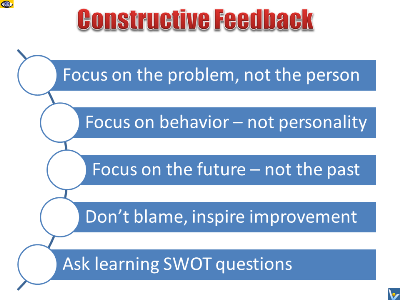
soft on the person, but hard on goals. Focus on behavior, actions and
results – not personality.
▪
Be a friend or a neutral observer – not a judge. Inspire critical thinking,
creative problem solving and search for opportunities for improvement.
▪ First,
acknowledge player's feelings and needs, then encourage and focus on
improvements.
▪
Invite the player to assess his/her own performance first; guide him/her by
asking effective questions.
▪
Ask
learning SWOT questions: What internal strengths and weaknesses of the
player did his/her recent actions reveal? What external threats and
opportunities emerged?
▪
Focus on the future – not the past. Jointly paint the picture of the desired
future state.
▪
Focus on the problem, not the person. Uncover root problems by asking ‘Why?’
questions until you reach the root problem.
▪
Don’t blame, inspire search for the best way out of the current situation.
|
|
|
|