Search


Though everybody agrees that the best ideas should win, creating a corporate environment where the best ideas do win is a business-design art not yet mastered by most companies and it prevents them from achieving growth 10+ and standing out from their competition.


If you are not fast enough, you'll be defeated both from inside and outside.

To make fuller use of the intellectual potential of your employees and energize them, create an environment where the best idea does win.

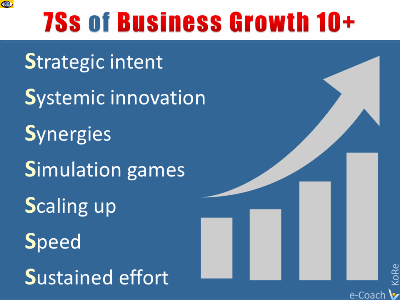
  7Ss of Business Growth 10+ Synergies Strategic Intent Growth 10+ Simulation Games Systemic Innovation Business e-Coach Speed Scaling Up Sustained Effort Fast Company - 7Ss of Exponential Business Growth 10+


KoRe Thinking Innovatons by Vadim Kotelnikov  

KoRe nugget: Today and always, remove barriers that prevent great ideas from becoming reality. The best way to select the best ideas is to establish Weighted Guiding Principles (WGP)


How to use Weighted Guiding Principles (WGP)

Formulate guiding principles and assign a weight to each one. This will allow you to determine a numerical value for every idea and quickly select the best ones.

→ Examples

  How to evaluate ideas quickly: Weighted Guiding Principles (WGP)


InnoBall (Innovation Brainball)


InnoBall (Innovation Brainball) entrepreneurial simulation game helps to establish the best-ideas-win environment.

InnoBall helps simulate implementation of ideas, assess their business potential, and prepare to win.

  Meritocracy tools and example: InnoBall business simulation game


"The operative assumption today is that someone, somewhere, has a better idea; and the operative compulsion is to find out who has that better idea, learn it and put into action – fast." ~ Jack Welch


Example: Red Hat Inc.

"While a meritocracy can be a bit of a bumpy road (lots of voices = lots of opinions = lots of data to dissect), at my company I have found that it truly does help us stay on the cutting edge and bring to light the best ideas. It also helps us keep associates engaged and fosters genuine leadership. What more could you ask for?"

~ James Whitehurst


Creative Leadership

Inclusive Leadership

Stimulate Generation of Radical Ideas

Cross-pollination of Ideas

Tips


Practices Preventing Idea Generation by Employees
in Hierarchical Structures and Losing Organizations

According to Jason Jennings and Laurence Haughton, the authors of
It's not the big that eat the small... it's the fast that eat the slow

→ Hijacking of ideas by the time they make it up the corporate ladder – when that happens, workers retaliate by keeping good ideas to themselves, thus slowing down the organization's thinking

→ Taking away sharp edges of ideas while they pass up through a hierarchical structure – when their ideas get honed down to something that doesn't mean anything, people become discouraged and state that they either don't have the time or interest in putting forth their ideas

→ Human barriers to change – rejecting good ideas that may change the status quo and thus threaten personal interests of a corporate 'gatekeeper'