|
Balanced Organization:
5 Basic Elements
Performance
Management (Water):
Keep in mind however, that without a proper
differentiation strategy,
mastering operational effectiveness alone is not enough to win the
marketplace.
Leadership in operational costs of production that allows for
low prices is very difficult to sustain. Price wars are very dangerous, so
avoid them wherever possible.
Case in
Point
Using the Best Practice
at GE: The Trotter Scorecard
Many
GE
business units employ a tool called the Trotter Matrix to check on their
use of best practices. The scorecard was developed by Lloyd Trotter, who ran
the Electrical Distribution and Controls side at GE. He listed six desirable
attributes for each of his plants and then scored each attribute.
Continuous Improvement Firm (CIF)
CIF is a
firm continuously
improving on value due to
improvements in
productivity initiated by the members of the general work force.
Productivity in CIF is broadly defined to include all facets of product
quality as well as output per worker. A basic operating principle of the CIF
is that improvements in product quality often produce simultaneous
reductions in costs.
The key success factor in this endogenous,
incremental and continuous technological and operational change is the
organization and management of the firm in such a way that all members are
motivated to promote change and are supported in their effort to do so. What
is remarkable about the CIF is its ability to operate simultaneously in all
innovative arenas: new products,
new technology,
new organizational forms,
and new customer relationship management...
More
5Ss
The 5S Program
defines the steps that are used to make all work spaces efficient
and productive, help people share work stations, reduce time looking
for needed tools and improve the work environment...
More
Case in Point
Canon: Eliminating
9 Wastes
The objectives of
Canon Production
System (CPS) are to manufacture better quality products at lower
cost and deliver them faster.
Canon invited all their employees to suggest
ideas for improvement and developed 6 Guidelines for the Suggestion System
to make it most effective. The company developed also a list of
9 wastes
to help their employees become problem-conscious, move from operational
improvement to systems improvement, and recognize the need for
self-development.
STRIDES Problem Solving Model
The
STRIDES model was developed by the Quality Support Council of
Fidelity Investments. This
problem solving model
provides employees in every part of the corporation with a common
language and process for implementing
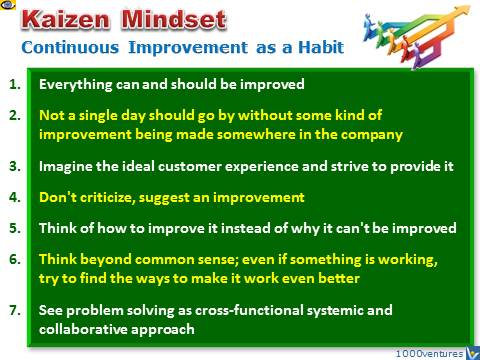
Kaizen
– a strategy of continuous improvement. As stated in Fidelity's Models
for
Quality Improvement, STRIDES is the approach to use "where the
problem is more complex."...
More
Lean Production
Lean is about doing more with less: less time,
inventory, space people and money.
Lean Enterprise: 13 Tips
Lean
Manufacturing (also known as the
Toyota
Production System) is, in its most
basic form, the systematic elimination of waste - overproduction, waiting,
transportation, inventory, motion, over-processing, defective units –
and the implementation of the concepts of continuous flow and customer pull.
Five areas drive lean manufacturing/production:
cost, quality,
delivery,
safety, and
morale.
Just as mass production is recognized as the production system of the 20th
century, lean production is viewed as the production system of the 21st
century...
More
Six Sigma
Six Sigma is a
long-term, forward-thinking initiative designed to fundamentally change the
way corporations do business. It is first and foremost "a business process
that enables companies to increase profits dramatically by streamlining
operations, improving quality, and eliminating defects or mistakes in
everything a company does. While traditional quality programs have focused
on detecting and correcting defects, Six Sigma encompasses something
broader: It provides specific methods to re-create the process itself so
that defects are never produced in the first place...
More
Enterprise-wide Business Process
Management (EBPM)
EBPM can assist you to develop greater clarity on strategic
direction and cascade it through your organization. A
process-managed enterprise supports,
empowers and
energizes employees,
encourages their initiative, enables and allows its people to perform
process work.
Value
chain leadership requires cultivation of a
shared vision in
all participants.
The shared vision provides common direction and focus,
motivates personal, team, and
organizational
learning, and thus enables all participants in the value chain to work
toward common goals...
More
Inspirational Business Plan:
Successful Innovation
Targeted Market:
"We know where most of the
creativity, the
innovation, the stuff that drives
productivity lies – in the minds of those
closest to the work."
–
Jack Welch...
More
Principal Lessons About Operational
Excellence Programs...
Process-managed
Enterprise...
Process Thinking...
BPMS:
Business Process Management System...
Reward
System...
Measuring Efficiency Improvement...
Two
Elements of a Contemporary Measurement System...
Apply 80/20
Rule to
Improve Your Margins...
A Connected Enterprise...
Extended Enterprise...
Virtual Integration...
Business Process Outsourcing (BPO)...
e-Business...
Bridging IT-Business Divide...
IT Architect...
Cleaner Production...
Case in Point:
General
Electric...
Case in Point:
GE
Work-Out...
Case in Point:
Dell Computer Corporation...
Case in Point:
British Petroleum...
Case in Point:
Toyota Production System...
Case in Point:
"Great Game of Business"...
Case Study Amazon.com...
Case Study
Avis...
Case in Point:
Six
Sigma Implementation at GE...
Case in Point:
Lean
Production at Gold Seal Engineering... |