| |
|
Selective Perceptions
By:
Vadim Kotelnikov
Perceptions drives our lives and
businesses because we gain
information about the world
through perception.
Selective perception is an
automatic mental habit. People
notice things that fit their
beliefs and ignore facts that do
not.
Understanding selective
perception helps improve
communication, empathy, and
critical thinking in personal
and professional contexts.
|
|
 |
 |
|
'We see things not as they are, but as we are'
The quote 'We see things not as they are, but as we are' reflects
the idea that perception is shaped by one's inner state - emotions,
beliefs, and experiences. Attributed to Anaïs Nin (though similar
philosophical ideas go back centuries), it underscores how
subjective reality is.
Our 'I' filters what we observe, making perception a mirror of the
self rather than an objective reflection of truth.
|
|
| |
An example of opposing views on
the same issue
August 2026.
NATO
leaders stated that their military exercises
near the Russian border were intended to
demonstrate the strength of NATO's military to
Russia.
Russian generals, after observing these
exercises, said they demonstrated the weakness
of NATO's military.
|
|
Ukraine War
The Next War Against
Rustate
Quotes by Military
Commanders |
|
| |
|
Selective perceptions in an
audience can be created
externally
|
|
|
| |
|
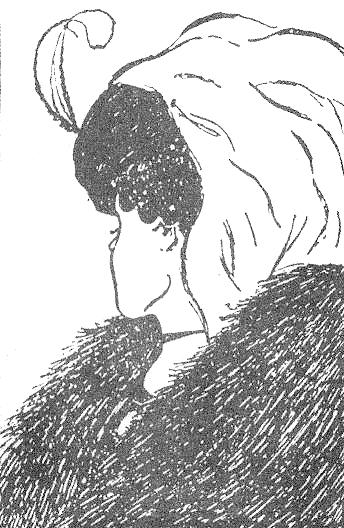
Here's an example of
selective perceptions formed
externally:
|
|
|
 |
|
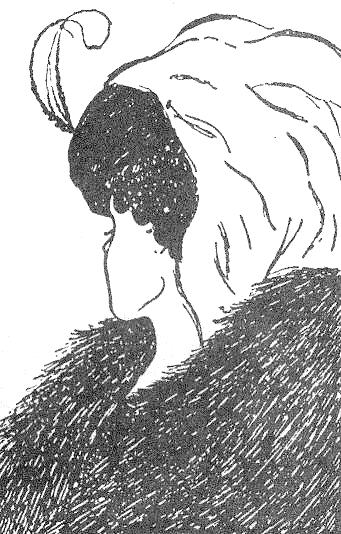
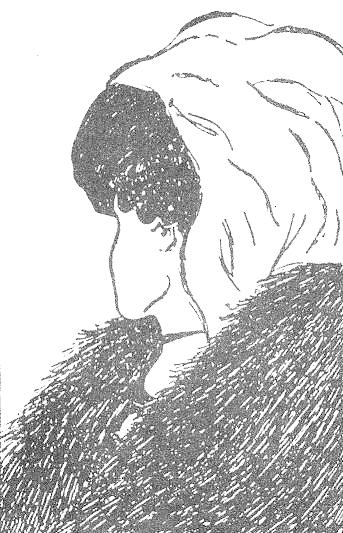
Does the picture depict a young,
beautiful woman or a poor old
woman?
Psychologists conducted an
experiment. They divided several
dozen people into two groups and
showed them the same picture.
People in the first group
claimed that the picture
depicted a young, beautiful, and
rich woman, while people in the
second group, looking at the
same picture, claimed that it
depicted an old, ugly, and poor
woman.
Why did the two groups of people
have such different perceptions
of the same picture? |
|
| |
|
The fact is that these two
groups of people were previously
shown similar but different
pictures, which pre-formed their
understanding of what was
depicted in the picture shown to
both groups.
The first group was shown the
left image beforehand, and the
second group was shown the right image
beforehand. This shaped people's
one-sided views, which
determined their subsequent
beliefs.
|
|
|
| |
|
Selective perception is the
unconscious process through
which individuals filter and
interpret information based on
their beliefs, emotions, and
experiences. It leads people to
notice certain stimuli while
ignoring others, especially
those that challenge their views
or cause discomfort.
This phenomenon influences how
we perceive media, communicate,
and make decisions. By focusing
on congruent information,
individuals reinforce existing
attitudes, sometimes leading to
biased judgments or confirmation
bias. This filter protects the
mind from stress, but it also
creates blind spots in daily
life and media choices.
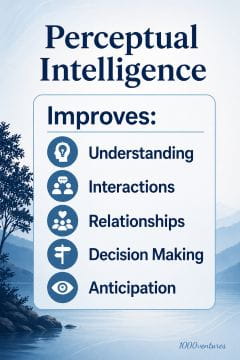
Perceptual intelligence (PI)
can
make you a fortune. →
Example
|
|
|
| |
|
Perceptions Rule Our Life and Business
How we generate information about the world is perceiving.
|
|
|
| |
Our life and business – decision making, communication, negotiation,
leadership, teamwork, motivation, value innovation, differentiation,
marketing, etc. – is all about perceptions. The essence of leading,
managing and selling is coming to grips with people's perceptions.
|
|
 |
| |
|
Most of your judgments result
from decisional shortcuts you
use to generate solutions that
are good enough most of the
time. When you perceive a
situation that looks familiar to
you, doesn't your past
experience cause you to see the
event in terms of what you
expect? Doesn't your limited
span of attention lead you to
categorize things by aspects
that appear similar to what you
already know?
|
|
|
| |
"We are constantly
bombarded with so much sensory information that
it is impossible for us to pay attention to
everything. Our
subconscious mind scans our environment and
selects what it deems may be important for us to
notice. Even then, people not only see things
the way they are, they also tend to see what
they expect to see, as well as what they want to
see." ~
Steve W. Williams |
|
"Much of human
perception is based not on information flowing
into the brain from the outside world but what
the brain, based on previous experience, expects
to happen next.”
~ Sandra Blakeslee
|
|
|
|