| |
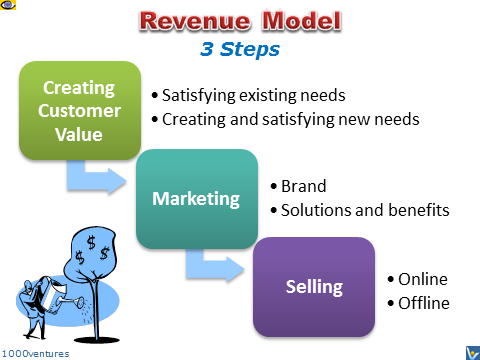
Leverage
artificial intelligence (AI)
enhance you
revenue model. In the AI era, information is
free and instant, making traditional
content-based selling obsolete. To win, shift
from selling "what" (data, features) to "how"
(transformation, outcomes, and trust).
Sell positive
transformation, not information. |
|
 |
| |
|
Focus on delivering tailored,
high-touch experiences that AI
cannot replicate, such as
strategic guidance, emotional
connection, and proven,
customized implementation that
drives revenue.
|
|
|
 |
|
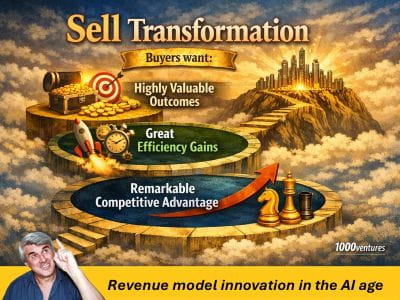
AI kind of killed
"information" as a product. People ask AI and
get a pretty solid answer in about 30 seconds –
for free. That changes the game for a lot of
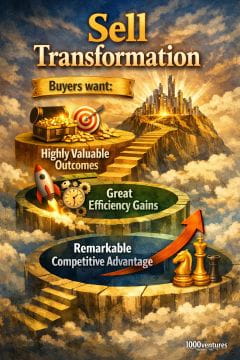
people. Buyers aren't seeking more facts; they
want highly valuable outcomes, great efficiency
gains, and remarkable competitive advantage.
|
|
| |
|
Businesses that sold information
in the pre-AI age now sell
services that lead to positive
transformation.
Ask yourself: does your value
proposition sound like an AI
overview or a before-and-after
story?
|
|
|
 |
|
That distinction
is everything right now. The people making real
money in this new AI era are not selling
information. They're selling outcomes.
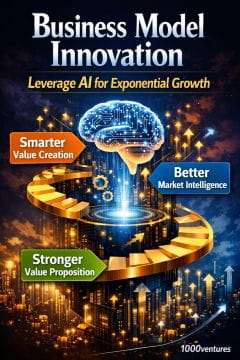
Value
Proposition: Shifting to intelligent,
personalized, and on-demand experiences that
anticipate customer wants and needs based on
better market intelligence and foresight.
Revenue Models:
Adopting usage-based or outcome-based pricing
rather than seat-based models to align payment
with results.
Don't try to sell something that AI can explain
for free. Sell something that prospects actually
have to go through.
|
|
| |
|
For instance, in business
education "Here's how
(something) works" is dying.
"Gain your first 100 customers
in 90 days, step by step",
"Triple the success rate of your
breakthrough project in three
days by playing the simulation
game
InnoBall", or "Shift from
organic growth to exponential
growth 10+ in two years" are
in demand.
|
|
|
|
 |
| |
|
Key Shifts from Information to
Transformation
|
|
|
 |
|
From Content to Context: AI provides
data, but human sellers must interpret it to
solve specific, complex client problems.
From Features to Outcomes: Customers
don't want more tools; they want transformation
that reduces effort and increases efficiency.
From "Know" to "Do": Sell implementation,
integration, and proof of value rather than just
information.
From Automated to Human: Use AI for
research, but rely on human
empathy,
trust, and
relationship-building to close complex
deals.
|
|
| |
|
Strategies
for
Selling Transformation
|
|
|
 |
|
Lead with
Insights, Not Pitches: Use AI to research
prospects' industry pressures, then use that to
offer a personalized perspective before
pitching.
Map the
"Before" and "After": Clearly articulate the
operational shift a client will undergo, moving
them from their current "pain" to a future state
of success.
Adopt a
"Consultative" Mindset: Focus on helping
clients navigate technical realities and
providing data-backed recommendations, rather
than just selling software.
Focus on Trust
and Reliability: In an era of AI hype,
customers value dependability and human
accountability. |
|
| |
|
Summary
In
the AI era, information is
abundant and instantly
accessible, rendering
traditional knowledge-based
selling obsolete. Instead of
pitching data or expertise,
successful sellers must focus on
delivering tangible
transformation – how AI empowers
businesses to innovate faster,
reduce costs, or unlock new
revenue streams.
The shift is from 'what we know'
to 'what we can achieve
together.'
Buyers aren't seeking more
facts; they want highly valuable
outcomes, great efficiency
gains, and remarkable
competitive advantage.
By
positioning your solution as
a catalyst for change, you align
with evolving buyer expectations
and stand out in a crowded
market. Emphasize measurable
impact, not just features.
|
|
|
|
|