| |
|
Cultural
differences are often at the root of
communication challenges.
Culture is the "lens" through
which people view the world. You
must know how to understand, identify
and overcome blocks and barriers
to cross-cultural communication.
|
|
|
 |
There are many cultural barriers in the world,
but love and
smiles easily
overcome them. |
 |
| |
For instance, North Americans view direct
eye contact as a sign of honesty, while many Asians view direct eye
contact as a form of disrespect.
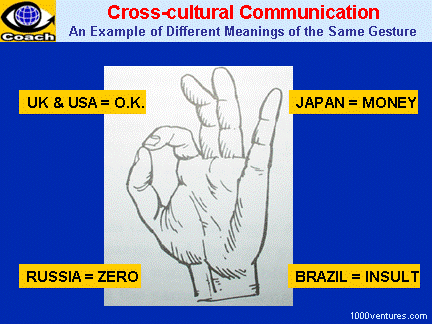
Simple gestures that would be benign or
complementary in one country could be a gross insult in another country.
|
|
 |
 |
Cultural Intelligence (CQ)
has
immense
relevance to the
increasingly global and diverse
workplace, marketplace, and
politicsplace.
~
Vadim
Kotelnikov |
|
Acts that people from one
culture perform every day and
phrases that they use all the
time with each other could be
offensive and judged negatively
by people from a different
culture.
You cannot treat everybody the
same regardless of culture
without adverse consequences.
|
|
 |
The bird thinks it is an act of kindness to give
the fish a lift in the air. |
Tagore |
| |
|
Identify the Belief Systems
to Spot
Blocks to Communication
|
|
|
| |
|
Examples of Effective
Practices
|
|
|
|
|
|
Global Private Banking Centre (GPBC)
Credit Swiss Private Banking (CSPB) Copernicus
project team developed the Global Private
Banking Centre (GPBC), Singapore. The project
team comprised 130 individuals with 20 different
nationalities. Generally, the multicultural mix
of the project was not an issue, because all
members were professionals who fit into the
culture of the project.
However, cultural differences were visible when
differences of opinion manifested themselves.
For
instance, members were expected to be forthright
in giving their views on projects and to speak
their minds. However, a newly joined IT expert
who was Chinese never expressed a candid opinion
that a concept was not worth pursuing at the
team meetings, but he would unilaterally decide
not to work on the concept if he was convinced
that it was not going to work. Initially his
behavior was seen as disloyal, almost hostile.
He was asked why he didn't publicly voice his
aversions to specific concepts when they came up
for discussion at the team meetings. After he
explained his rationale, it became apparent that
his behavior was influenced by traditional
Chinese values.
Traditionally, the Chinese do not like to
publicly criticize a colleague. They want to
ensure that the person being criticized does not
lose face.
|
|
| |
|
Dell Inc.
When Dell Inc. moved into Asia,
people told them that their
Western concept wouldn't work
there. "But rather than
tailoring the strategy to fit
the culture, we said, " We think
our direct model will work
cross-culturally. And we're
willing to take the risk,"
writes
Michael Dell, Chairman and
CEO of the
Dell Inc.
"To be sure we do some
localization," he continues. You
obviously can't sell
English-language computers in
China. And from a cultural
perspective, customers in other
countries are different. We
learned, for example, that some
Germans aren't comfortable
telephoning in a response to an
advertisement; they find it too
forward. They will, however,
respond to an ad that features a
fax number. They'll send in a
fax, asking for more
information, and will provide
their name and phone number so
that a Dell representative can
call them. The conversation that
ensues is almost exactly the
same as that which would have
occurred if the German customer
had made the call himself. It
was a slight modification that
allowed us to adapt to cultural
differences without altering our
business strategies."
|
|
|
|
|