 |
|
Luis Pasteur, "The chance
supports only the prepared
spirits." This is the key to
serendipity, your ability to
make unexpected discoveries by
accident.
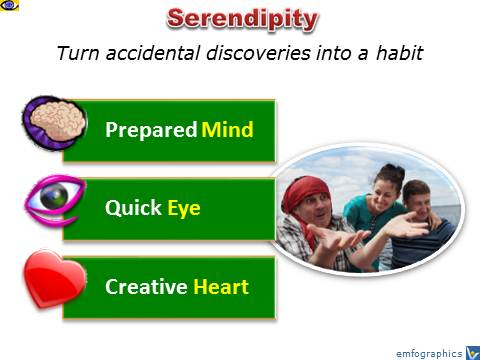
Serendipity is your attitude and
aptitude for making unintended
discoveries by accident ‒
habitually.
|
|
| |
|
What is Serendipity
The term "serendipity" was
coined by Horace Walpole in 1754
when he described a Persian
fairy tale, The Three Princes of
Serendip. The princes -were
“always making discoveries, by
accidents and sagacity, of
things which they were not in
quest of”.
|
|
|
| |
|
Accidental Breakthroughs: The
Role of Serendipity in
Innovation
Vadim Kotelnikov is a
prominent voice connecting
serendipity (accidental
discovery) with
innovation, viewing it not
just as luck but as a skill to
be cultivated, emphasizing the
need for a prepared mind,
observation, and passion to turn
unexpected findings into
valuable breakthroughs,
essential for business and
creativity. He highlights
that true serendipity involves
an "achievement
attitude" to leverage
accidents and that it's a
developable capability, crucial
for
turning problems into
opportunities and
gaining a competitive edge.
|
|
|
|
 |
| |
"Where there is
great doubt, there will be great awakening;
small doubt, small awakening, no doubt, no
awakening," says a
Zen proverb.
Be a student, keep
an open mind. Be observant, keep your eyes open
at all times. Look at people, business,
processes, nature and everything else with no
fixed ideas. with no judgment. They are all
doors to
inspiration and new discoveries. |
|
|
| |
|
Knowledge and Thinking Skills
|
|
|
|
|
|
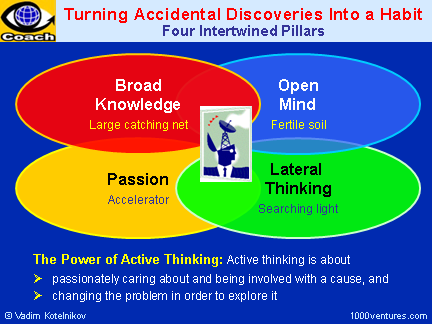
Broad
Knowledge
Broader knowledge, better ideas. The broader
your knowledge the more and better
creative synergies you can build. “The mind,
sharp but not broad, sticks at every point but
does not move,”
said Rabindranath Tagore.
So
open your mind to new knowledge and ideas from
outside your main area of expertise to broaden
your patterns of thought – your mind-set – and
move your thinking into
the whole range of other directions to
provide
greater creativity, balance and flexibility.
Experiment with new ideas to deepen and broaden
your knowledge further and make new discoveries.
Lateral Thinking
Step outside the box of your habitual
thoughts and see things for what they are, not
what you assume them to be. Make it a habit to
look wider and combine the unusual...
More
Challenge Assumptions and Ask Searching
Questions Constantly
Creativity requires an inquisitive mind.
Unless you challenge your assumptions and ask
lots of
"Why?" and "What If"? questions, you won't
generate creative insights...
More
|
|
| |
|
Serendipity as a
Competitive Advantage
|
|
|
|
|