Managing Innovation:

Technology Strategy

Technology Commercialization

Venture Pathways

By Vadim Kotelnikov, Founder, Ten3 BUSINESS e-COACH - Innovation Unlimited, 1000ventures.com 

Technology Commercialization

Venture Options for Inventors, Small & Large Businesses

INVENTORS

& ACADEMY

SMALL

BUSINESS

LARGE

BUSINESS

Do It Yourself

Start Up Company

Venture Financing

In-Company Venture

Do It With Others

Consultancy

Licensing

Strategic Alliance

Joint Venture

Licensing Out

Strategic Alliance

Joint Venture

Venture Acquisition

OEM Manufacturing

Private Label Deal

Spinout

Strategic Alliance

Joint Venture

Merger

 Discover much more!

Technology Transfer

Technology Commercialization

Strategic Licensing for the New Economy

16 Ways to Avoid the Hassle of Commercializing University Technology

Alternative Pathways for Technology Commercialization

Model Agreements

Sample Exclusive Patent License Agreement

Sample Option to License Agreement

Terms of the License Agreement

Sample Material Transfer Agreement

Sample Material Transfer Agreement Questionnaire

Innovation

4 Categories of Innovation

The Art of Innovation: 9 Truths

The Jazz of Innovation

Radical Innovation

Incremental vs. Radical Innovation

Radical Project Management

MANAGING RADICAL INNOVATION (Ten3 Mini-course)

Start Up Company

Venture Financing

Venture Strategies

In-Company Ventures

Spinouts

Deciding If Your Innovation Portfolio Has Enough Stretch

3 Criteria To Assess Your Innovation Portfolio

Technology Commercialization through Start-Ups


New disruptive technologies often require new business models. Because start-up companies are free to chose or develop a new business model, in this regard start-ups have an advantage over more established firms. In addition to the risk incurred in the technological and the economic domains, and the need for intensive experimentation, an unproven business model adds additional risk, and entrepreneurial ventures usually are more prepared to accept this risk that would be a large, well-established firm.

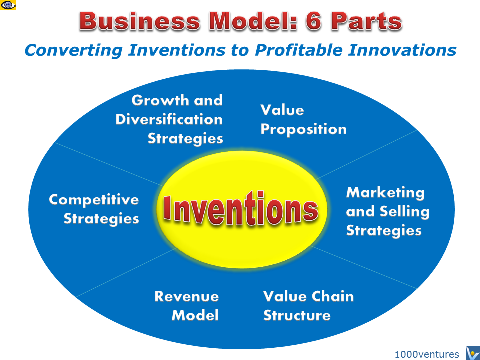
The business model itself is an important determinant of profits to be made from a technological innovation. A mediocre innovation with a great business model is often more profitable that a great innovation with a mediocre business model.2

16 Ways to Avoid the Hassle of Commercializing University Technology

By: Terry Collison

If you have a technology policy and a procedure, make sure nobody in the university community actually understands what it is. Complexity is good... More

Alternatives to Licensing

Excerpts from the Strategic Licensing for the New Economy, by Dennis Fernandez with Sarah Stahnke, Rebecca Sheehan and Mary Chow


In deciding how to most profitably mobilize intellectual property, a company should consider a wide range of options.

New Venture – If the product and the supporting business-structure exist in the company, though the risks are high, beginning a new venture of developing, marketing, and selling a product promises the highest reward for the intellectual property.

Venture Acquisition – Buying a new company is less risky than beginning a New Venture because much of the costly development has been completed and the infrastructure for a successful production line is in place.


Strategic Alliance – If two companies share mutual interests, it may behoove both to consider forming an alliance that would enable profit-sharing. Through an alliance, firms may either use each other’s manufacturing skills to take complete advantage of a market, or one company may agree to market and sell products manufactured by another company.

Joint Venture – When two companies have more than a few ideas in common, they may wish to consider forming a third company as a joint venture. If the skills and resources of the participants are particularly complimentary and both sides are willing to diplomatically deal with the risks, rewards and operation of the company, then this is certainly an appealing option.


References:

  1. Radical Innovation, Harvard Business School

  2. Role of the Business Model in Capturing Value from Innovation, Henry Chesbrough and Richard S. Rosenbloom

Map

Ranked #1

Search

Testimonials

Free Downloads

  Products

SMART Learning

Training

 Contact

We invented Business e-Coaching in 2001

Today, we have customers in 100+ countries!

Our customers:

3M, ABB, Adidas, Alcatel, American Express, Bayer, Boeing, British American Tobacco, BP, Canon, Cisco, Citigroup, Colgate, Corning, Deloitte, Ernst & Young, Fujitsu-Siemens, GE, Goldman Sachs, HP, Hitachi, Huyndai, IBM, Intel, Johnson & Johnson, JP Morgan Chase, KPMG, Lufthansa, Microsoft, Motorola, Nokia, Oracle, Samsung, Shell, Siemens, Sony, United Bank of Switzerland

Ten3 Mini-courses: SMART & FAST sets Full version of Ten3 Business e-Coach Ten3 Business e-Coach (home page)

Ten3 Business e-Coach, version 2008

Inventor, Author & Founder – Vadim Kotelnikov

© Vadim Kotelnikov, GIVIS