Strategic Management:

Harnessing the Power of Diversity

Joint Ventures (JVs)

Sharing Capital, Technology, Human Resources, Risks and Rewards

By: Vadim Kotelnikov

Founder, Ten3 Business e-Coach Inspiration and Innovation Unlimited!


 Yes!  You are in the right place!

This site is Ranked Top 5 by Google for

"Joint Ventures"

out of about 2-million-wide (!!!) competition!

"Good fences make good neighbors"

– Robert Frost 


Joint Ventures New Product Development Rapid Growth Firms Joint Ventures: Business Benefits

Benefits of Joint Ventures2

  • Provide companies with the opportunity to obtain new capacity and expertise  

  • Allow companies to enter into related businesses or new geographic markets or obtain new technological knowledge

  • Have a relatively short life span (5-7 years) and therefore do not represent a long-term commitment

  • In the era of divesture and consolidation, offer a creative way for companies to exit from non-core businesses: companies can gradually separate a business from the rest of the organization, and ultimately, sell it to the other parent company (appr. 80% of all joint ventures end in a sale by one partner to the other).

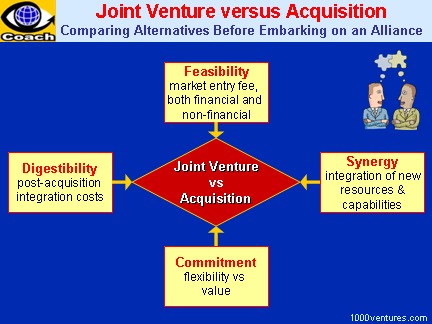
Joint Venture Venture Acquisitions Synergy 1000ventures.com Ten3 Business e-Coach: why, what, and how Joint Venture Mergers and Acquisitions JOINT VENTURE vs ACQUISITION

Structuring a Strategic Alliance

10 Questions To Answer

  1. How good are you in managing cultural differences?... More

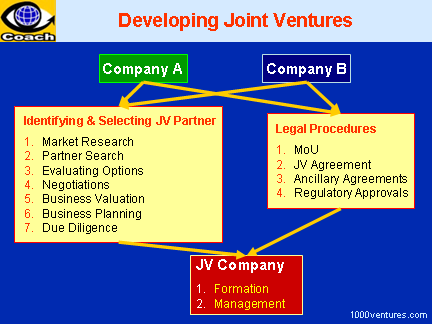
Joint Ventures Due Diligence Business Plan Business Valuation Negotiation Tips Market Research Developing Joint Ventures

Joint Ventures Managing Cross-cultural Differences Strategic Leadership Decentralization and Delegation Business Strategies

Most Common Causes of JV Failure

According to a recent survey, only 44% of CEOs of JVs characterized their venture as "very successful".2

The most common causes of failure cited by CEOs are:

12 Tips for Global Business Travelers

Business Partnerships

Synergy

Strategic Alliances

Business International

Competitive Advantage: US versus Japan

Cross-Cultural Differences: China and United States

Russians: Comparative Character Features (a slide show)

Negotiating

Conduct During Negotiations

Intellectual Property Management

Licensing of IPR

Model Agreements

Preliminary MoU between Prospective Joint Venture Partners

Joint Venture Agreement: Checklist

Jokes

Business Partners

Cross-Cultural Differences

Why Joint Ventures?

As there are good business and accounting reasons to create a joint venture (JV) with a company that has complementary capabilities and resources, such as distribution channels, technology, or finance, joint ventures are becoming an increasingly common way for companies to form strategic alliances.

Sustainable Competitive Advantage


In a joint venture, two or more "parent" companies agree to share capital, technology, human resources, risks and rewards in a formation of a new entity under shared control.

Important Factors

to be Considered Before a Joint Venture is Formed

  • screening of prospective partners

  • joint development of a detailed business plan and shortlisting a set of prospective partners based on their contribution to developing a business plan

  • due diligence - checking the credentials of the other party ("trust and verify" - trust the information you receive from from the prospective partner, but it's good business practice to verify the facts through interviews with third parties)

  • development of an exit strategy and terms of dissolution of  the joint venture

  • most appropriate structure (e.g. most joint ventures involving fast growing companies are structured as strategic corporate partnerships)

  • availability of appreciated or depreciated property being contributed to the joint venture; by misunderstanding the significance of appreciated property, companies can fundamentally weaken the economics of the deal for themselves and their partners.

  • special allocations of income, gain, loss or deduction to be made among the partners

  • compensation to the members that provide services

The Role of the Business Architect

Business Architect is a person that initiates new business ventures or leads business innovation, designs a winning business model, and builds a sustainable balanced business system for a lasting success.

Business Model: 1+6 Elements

Business architects can be found in a multitude of business settings: corporate change leaders, initiators of joint ventures, managers of radical innovation projects, in-company ventures, spin-outs, or new start-up ventures.

Although the settings in which business architects act are different, they all design and run a new venture to achieve its sustainable growth.

Human Resources (HR) Action Steps to Prepare for a Successful JV2

  • Business Strategy. Begin with a sound, well-articulated strategy.


    Before moving forward, determine and explain why you wish to enter into a joint venture, why you have chosen your partner(s), and what you hope to achieve. Define involvement (managerial, capital, etc) of the parent companies and how long the JV will last.

    Put in place strategies to define governance, accountability, decision-making process, and conflict- and issue-resolution procedures. Ensure buy-in and participation at the highest level. Consider outcomes: what could cause you to terminate the joint venture, and what is the preferred exit strategy.

  • Human Resources (HR) Strategy. Develop HR strategies that align and support the goals of the JV: develop a distinct identity and culture for the new organization; communicate aggressively to employees; and establish distinct career paths, management, and a means of return for employees transferred to the JV. Create compensation, incentive, and retention programs tied to the success of the JV. Maintain open communication between the HR departments of the parents and the JV.

  • Leadership. Define a process for leadership selection that's seen as fair and credible, and name top-tier leadership as soon as possible. Look for key indicators of leadership potentials such as behavior, past experience, and measurable outputs.

  • Communication. To engage and motivate your employees, communication should be frequent and used to create a common vision, establish a connection with leadership, explain the new rules, support the individual transition process, aid in retention, and ultimately, define the new organization in terms of "We" instead of an "It" or "They". Share as much information as you can, and never sugar-coat or make false promises.

  • Talent. Make the identification, retention, and motivation of the key talent a top priority. As times of uncertainty can lead to defections, take strong counter-measures to prevent them. Paying close attention to the specific skills, knowledge, and behavior that will be required to achieve the new organization's business objectives, identify the key players in both the parent companies who will be needed during the transition to a joint venture organization and beyond. Be aware of which employees are most at risk for recruitment by other organizations and collect data on the causes and costs or turnover that might influence which employees to target and which retention practices to implement. Conduct employee research to help the new organization determine what matters to employees and can serve as the foundation for all programs and incentives.

 Case Study  Toshiba

Toshiba’s approach is to develop strategic alliances with different partners for different technologies because a single company cannot dominate any technology or business by itself... More

Venture Management

Management of the venture-building process is fundamentally different  from corporate management that is focused on delivering the annual operating plan. Management of a new high-growth business is build around a  customer-driven idea or a technology. It requires entrepreneurial mindset and skills. Being first to the market is the top priority for the venture manager. Your core competence, the ability to move quickly from idea to market, is a key enabler of business success... More


 Discover much more in the FULL VERSION of e-Coach

Strategic Business Partnerships...

Choosing a JV Governing Structure...

Three Possible JV Governance Arrangements...

Preparing a Business Plan...

Operating an International Joint Venture...

Common Reasons for Joint Venture Difficulties...

Factors that Contribute to the Poor Track Record of Joint Ventures...

Eight Conditions for Trust Between Organizations...

Human Resources Strategies...

 Case in Point  Diamond Associates...


References:

  1. Joint Ventures / Partnerships, Hewitt

  2. Joint Ventures: Minimizing Risk and Maximizing Success, Hewitt

  3. Close Connections, Ranjit Shastri

  4. Trusted Partners, Jordan D. Lewis

  5. Joint Ventures Revealed, PlugInForProfit

  6. Mastering Alliance Strategy: A Comprehensive Guide to Design, Management, and Organization, James D. Bamford, Benjamin Gomes-Casseres, Michael S. Robinson

Happy About Joint Venturing


All You Can Meet


Map

Ranked #1

Search

Glossary

Free Downloads

  Products

Testimonials

Training

 Contact

We invented Business e-Coaching in 2001

Today, we have customers in 100+ countries!

Our customers:

3M, ABB, Adidas, Alcatel, American Express, Bayer, Boeing, British American Tobacco, BP, Canon, Cisco, Citigroup, Colgate, Corning, Deloitte, Ernst & Young, Fujitsu-Siemens, GE, Goldman Sachs, HP, Hitachi, Huyndai, IBM, Intel, Johnson & Johnson, JP Morgan Chase, KPMG, Lufthansa, Microsoft, Motorola, Nokia, Oracle, Renault, Samsung, Shell, Siemens, Sony, United Bank of Switzerland

Ten3 Mini-courses: SMART & FAST sets Full version of Ten3 Business e-Coach Ten3 Business e-Coach (home page)

Ten3 Business e-Coach

Inventor, Author & Founder – Vadim Kotelnikov

© Vadim Kotelnikov, GIVIS