|
Why Venture Strategies?
The most successful companies are those that have developed
aggressive venture strategies and have made ventures critical components of
their strategic and operating success.
For today's corporations, traditional
internal expansions,
efficiency improvements and "synergistic" acquisitions are no longer sufficient
sources of growth in most industry segments that had grown crowded and
hypercompetitive. The new challenge is to search for emerging "white space"
opportunities, "new-business creations that would meet the unmet, unserved
needs of customers in emerging markets."1
3 Strategies of Market Leaders
In ventures, large and midsized companies can discover a
source of
growth they are striving to achieve. New business creation has become central to achieving
strategic and financial objectives of market champions. "Silicon Valley wouldn't exist if big companies couldn't identify technology
and market opportunities and move with speed to capitalize on them", says
Mike Moritz of Sequoia Capital Partners.
Be Different and Make a Difference!
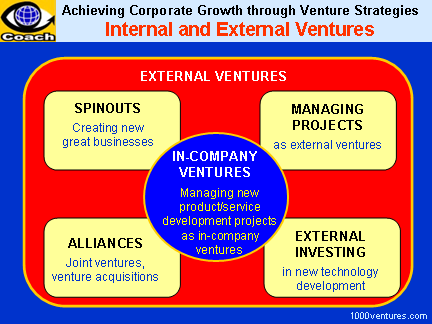
Spinouts
Spinouts, a new form of creating and financing a high-tech company has
become very popular. This novel approach has a number of advantages over a
merger or acquisition and it plays an increasingly high role for high-tech
companies.
A spinout enterprise differs from a spin-off.
Spinouts remain closely tied to the company that developed them. In most
cases, the ties are both financial and operational. Financial ties can be
enforced through interlocking of stock ownership and financial oversight by
the parent company. Operational ties may include shared professional and
administrative services as well as marketing and leadership support.
New ventures established as independent
companies can more readily fulfill their potential. In this case, the
entrepreneurs do not have to argue with superiors or put up with
interference...
More
3 Strategies of Market Leaders
The market leader is dominant in its industry
and has substantial market share. If you want to lead the market, you must
be the industry leader in developing new
business models and new products
or services. You must be on the
cutting edge of
new technologies and innovative
business processes. Your
customer value proposition must offer a superior solution to a
customers' problem, and your product must be well
differentiated...
More

Corporate Investing in External Ventures
External
venture
investing in new technologies and emerging markets has become a vital
component of corporate strategies in the
new economy driven by small innovative firms.
Partnership between small
innovative firms and large corporation is mutually beneficial. While
entrepreneurial companies can identify technology and market
opportunities and move faster to capitalize on them, they can achieve
enormous leverage through technology and distribution agreements with large
global corporations. Herein lies strategic opportunity for large
corporations.
In United States in 1994, only 2% of venture
capital investments was corporate venture capital, but in 2000, corporate
venture capital accounted for 17%, nearly $20 billion...
More
Venture Acquisitions
In
today's era driven by
systemic innovation, acquiring and integrating
capabilities,
know-how, and technologies has become an efficient route to growth and a
strong alternative to internal research and product development.
Acquisition
and integration of ventures is an effective method for supplementing a
product and business portfolio with the best available technology, as well
as enter emerging markets, with speed.
In-Company Ventures
To achieve their growth objectives through
in-company
ventures or in-company startups,
many corporation may need to change their mindset and organization concept,
loose controls and provide an enabling environment to empower the venture
manager. They need also to adopt the
business systems approach to managing projects aimed at development of
innovative products or services...
More

Blue Ocean Strategy:
6 Principles
Blue Ocean Strategy is about
revolutionary
value innovation.
The six principles drive the successful
formulation and
execution of Blue Ocean Strategy.
These principles attenuate the six risks...
More
Achieving Top-line Growth...
Strategic Intent...
Launching a Crusade...
Opportunity Approach
to Business Development...
Discovering Opportunities...
Fuzzy Front End...
Focusing
Activities...
Building a Fast-Growing Company...
Strategy Innovation...
New-to-the-World
Product Development...
Radical Project Management (RPM)...
Managing Projects as External Ventures...
Joint Ventures...
Four Success Factors
Relating to Venture Management...
Case
Study
Thermo Electron...
Case
Study
Corning...
Case
Study
Nortel Telecom...
Case
Study
Dell Inc...
Case
Study
GE Equity...
Case
Study
Cisco...
Case
Study
Quantum...

|