|
10 Differences between
a
Winner and a Loser |
|
|
|
Happy vs Unhappy People
10 Differences |
-
Unhappy people
fear change:
It's the most
unhappy people who most fear change.
~ Mignon McLaughlin
-
Happy people
create
positive change:
"Those only are happy who
have their minds
fixed on some object other than their own happiness: on the happiness of
others, on the improvement of mankind, even on some art or pursuit,
followed not as a means, but as itself the ideal end. Aiming thus at
something else, they find
happiness
by the way."
~ Norman R. Augustine...
More
|
|
Resistance to Change in
the Workplace
Main Reasons |
-
Fear of the
unknown.
Change implies uncertainty, and uncertainty is uncomfortable. Not
knowing what may potentially happen often leads to heightened
anxiety. Resisting change is one of the anxiety-reducing actions.1
-
Fear of failure. The new order may
require skill and abilities that may be beyond our capabilities.
There is resistance to trying a new approach as people know how to
operate in the existing order, but fear they will not be able
to acquire the new skills and behavior that will be required of
them.
-
Disagreement with the need for change.
Associates may feel that the new direction is a wrong direction.
-
Losing something of value. All
associates want to know how the change will affect them. If people
believe they will wind up losing as a result of the change, they
will resist.
-
Leaving a comfort zone. People
are afraid to go after what they want because it would force them to
stretch their comfort zones. It's only natural to put
off things that scare us, to sidestep goals that require us to leave
our comfort zone and take a risk.
-
False beliefs.
To put themselves at ease and avoid taking the
risk, many people fool themselves into believing everything will all
work out someday by itself.
-
Misunderstanding and lack of trust.
People resist change when they do not understand its implications and
perceive that it might cost them much more than they gain. Such
situations often occur when trust is lacking between the person
initiating the change and the employees.2
-
Inertia. All organizations suffer
from inertia to some degree and try to maintain status quo. Change
requires effort, oftentimes, a significant one. So, don't
underestimate the power of fatigue and burnout.
|
|
Overcoming Resistance
to Change
Most Common Ways2 |
-
Education and communication
-
Participation and involvement
-
Facilitation and support
-
Negotiation and
agreement
-
Manipulation and co-optation
-
Explicit and implicit coercion
|
|
Why Do People Resist
Change?
Yin-Yang of Change Management
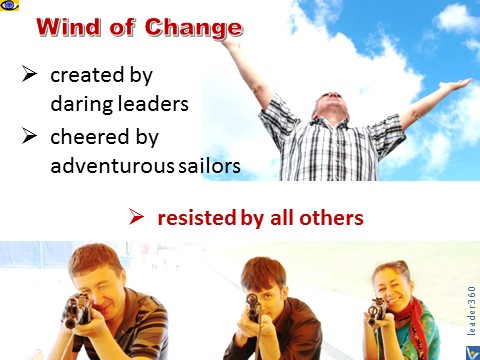
Most people don't like change because they
don't like being changed. When change comes into view, fear and resistance
to change follow often despite its obvious benefits.
People fight against
change because they:
-
fear the unknown, or
-
fear to lose something they value, or
-
don't want to leave their comfort zone, or
-
don't understand the change and its
implications, or
-
don't think that the change makes sense, or
-
find it difficult to cope with either the level
or pace of the change.
Resistance emerges when there s a threat to
something the individual values. The threat may be real or it may be just a
perception. It may arise from
a genuine understanding of the change or from misunderstanding, or even
almost total ignorance about it.3
Why Change Fails: 8 Common Errors
Entrepreneurial Leader: 4 Specific Attributes
Change as an Unnatural Act
Change theory tells us that human systems seek
homeostasis and equilibrium, i.e. prefer a predictable, stable world.4
Give People Time To Digest
a New Idea
Give people time to digest a new idea. "Be
persistent. Don't expect to "win" the first time. Your first job is just to
start the other person thinking," advised Benjamin Franklin in his
Bargaining Tips.
People always resist change,
new ideas
and new courses of action, even if the ideas are good for them. However, if
they have an opportunity to digest these ideas for a few days, they may
accept them with enthusiasm. Usually, an individual needs from 24 to 72
hours to absorb a new idea. So, present your ideas in very casual way, as
thoughts for consideration or as a
coaching or
searching question,
and then just leave the idea with others, say "we'll discuss this later"
and give them an opportunity to think about it for a few days...
More
Lessons
from Jack Welch
3Ss of Winning in
Business
Self-confidence:
The root of many of
bureaucracy ills is insecurity. Insecurity makes people resist change
because they see change only as a threat, never as an opportunity...
More

10 Commandments of Innovation
Lead Change.
Create a mindset of creative
dissatisfaction to reduce resistance to change...
More
|