Continuous Improvement Firm


Corporate Culture:

Kaizen Culture

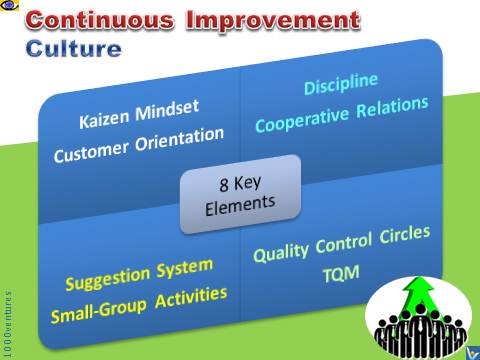
Kaizen Culture (Continuous Improvement Culture)

The 8 Key Elements

By: Vadim Kotelnikov

Founder, Ten3 Business e-Coach Inspiration and Innovation Unlimited!


"The emphasis should be on why we do a job."

~ Edwards Deming

   More Continuous Improvement Quotes

Free Micro-course

10 slides

Kaizen


Kaizen Culture: 3 Pillars Continuous Improvement Culture: 8 Key Elements Kaizen Mindset Customer Care Quality Control Circles Suggestion System Total Quality Management (TQM) Kaizen Culture, Continuous Improvement Culture: 8 Key Elements


Continuous Improvement (Kaizen) Culture in Japan and in the West


Kaizen is a Japanese workplace philosophy which focuses on making continuous small improvements. Kaizen is constant. It is not a problem based approach.

Workers come up with new ideas and submit them all the time, and quality circles meet frequently. Any hiccup on the factory floor results in the meeting of a quality circle to talk about the issue and discuss changes to implement. As a result, Japanese companies are continuously becoming more efficient and streamlined, allowing them to effectively compete with other companies which also integrate the Kaizen philosophy into their daily practice.

Implementing Kaizen: 7 Conditions

Many well known Japanese companies such as Toyota and Canon use Kaizen, with a group approach which includes everyone from CEOs to janitors on the factory floor. This group approach has been adopted successfully in other regions of the world as well, but Japanese workers have refined it to an art form. It is Kaizen mindset and process-oriented thinking, as opposed to the result-oriented thinking favored by most Western firms, that has enabled Japanese industry to attain its competitive edge in the world markets.

It has been suggested that Kaizen works particularly well because Japan is a collective culture, and Kaizen relies on collective values. People in more individualistic cultures may struggle with some of the basic principles of Kaizen.

Kaizen also suggests that everything constantly has room for refinement and improvement. Under the Kaizen philosophy, perfection can never be truly reached, and this value is contrary to the beliefs of many Westerners. The Western philosophy places a high value on the achievement and maintenance of perfection.

Suggestion systems in Japan and in the West have also different impact on company’s operations. According to Masaaki Imai, author of Kaizen: The Key To Japan's Competitive Success, Japanese managers have more leeway in implementing employee suggestions that Western counterparts. Japanese managers are willing to go along with a change if it contributes to any of the seven goals of the suggestion system. This is a sharp contrast to the Western manager's almost exclusive concern with the cost of the change and its economic payback.

Continuous Improvement Firm (CIF): Kaizen, Lean Manufacturing, Suggestion Systems, TQM, Best Practices

Continuous Improvement Firm (CIF)

3 Basic Principles of Continuous Improvement

Cross-functional Management (CFM)

Kaizen – the Japanese Strategy of Continuous Improvement

Kaizen Culture: 3 Pillars

Kaizen Mindset

Kaizen Strategy: 7 Conditions for Successful Implementation

Quick and Easy Kaizen

Kaizen and TQM

Kaizen and Innovation

Suggestion Systems

Japanese Suggestion System

Fun4Biz Suggestion System

Kaizen and Kaikaku

10 Kaikaku Commandments

Toyota Problem Solving Techniques

5-Why Technique

Lean Production

The Toyota Way: 14 Principles

3 Broad Types of Waste

7 Wastes

5S

Just-in-Time (JIT)

Glossary Kaizen and Lean Production Terms

Quotes of Lean Manufacturing

Case Studies

Toyota Production System

Canon Production System (CPS)

Fidelity Investments: Practicing Kaizen


Corporate Culture

Inspiring Culture

Questioning Culture

Culture for Innovation

Quality Management

8 Rules for Quality Management

Total Quality Management (TQM)

Areas Targeted by TQM in Japan

Deming's 14 Point Plan for TQM

14 TQM Slogans at Pentel, Japan

Employee Empowerment

Getting Employees Involved: 9 Ways

Managing Cultural Differences

Manufacturing Strategies: US vs. Japanese Companies


 Free Micro-courses

Ten3 Mini-courses

 Slides

Continuous Improvement Firm (CIF)

60

Synergizing Value Chain

200